Home
Our team
Content
    Cover Story
    All Articles
    Animals Rule!
    Around Town
    Cityscapes
    Community Impact
    Elder Profile
    For The Love Of It
    Good For You
    Goodness InDeed
    Green Page
    History
    Local Sports
    Meet your Neighbor
    Miscellaneous
    Spotlight on our Sponsors
    The Arts
    Your Green Spaces
Advertise
Archives
Donate
Contact


The Lebanon Times - Good people, good places and good things happening
  • Home
  • Our team
  • Content
    • Cover Story
    • All Articles
    • Animals Rule!
    • Around Town
    • Cityscapes
    • Community Impact
    • Elder Profile
    • For The Love Of It
    • Good For You
    • Goodness InDeed
    • Green Page
    • History
    • Local Sports
    • Meet your Neighbor
    • Miscellaneous
    • Spotlight on our Sponsors
    • The Arts
    • Your Green Spaces
  • Advertise
  • Archives
  • Donate
  • Contact
All, Cover Story

The Past and Future of Sugaring in Lebanon

February 24, 2024 by Richard Ford Burley 1 Comment
sugaring in lebanon - maple syrup lined up on a window

You can find maple syrup in every city, town, and rest stop in New England, and in every grocery store and gift shop from Connecticut to Maine. Whether you buy it in the familiar, screw-capped, gray plastic jugs or in fancy glass bottles shaped like little leaves, maple syrup carries with it a long tradition of community, family, and hard work. Nowhere is that more true than in Lebanon, where some of the oldest families in town are not only continuing the long legacy of maple sugaring, but carrying it forward into a more efficient – and more sustainable – future.

Perched on the top of Storrs Hill sits a white farmhouse, decorated with signs reading “century farm” and “bicentennial farm” on the side. It was built in 1784 by Nathaniel Storrs, one of the first settlers to come to the area. The land had come into his brother’s possession in 1763, just two years after Governor Benning Wentworth signed the charter that brought Lebanon into existence. In February of 1769, “Grandfather Nathaniel” (as his descendant Heidi Townsend Bundy calls him) bought the plot from his brother Cornelius, and two years later he moved his whole family up from Mansfield, Connecticut. The log cabin they first lived in no longer survives, but the farm, which has gone by several names over the years, including Storrs-Townsend and the current Tomapo (an abbreviation of Townsend Maple Orchard) is still in the family – and still producing maple syrup.
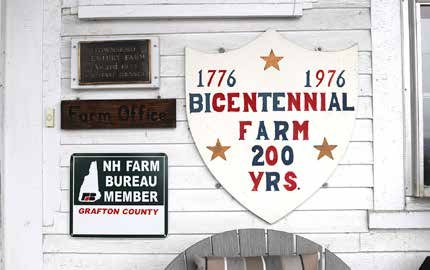
sugaring in lebanon - farm 200 years sign
Tomapo Farm, January 2024.
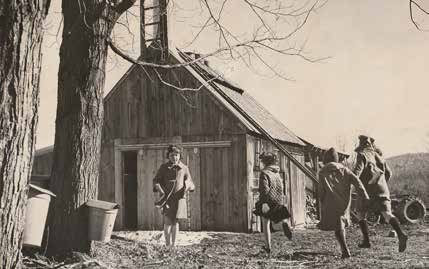
sgaring in lebanon - sepia photo from 1965 showing Tomapo farm sugar house with 4 children outside
Storrs-Townsend (Tomapo) Farm sugar house 1965.

“We believe that they were probably sugaring shortly after Grandfather Nathaniel settled here,” Heidi says, sitting at the kitchen table in the old farmhouse. Nathaniel was her fifth-great-grandfather. “We only have records back to 1824,” she but “of all the things on the farm, that’s the one thing that we can track having been here. I have diaries from Grandfather Abel from the late 1800s. I have diaries from my grandfather, Harry [Storrs Townsend], from the late 1950s…we’ve got a lot of paperwork that makes us believe that sugaring was here early on.” Sarah Murchie, Heidi’s daughter, sits across the table with her own toddler daughter sitting in her lap: “It’s been the one constant,” she adds.

The earliest history of maple syrup itself isn’t perfectly clear, but one thing that everyone can agree on is that it’s always been plenty of work. Indigenous oral histories from across the northeast tell of the origins of sugaring – clearly an indigenous practice long before the arrival of settlers – with several suggesting that syrup itself once flowed directly from the trees until greater powers intervened, diluting it into sap to prevent humanity from becoming too lazy. When the sap comes out of the trees, its sugar content is very low, usually one to two percent by weight. Finished syrup is around sixty-six percent, and the art and science of sugaring is in how you get from one to the other.

Once upon a time, the secret to maple syrup production was simple: more bodies. “When my father was young,” Heidi says, “there would be an announcement at the [high] school in the afternoon, that the Townsends needed help…and the boys would hike up over the hill and spend the afternoon gathering sap.” Today, the sap is collected using vacuum pumps and plastic lines that crisscross the hillsides and collect in great tanks, but back then, the height of technology was metal buckets and rubber boots. “They still stop at the market and identify themselves as one of those kids that gathered sap, [saying] ‘we had so much fun’…I was around when there were buckets, and I don’t remember it being fun,” Heidi laughs, reminiscing. “They were happy. I always had sap in my boots; my mittens were always wet.” The industry has modernized since, not least because students who will work for a dollar an hour (plus a little ‘sugar on snow’ at the end of the day) are understandably harder to come by than they used to be.

“We have come into the 21st century,” Heidi says. “Back ten plus years ago…we added a vacuum system to our mix…so for quite a while we had a vacuum system on the one side of the road, about a thousand taps, and then we had five hundred on the other side that were all gravity fed to a tank” (they’ve since expanded to over 2,000 taps). But that division still meant extra manual labor, and so they tried an experiment with something called a “sap ladder”. “You bring all of your tap lines into a main line that’s headed downhill, and then there’s a vacuum system that has you spread that volume out into small lines so it will climb up into another line that goes downhill,” Heidi explains, describing the way the sap can travel up a line sixteen feet into the air to safely cross a road frequented by farm trucks and utility vehicles. “And then this past year, we added reverse osmosis to the mix.”
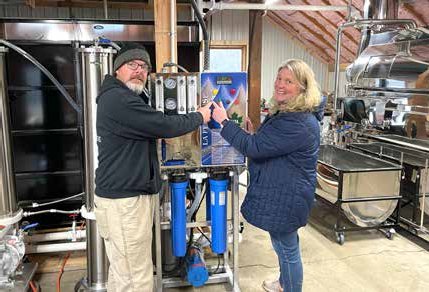
sugaring in lebanon - eric and his wife cole pressing the start button on the RO machine
Eric Cole and his wife, Susan Cole, pressing the start button on the RO machine for the first time.

Reverse osmosis – or RO – is a technology that might be more familiar as a water filtration system: using high pressure and a semi-permeable membrane, water is divided into pure drinking water on the one side and a leftover liquid called concentrate on the other. Its use in sugaring just flips around which side is considered valuable. In a drinking water system, it’s the pure water that’s the goal, but in sugaring, it’s the concentrate. “So what it does is, it separates. Seventy-five percent of the water is pulled out of the sap before you even put it in the evaporator,” Heidi says. “I end up with hundreds of gallons of pure water in a tank that I use for cleaning, and then I have the rest of the sap that’s left, which has been condensed from two percent sugar to eight percent.” That means less time and energy spent boiling the sap down into syrup. “Last season, I spent ten 12-14 hour days in the sugar house [boiling sap], and I had help,” she adds. “This last season, 2023, we had the reverse osmosis set up, and I ended up doing 6-8 hour days, at most.” These moves toward labor-saving modernization aren’t limited to Tomapo Farm, either.

Not a mile away as the crow flies is another farm that’s also been around since almost the first days of Lebanon. Standing in his garage-turned-sugar house, Eric Cole explains that Elm Tree Farm has been in his family for eight generations. “We do business here as Ascutney View Farm, which is off of Poverty Lane…our kids will be the ninth generation.” But while sugaring is something the family has done for as long as anyone can remember, this particular venture is something new for Eric, who doesn’t look old enough to be on his third career. “I went to school for forestry, got my forestry license…was in the logging industry for a few years.” After hurting his back, he spent seventeen or eighteen years selling logging equipment:
“skidders and feller-bunchers…everything that you need to cut down a tree in the forest and process it and get it to the mill.” And then, a year ago last November, “I decided to…I say ‘retire’ from my second career,” he says, looking at the setup in the repurposed three-car garage. “And now I’m on career number three.”

The garage doesn’t look like the old traditional sugar house that’s just next door, where Eric grew up sugaring with his brother, father, and grandfather, nor does it look like the modernization of a legacy sugar house like they have at Tomapo. In fact, from the outside, the only clue that it isn’t for cars is the way three large blue sugar lines run up to (and through) the exterior wall. But one look inside tells another story: two raised, black, 3,000 gallon tanks take up a quarter of the interior space. Another half is taken up by an enormous stainless steel machine. “So that’s a three-and-a-half by fourteen CDL evaporator,” Eric says. “It’s oil-fired. Help is fairly limited today – for a lot of people – and so my goal was to be able to do as much of this myself as I possibly could.”

He isn’t overstating things: every part of his sugaring operation can be run from right where he’s standing. The sugar bush, a 20-acre patch with about 2,200 taps so far, is about three quarters of a mile up the hill. “I have a twenty foot conex box, a shipping container, out in the woods with a 2,200 gallon tank inside of it, and a vacuum releaser. So the vacuum goes out to the releaser, from that releaser I’ve got main lines that go all through the woods, which brings the sap down to the storage container…and then I have a pump that’s run off a generator out there, and it pumps the sap back to here.” From his phone, he can tell in real time the temperature and vacuum pressure of any given segment of line, and how full the sugar bush storage tank is. It’s a far cry from buckets and boots. “I don’t touch anything through the whole process. It just comes out of the trees, through here, through here, to the barrel,” he says, pointing. “It’s very efficient for me, as one person. I can do pretty much everything myself.”

Next to the internal storage tanks is an RO setup not unlike the one at Tomapo, but unlike the eight percent sugar concentrate that Heidi runs through her setup, Eric runs his up to twenty, using his two tanks and multiple passes to achieve that level of concentration. The difference is in how long the sap spends being heated in the different evaporators.

The color and flavor of maple syrup come from something called the Maillard reaction. It’s a reaction between amino acids and certain sugars that happens when they’re exposed to heat – think a nicely seared steak or a lightly-browned campfire marshmallow. That browning is what gives maple syrup its flavor, and it’s a function of the type of sugars in the sap and the length of time it spends being heated. Depending on the evaporator, the concentrate might be too sweet, in which case it wouldn’t be able to spend enough time exposed to the heat to develop all the color and flavors that maple syrup is famous for. Heidi recalls an early boil after taking hers to twelve percent: “I tasted that syrup, and I thought… this doesn’t have the kind of flavor I want.” Meanwhile at Elm Tree Farm, Eric says his “rig boils so smoothly at twenty percent that that’s what I shoot for.”
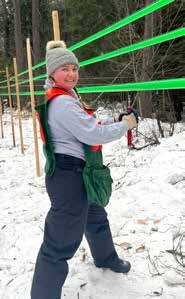
sugaring in lebanon - Clara installing tap line
Clara Cole helping install tap lines at Ascutney View Farm for another sugaring season.
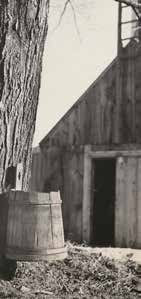
sugaring in lebanon - sepia photo from 1965 showing a wooden sugaring bucket hanging on a tree
Wooden sugaring bucket Storrs-Townsend Farm sugar house, 1965
sugaring in lebanon - Heidi holding the wooden sugaring bucket
Heidi Townsend Bundy holding the same sugaring bucket in 2024

Reducing the number of hands needed isn’t the only upside of modernizing the sugaring process: a more efficient setup also means a significant reduction in greenhouse gas emissions. At Tomapo, Heidi says they used to get six gallons of sap for every third of a cord of wood. Thanks to improvements that include the new RO setup, they now get thirty-six gallons for the same amount of wood, an over 80% reduction in emissions. Meanwhile, running twenty percent concentrate, Eric’s boiling runs are far shorter than they would otherwise be. “Last year my longest boil was two, two-and-a-half hours. I can make about forty gallons of syrup an hour,” and less time boiling means fewer emissions.

But for all the ways that sugaring has changed, some things are still the same. When asked “why sugaring?” Eric says it’s a mix of nostalgia and the need for a challenge. “I have a lot of memories of my father and my grandfather here in the sugar house… [and] I’m just kind of drawn to the woods.” Heidi’s father, Bruce Townsend, still comes down to the sugar house once a season, too. “He tastes the syrup, tells me it ‘tastes pretty good,’ and then as he leaves…he’ll turn around and look at me and say, ‘well, you look like you know what you’re doing.’” She laughs and says, “But that’s Dad…It’s a fun activity, it really is. I mean it’s a lot of work, but it’s fun, especially when you can do it with family.” With a little luck, and a little help from new technologies, they’ll be able to do it for generations to come.
Share:
Reading time: 10 min
All, Cover Story

If You Give a Girl Scout a Cookie…

by Rose Terami No Comments

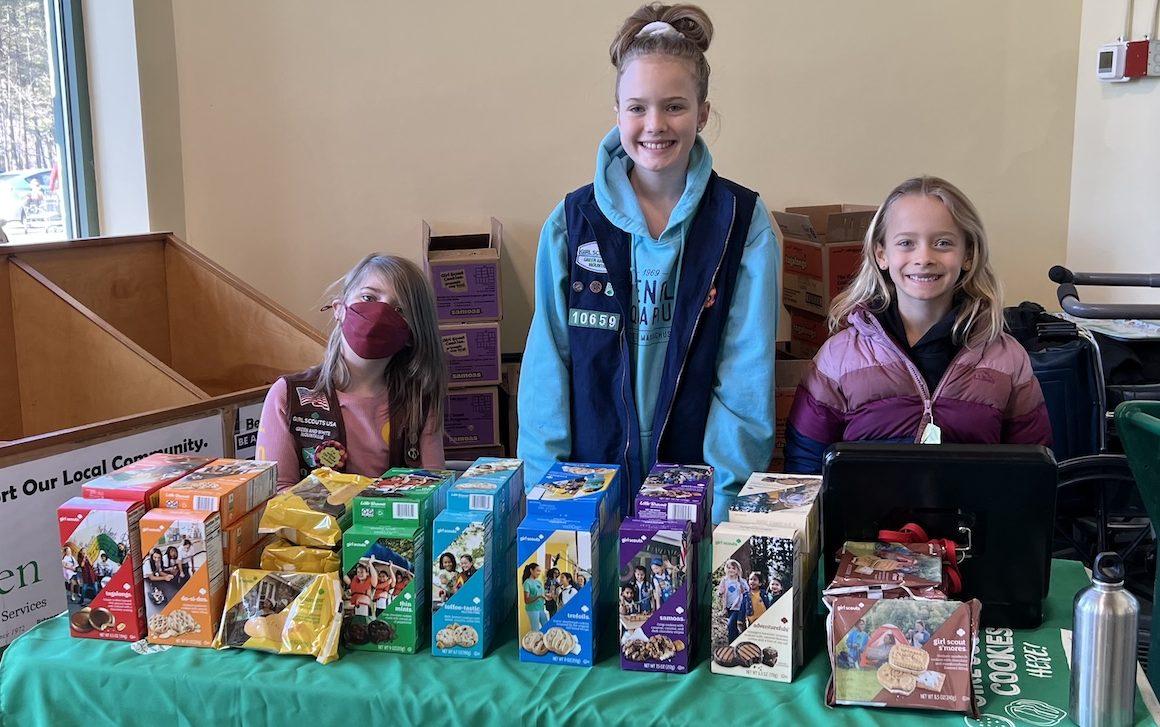
Once a year, Girl Scouts from across the country unite to fulfill a shared tradition and mission – in the well-known form of selling cookies. Whether you’ve sold Girl Scout cookies at some point in your life or eagerly await stocking up your pantry with these nostalgic treats, there’s something to look forward to for everyone when Girl Scout Cookie season rolls around. For the local Girl Scouts in and around Lebanon, there’s a lot of preparation that leads up to this beloved – and busy – time of year. Lebanon local Erin Buck is a troop leader to 18 Girl Scouts in the Upper Valley, including her two daughters, Acadia and Azalea Buck. This year, they have some big goals for cookie season. Acadia, 14, plans to sell at least 1,000 boxes of cookies, while Azalea, 8, has made a goal to sell 2,024 boxes between January up until March.

Selling cookies is more than just a fundraiser or an activity to pass the time; for Girl Scouts, it’s an opportunity to learn and realize their ability to succeed when they put their minds to something.

“I like doing cookie booths because I get a chance to manage the money or do credit-card transactions,” Acadia says. “And, I like eating cookies.”

Certain incentives also help motivate Girl Scouts to reach their cookie-selling goals. This year, if a Girl Scout sells 1,000 boxes of cookies, she gets a pair of custom Converse sneakers, and another pair will be given to a child in need. If she sells 2,024 boxes, she wins a two-week day or resident camp program or an iPad, and if she sells 5,000, she wins a travel trip.

At age 10, Acadia was the top cookie seller of the Girl Scouts of the Green and White Mountains and was awarded a trip to Athens , Greece. Unfortunately, the trip was canceled due to the pandemic.

But, it’s not just the incentives that inspire Girl Scouts to sell cookies, Acadia and Azalea both report. “The most important thing about the shoes [prize] is that you also give a kid [in need] shoes,” Azalea says.

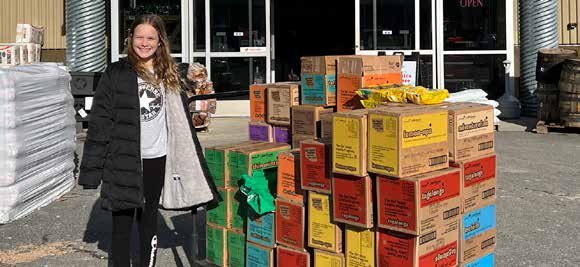
give a girl scout a cookie - Acadia delivering cookies sold at Tractor Supply
Acadia working toward her 1000 boxes of cookies sold at Tractor Supply.

“The Girl Scout Cookie program is the world’s largest girl-led entrepreneurial program,” says Carrie Loszewski, VP of engagement for Girl Scouts of the Green and White Mountains. “[It teaches] five incredibly valuable lessons in life skills: decision-making, goal-setting, financial literacy, business ethics, and people skills.”

Girl Scouts learn about and practice these skills throughout the year leading up pivotal moments like Cookie Season where they get to witness the culmination of their efforts in action. Along with these five important skills, Girl Scouts also focus on the importance of building and belonging to a community throughout the year.

Buck became a Girl Scout troop leader shortly after Acadia became a Girl Scout when she was in kindergarten. Since then, their troop has grown and had many memorable experiences together.

Acadia’s troop is a multi-level troop (Girl Scouts of all different grade-levels and ages) that caters to each girl’s interests and needs. “My role is to support all of those kids and create a bigger sisterhood than just ourselves,” Buck says. “I’m blessed that I get to do this with both of my children at the same time, and be able to offer a second family for a lot of children in our community.”

Buck also supports her daughters as a “Cookie Mom”. Cookie moms are a crucial part of their daughters’ experiences as they help with delivering cookies and restocking inventory, and they travel all across the Upper Valley to do so. “That’s what we do as Cookie Moms; we help [our Girl Scouts] get there,” Buck says. “I think one word to describe Cookie Moms is ‘organized’,” Buck says. “I put a lot of energy into understanding what both of my kiddos goals are for the season ahead…it means being realistic about our
goal-setting and managing expectations.” There are various steps throughout the season that start with initial ordering, which involves asking local businesses and community members to support their local Girl Scouts. This encourages Girl Scouts to get to know members of their community and create new relationships, while also teaching business and entrepreneurial skills. Next steps include booth sales at local businesses, like Joann Fabrics or the Lebanon Coop.

Acadia and Azalea’s troop meets every Monday. Weekly troop meetings begin with a snack, followed by reciting the Pledge of Allegiance and the Girl Scout Promise and Law. The rest of the meeting might consist of crafts or an activity that explores the traits involved in earning a particular badge.

During cookie season last year, Girl Scouts in Buck’s troop created their own version of The Day the Crayons Quit – an imaginative picture book written by Drew Daywalt about the interpersonal conflicts between different colors in a box of crayons.

The Girl Scout version of the story followed a similar plot, but instead of crayons, each of the girls were assigned different Girl Scout cookies – both current and discontinued varieties. By looking at life through the perspective of each cookie type, they created dialogue between each of their characters. The re-imagined story, “The Day the Cookies Snapped”, was a way for the Girl Scouts in Buck’s troop to use their imagination to find a creative solution to a make-believe problem, and to familiarize themselves with all the different types of Girl Scout cookies. The Girl Scouts program is built around trust and nurturing relationships through unique shared experiences. Through activities, badge opportunities, and community service, Girl Scouts have a chance to work together as a team and express themselves creatively, while also offering their unique talents to help solve problems.

“Encouraging girls to explore, reach for their dreams, and thrive in our complicated world while being their authentic selves is core to the mission of Girl Scouts,” Loszewski says.

“While many Girl Scouts earn these prestigious honors, earning badges and participating in our activities fulfills our mission to make the world a better place,” she adds. “You see it when a young girl comes out of her shell to speak up for herself, when a child conquers her fear and reaches the top of our climbing wall or jumps into the water at summer camp, or simply makes a new friend.”

give a girl scout a cookie - Azalea preparing food
Azalea preparing food for community members at the LISTEN Center Dinner

Girl Scouts interact with their local communities in a number of ways. Some of Acadia’s favorite ways to give back to her community as a Girl Scout are by volunteering to help serve dinners at the LISTEN Center, helping out at local humane societies, and participating in local food drives. “I get to help my community and learn business skills,” she says. “I also feel like a leader in my community.”

Through the Girl Scout program, girls complete a variety of tasks that challenge them to employ their knowledge and skills to earn badges. Each badge represents a different trait or skill earned when a Girl Scout completes a particular project among a variety of categories.

“Since 1912, girls have learned to turn their passions into action through Girl Scouting. Whether they’re using science, technology, engineering, and math (STEM) skills to solve problems; starting their own nonprofits; finding more ways to protect the environment; or discovering the power of spreading kindness, all their actions add up to a better world,” Loszewski says.

Earning badges in areas like these encourages Girl Scouts to not only better themselves, but also make a difference to others around them by giving back to their community.

“Girl Scouts of all ages take action in their communities,” Loszewski adds. “The pinnacle of the Girl Scout Experience is the Gold Award, which Girl Scouts in grades 9-12 may earn. This past membership year, 18 Girl Scouts in our council achieved this remarkable honor. They took on issues like fighting the negative impact of fast fashion, helping grieving children, helping children deal with stress and anxiety, honoring veterans, encouraging reading, feeding the hungry, and more.”

Younger Girl Scouts – like Azalea – also give back to their communities and learn leadership skills by earning awards and badges for their grade levels.

give a girl scout a cookie - Azalea, Erin, and Acadia smiling at the Memorial Parade
Azalea, Erin, and Acadia at the Memorial Day Parade in Lebanon.

“We try to plan a variety of activities so it hits every kid’s interest,” Buck says. Everyone is able to share their interests and can expect their ideas to be heard. The older girls of the group including Acadia will help the younger troops like Azalea, voice their opinions. Older kids give ideas that will benefit the wants and needs of the younger girls and they have a strong connection with them.

“Often, our youngest look up to our biggest,” Buck says. “Emotionally, [the older girls] are very important, they help stabilize the younger side of the group. They find a lot of comfort in each other and that’s an integral part of what we do.”

“Really, it’s just about how much fun we get to have with the Girls and we get to go on fun trips,” Azalea says. “And it’s amazing that we get to help the community and other people.”

Fun trips that align with learning goals – like visits to a trampoline park or amusement park, camping adventures, and even international travels – are some of the experiences that Girl Scouts look forward to as they advance through the program and celebrate their accomplishments. An annual boat race is one of Azalea’s favorite Girl Scout memories, where her troop works together to craft boats out of cardboard and duct tape and race them across the pool at Six Flags.

The quality time that the Girl Scouts get to spend with each other allows for relationships to develop and flourish within the troop. For Azalea, it’s this quality time and friendships that she loves most about being a Girl Scout. “I love spending time with everyone and I know I’m with safe people,” she says.

“When other parts of life aren’t going well, Girl Scouts is a big outlet,” Buck adds. “It’s a different group of people that you can be yourself with.”

Share:
Reading time: 8 min
All, Around Town

The Lebanon Outing Club

by Sean Nam No Comments
lebanon outing club - three kids skiing

Making Ski-History for 100 Years and Beyond

The Lebanon Outing Club at Storrs Hill celebrated its 100th season in 2023. To commemorate the event, a centennial celebration weekend was organized, featuring good food, guest speakers, and of course, skiing.

Over the course of its history, The Lebanon Outing Club (LOC) has provided a local hub for winter activities at Storrs Hill, with opportunities for skiers, snowboarders, and competitive training such as alpine ski racing and ski jumping. Other special community events, like the “full moon fiesta” and family fun nights, provide an opportunity for local families to gather and celebrate the joy of the winter season in Lebanon.

The Lebanon Outing Club was originally founded as a student club at Lebanon High School in 1923 by Erling Heistad, a Mechanical Arts teacher, Winter Sports and Track coach. Heistad’s goal was to make a ski jump within walking distance for every child in Lebanon. Since then, LOC has more than accomplished that goal, having taken countless measures over the years to improve skiing opportunities for Lebanon and the Upper Valley.

In 1925, the Club installed its first ski jump at Storrs Hill and nicknamed it the “Scrape”, because ski jumpers would often scrape their bellies when they landed. The first alpine ski trail at Storrs Hill was installed in 1931; a second ski jump and lighting for night skiing were added in 1939. Various other improvements and additions were made over the years – including new ski jumps, expanded slopes, and a second lodge – and by 1973, LOC embarked on a modernization project led by Storrs Hill Ski School founder and developer of Snow Crest ski area (later known as Whaleback), Ernest Dion. LOC reorganized and officially became a 501(c)(3) nonprofit organization in 1986, and the Club assumed responsibility for ski area operations from the City of Lebanon.

More recently, Storrs Hill and the Lebanon Outing Club have continued to improve their operations and provide joy to many skiers and residents of the Upper Valley. The Olympic torch made an appearance at Storrs Hill in 2002, where it passed through the “ring of fire” off of the 35-foot ski jump. Many Olympians have skied at Storrs Hill at some point, like ski jumper Nick Alexander (Lebanon native) and alpine skier Mikaela Shiffrin. LOC also continues to improve its slopes and jumps over time: recently, the Club purchased a winch cat groomer to improve the slopes and installed stainless steel tracks on the ski jumps. In 2016, they refurbished the ski lifts, and in 2020, replaced the lift’s platter poles. The Club has also improved its lighting with LED lights provided by the City of Lebanon.

In January, LOC received a grant from the Killington World Cup Foundation (KWCF), which has allowed them to make lift improvements after recent weather events and electrical shortages. “The damage caused by the weather caused a lot of headaches and hardships,” says Lebanon Outing Club president Cory Grant. “A lot of thanks goes to that organization (KWCF) for helping us out with that grant.”

During the pandemic, the Lebanon Outing Club – like many other local organizations – had to navigate the changing times, adjusting to abide by new community guidelines while continuing to provide a place to ski for Upper Valley residents. To do so, the Club expanded its lodge, adding an outdoor canopy to ensure that enough people could fit in the lodge while also keeping that infamous 6-foot distance from each other.

lebanon outing club - two smiling people holding a thank you sign

Today, the Lebanon Outing Club and Storrs Hill continue in their dedication to providing the community with a great place to ski and celebrate winter. Multiple local high schools use Storrs Hill to practice and race, and LOC provides lessons for all ages and experiences, from first-time skiers to competitive racers. Storrs Hill also hosts U12 and U14 ski races, and Ski Jumping Junior National Qualifier competitions also happen on the hill.

Some short-term future plans for continued improvements include adding a tubing and sledding area to Storrs Hill. Another goal is to introduce a freestyle team – a place where skiers and snowboarders can safely practice freestyle skiing and snowboarding, says Cory Grant. To accomplish these goals and other future plans, more committees and volunteer work are essential. The Lebanon Outing Club is a nonprofit organization, and many of the things that they offer the community can only be accomplished through the help of generous donors and volunteers. As the Club continues to grow, Grant says that committees and volunteers will become more and more important. “Come learn more about what we’re doing,” Grant says. “Help us build a greater future for the Upper Valley.”

Share:
Reading time: 3 min
All, Local Sports

New Coach, New Era For Lebanon High School Hockey

by Frank Orlowski No Comments

Those of us who have ever played sports in high school remember our favorite coaches fondly. At the time they may have seemed too tough, too regimented, or too discipline-oriented, but after some time, we realized the lessons that they taught us were important in negotiating the real world in which we later found ourselves. Those lessons of teamwork, giving it your all, carrying through till the finish, and practice till you get it right are not just applicable to sports, but to almost every aspect of life.

For the players on the Lebanon High School (LHS) Boys Hockey Team, they now have a new coach from whom they’ll learn both the intricacies of the sport and the life lessons of participating on a team. Last year, Dean Cashman assumed the role of head coach of the Raiders hockey team. Now in his first season as Lebanon’s coach, Cashman is far from a newbie to the sport, and coaching.

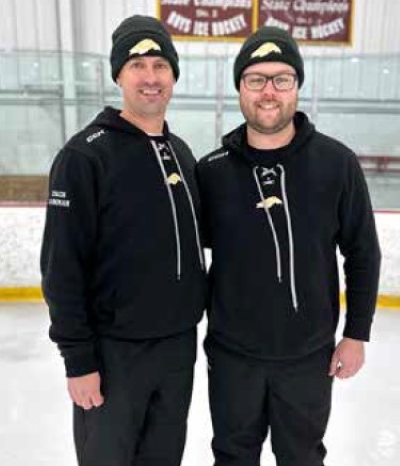
Coach Dean Cashman (left) with assistant coach Ben Peters.

“I played for Dick Dodds at Hanover High, graduating in 1996,” says Coach Cashman. “When I returned home from college, Scott Peters was looking for a youth hockey assistant and Dick Dodds offered up my name. Scott and I have been friends ever since, and I helped him for four years before I eventually ended up assisting Dick (Dodds) for 10 years at Hanover. Last year, I transitioned back to youth as I thought it would be my last chance to coach my boy. I coached the U14 Storm team.”

A big change in the program at LHS was adding Mascoma Valley Regional High School to their co-op arrangement which resulted in a move up to a higher division in high school hockey in New Hampshire, which peaked Cashman’s interest in taking on the coaching vacancy. “With the new co-op alignment of Lebanon-Mascoma-Stevens (high schools) and the bump up to Division 2, there was a clean slate and opportunity to build a new beginning for the Raiders,” says Cashman. In addition, “Five of the kids I coached at the U14 Storm (team) are a part of the team now. Knowing how much they all love the game
motivated me to get involved.”

Familiarity with those involved in the current LHS team extends beyond the players themselves. “Scott Peters’ son, Ben, who I coached for four years, is my assistant now,” says Cashman. Support from parents, and the community in general, is critical for the success of any high school sports team and their coaching staff. Dean Cashman says his Lebanon team is reaping the rewards of that community support.

“A group of proud alumni and parents created a Boosters program to support the boys’ and girls’ teams,” Cashman says. “(Held recently) was the first Winter Classic at Campion rink. The girls played at 10am and the boys at 1:30pm. In between games there was a public skate for families with current Raiders players. All day long the lobby was filled with raffles, concessions, and a side room with little kids coloring and playing. Both (Lebanon) teams won their games but seeing the hundreds of people roll into Campion
throughout the day was the biggest win.”

Cashman says one initiative in particular is creating much goodwill, and bolstering his confidence for the future of the Lebanon program. “Credit to Nenia Ballard for implementing a ‘Kid Captain’ at each home game. Before the game, a local kid gets a gift bag with a t-shirt, puck, and certificate to memorialize the day. They also come down to the locker room with me and take a picture with our Captain, Jack Clary, or some other players they might have a tie to,” Cashman says. “When I get these pictures post-game, it’s a reassurance that we are building a program the community can be excited about.”

At any level, when a new coach comes onboard, they put their own mark on the program by detailing their priorities. Dean Cashman was no different, upon becoming head coach of the Lebanon Raiders. “(We’ve) made a concerted effort in letting the players know from day one that accountability was going to be demanded from the players. The players are all showing up every day, working hard and getting better. They are excited to come to the rink,” Cashman says, adding that he’s always open to a dialog with his players.

“The players know that they can approach me at any time. Coach Peters and I consistently meet with individual players. We discuss school and their other life interests. Whatever they want to discuss. It doesn’t have to be hockey.”

Eventually, it’s the players’ reaction to their coaching staff that helps determine the success of any program. Jack Clary, the Raiders’ team captain, affirms the positive reaction of the players towards Lebanon’s new coaching staff.

“Coach Dean has been met with lots of enthusiasm and has brought so much to the program,” says Clary. “He and I came into this year preaching the importance of discipline and camaraderie, and it has paid immediate dividends. Everyone shows up each day ready to work, and I know we will continue to improve as the season progresses.”

Share:
Reading time: 4 min

Our Latest Issue

The Lebanon Times is delivered to every mailing address in Lebanon.

  • Subscribe at an out of town address!
  • Pick up a copy!

© 2024 copyright Greater Good Media. All rights reserved.