Did you know that Dartmouth Health prioritizes art as a part of its facilities and care? And not just a beautiful mural here or there, either, but programs and initiatives that bring the community together. In addition to permanent and rotating exhibitions, the hospital has creative arts specialists such as writers, visual artists, and harpists, as well as public art projects, and even offers live performances. Working with organizations like the Upper Valley Music Center, the AVA Gallery and Arts Center, and the Hopkinton Center of the Arts, Dartmouth Health’s focus on utilizing art for healing is philanthropically funded for a good cause.

The Dartmouth Health Center’s Creative Arts program employs arts-focused contracted staff, including a creative writer, a visual artist, and two therapeutic harpists.
Integrating Arts and the Humanities was one of Dartmouth Health’s projects even back when the hospital was known as the Mary Hitchcock Memorial Hospital. In the late ‘80s, Gertrude Mertens’ support, along with Mary and Laurance Rockefeller’s 107 Audubon Bird prints, kicked off the program that soon included various other forms of art within the hospital’s walls. One of these is the rotating gallery program, where eight galleries rotate four times a year, said Gillian Cook, the program coordinator for care experience. Artists can find the hospital and apply, or Cook will find artists that she thinks will be a good fit.
In addition to these galleries — which include art in mediums such as oil paintings and pastels — Dartmouth Health also began a Creative Arts program in 2005 for the Dartmouth Cancer Center. Here, an arts-focused contracted staff, including a creative writer, two therapeutic harpists, and a visual artist, all work within the cancer center, said Heather Allin, the program manager of the Complementary Care program for the Dartmouth Cancer Center.
“Patients can request one-on-one services,” Allin continued, if they, for example, need the creative writer to help them write their memoirs. The success of this program, Cook expressed, has allowed it to move into an inpatient center setting, as well, with the same artists. Providers often give referrals to patients if they believe the services would be good for their patients’ well-being. Cook and Allin both said that all supplies that patients work with are donor-funded.
Still, these only scratch the surface of how Dartmouth Health embraces the arts within its care. Cook explained that there are also several live performances, with “at least one person playing every day of the week” in two public areas in the hospital. Featured musicians include pianists, a cellist, a violinist, and a few guitar players. The hospital also hosts a “winter holiday concert series where community choirs and other ensembles will come and play in our main rotunda,” Cook said.

A stained glass window by artist Sabra Field.
Allin said they’ve tried something new this year in the cancer center hematology oncology waiting room. “People are there waiting for long periods of time,” she said, so a visual artist set up a new collaborative art project, where she “laid down tarps and a canvas, and over the day, people can come and she gives instruction.”
“By the end of the day,” Allin said, “You have this beautiful picture that has just come together with multiple people participating.” This program has been conducted weekly for the past six or so months.
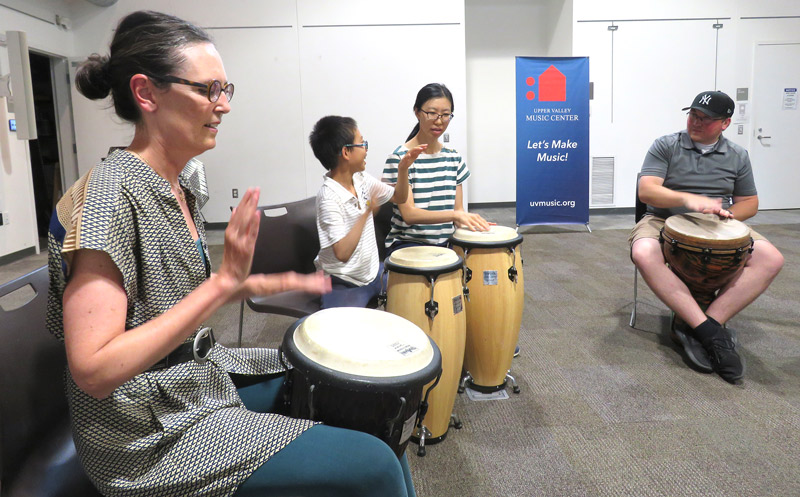
Among the many arts- and humanities-focused services the hospital offers, another worth mentioning is how Dartmouth Health collaborates with local organizations. There’s the AVA Gallery and Art Center, which aids the hospital with public art, as well a partnership with the Upper Valley Music Center to offer an aphasia choir for patients “who are experiencing speech deficits from either stroke or traumatic brain injury,” Cook explained. She recounted that one of the caregivers of a patient with aphasia said, “her son hadn’t been singing in church until he started going to aphasia choir, and now he sings again.”

Left Gillian Cook, program coordinator for care experience at Dartmouth Health. Right Heather Allin, program manager of the Complementary Care program for the Dartmouth Cancer Center.
This is just one of many uplifting patient accounts. Cook expressed that “one person said during those days when [her] husband fought for his life, the art at the hospital became more than beautiful decorations. With each stop, she found a momentary hiding place from all things medical.”
Allin recounted a few testimonials from those working with the artists, such as “creating art helps me forget my cancer for a while,” and “I was not having a good week of chemo. I was not sure if I’d be able to do the activity, but I found getting involved helped lift my spirits.”
Overall, it’s clear that Dartmouth Health’s Arts and Humanities programs have had, and continue to have, an impact on the patients they serve and the community they collaborate with. A unique aspect of Dartmouth Health, the programs show how nontraditional methods of healing are worth exploring, especially considering how much help they can provide.