Home
Our team
Content
    Cover Story
    All Articles
    Animals Rule!
    Around Town
    Cityscapes
    Community Impact
    Elder Profile
    For The Love Of It
    Good For You
    Goodness InDeed
    Green Page
    History
    Local Sports
    Meet your Neighbor
    Miscellaneous
    Spotlight on our Sponsors
    The Arts
    Your Green Spaces
Advertise
Archives
Donate
Contact


The Lebanon Times - Good people, good places and good things happening
  • Home
  • Our team
  • Content
    • Cover Story
    • All Articles
    • Animals Rule!
    • Around Town
    • Cityscapes
    • Community Impact
    • Elder Profile
    • For The Love Of It
    • Good For You
    • Goodness InDeed
    • Green Page
    • History
    • Local Sports
    • Meet your Neighbor
    • Miscellaneous
    • Spotlight on our Sponsors
    • The Arts
    • Your Green Spaces
  • Advertise
  • Archives
  • Donate
  • Contact
All, Cover Story

Lions Club Members Want To See… How Lebanon “Decks The Halls” This Christmas Season

December 11, 2025 by Frank Orlowski No Comments

Chances are we’ve all viewed that hilarious scene in National Lampoon’s Christmas Vacation in which Clark (Chevy Chase’s character) connects the extension cords and illuminates his house with 25,000 Christmas lights, with which he painstakingly decorated the exterior. Clark’s lighting display temporarily blinded his neighbors, caused the electric meter to go into overdrive, and likely could be seen from space.

Now none of us have the time, patience, or forgiving neighbors (let alone the funds to cover that December electric bill) to match Clark Griswold’s extravagant light show, but many of us do enjoy having a more modest lighting display over the holiday season. After all, when it gets dark at 4:30 in the afternoon, who doesn’t like a little extra exterior lighting?

Roadside pick-up crew: (L-R) Mark Kimak, Peter Bickford, Paul Dalton,Tom Zuttermeister, Chris Herring, Catherine Herring, and Geoff Tomlinson

Roadside pick-up crew: (L-R) Mark Kimak, Peter Bickford, Paul Dalton, Tom Zuttermeister, Chris Herring, Catherine Herring, and Geoff Tomlinson

The local Lebanon-Upper Valley Lions Club sure does, and they’re proving it by offering their first-ever Holiday Light Display Contest during the month of December. The Lions are challenging residents and businesses in Lebanon and West Lebanon to decorate their dwellings, offices, and stores in their holiday finest, featuring festive lights and accompanying decor. Photos of the displays then may be sent to the Lions, and a committee of Lions members will choose the winner and two runners-up.

The idea for this contest originated with long-time local Lions Club member Tom McGonis. His objective in proposing this new contest? “It’s a chance to build community spirit.”

The next step was proposing the idea to the Lions Club members. They proved to be receptive to the idea, so the contest was on. The members feel the contest is a perfect fit for the holiday season. “We wanted to choose an idea that would excite the community and light up Lebanon,” McGonis says.

The rules of the contest are simple and straightforward. Homes and businesses are both open to compete. Decorate the building (and possibly the adjoining yard) with your best holiday decor, featuring a festive light display, take a photo (or photos), and send them via email or the post office to the Lions Club. Club members will then judge the photos, and pick a winner and two runners-up. The three chosen will each be awarded a prize from a local business: Katie’s Cookies of Lebanon is providing the prizes. The contest is only open to Lebanon and West Lebanon homes and businesses, and runs from December 1 to December 31.

Any expectations of how many homes and businesses will enter this contest? “We have no idea, being our first time,” says McGonis, though he adds that the hope is they will have many participants.

Hosting a pizza party for the Lebanon Girl Scouts

Hosting a pizza party for the Lebanon Girl Scouts

Promotion of the contest includes signs and posters around town, news stories in local media (such as this article in the Lebanon Times), and word-of-mouth, says McGonis. As is true with all the programs the Lions undertake, they are always happy to accept corporate sponsorship from local businesses, though, “The contest is not a fundraiser,” he adds.

The Lebanon-Upper Valley Lions Club is involved in a wide variety of philanthropic work and projects. They provide assistance to well-respected Upper Valley organizations such as David’s House, Listen, and The Haven. In addition, they perform community work, such as clean-up on their one-mile stretch of Route 120, and they assist in keeping Lebanon’s fire hydrants clean and working properly during the winter months – so important when winter structure fires occur, and ice and snow can interfere with hydrant operation. Lions members take part in holiday food distribution efforts, and offer scholarships to high school students. They even pair with other organizations in fun and educational events. Tom McGonis says the Lions recently teamed up with a local Girl Scouts troop to put on a pizza party.

Of course, they are involved with the major function of all Lions Clubs – that being assisting with those facing eyesight issues. Eyeglass collection, sight screening and education, support of those providing seeing eye dogs, and financial support for those in need facing vision problems, continues to be a mainstay of all Lions Clubs.

Tom McGonis says the Lebanon-Upper Valley chapter of the Lions consists of, at various times, between 10 and 20 members. Several members have devoted years of service to Lions Clubs; McGonis first became a Lions Club member in 1972, and Paul Dalton, who is involved with the Holiday Lights Contest, also has several decades of service in area Lions Clubs.

This December, whether you’re a Clark Griswold holiday-lights-extravaganza-wannabe, someone who puts an effort every year into a tasteful holiday light show, or someone who’s always wanted to dress up your home or business in a festive holiday light theme, why not be a part of this first-ever Lions Club contest? Again, the rules are simple – your lights display must be in Lebanon or West Lebanon, and you need to send the photos of the display to the Lebanon-Upper Valley Lions Club during the month of December. You may win, “A major award,” (as did the father in another popular Christmas movie), but you will, “show that our community has holiday spirit,” says McGonis. Good luck!

Want more information about the Lions’ Holiday Light Display Contest, or the Lions Club in general? Just visit the Lebanon-Upper Valley Lions Club website.
Share:
Reading time: 4 min
All, Cover Story

Did Someone Say “Free Skiing”?

March 5, 2025 by Frank Orlowski No Comments

If you’re a skier, you are well aware of the hit your wallet takes on a weekend ski adventure. Lift tickets for you and a partner, maybe a child or two, add in hot chocolate, a burger and chili, maybe an adult beverage mid day…the costs add up quickly and substantially. That is, of course, unless you are skiing or snowboarding at Lebanon’s own Storrs Hill this winter season.

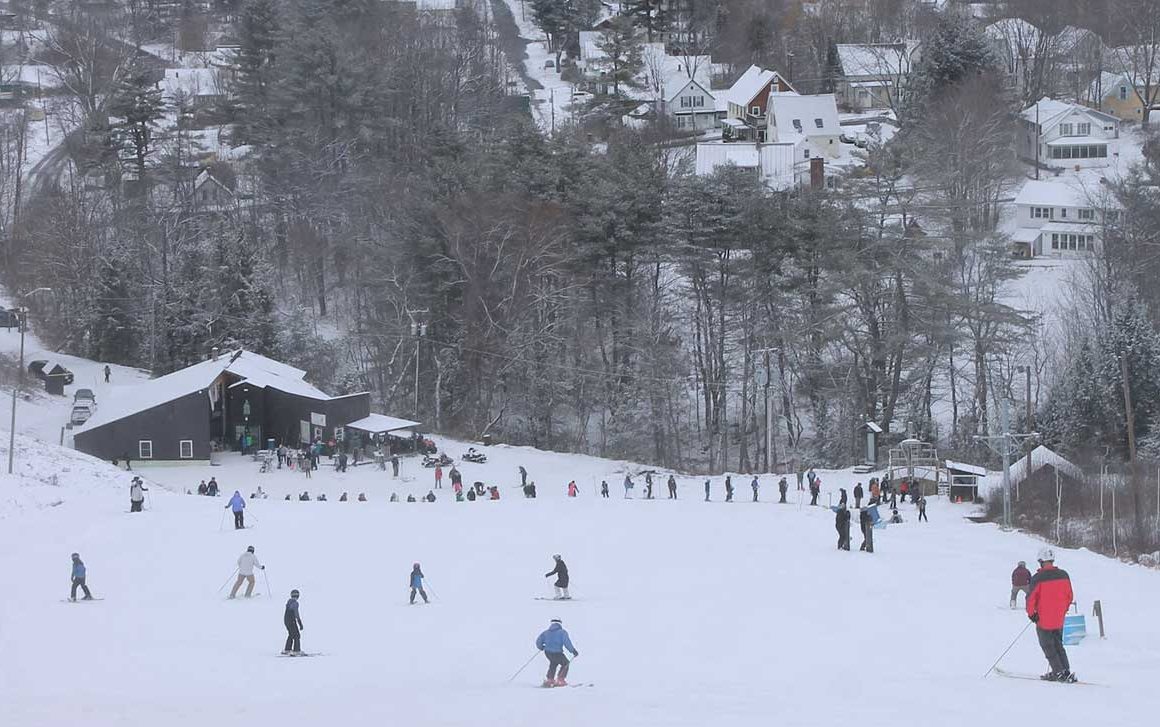
Thanks to a generous gift from the philanthropic Jack and Dorothy Byrne Foundation, visitors to the Lebanon ski area paid nothing for their lift tickets during the ’24/’25 season. That’s correct; skiers and snowboarders experienced free tickets at the venerable hill in the heart of town. So did area winter enthusiasts take advantage of that economical opportunity?

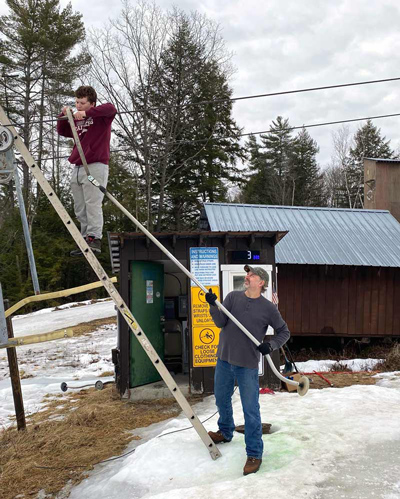
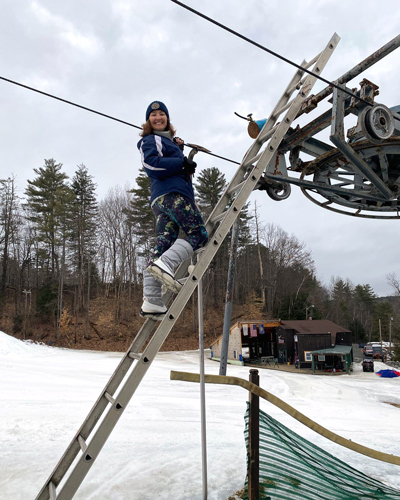
Volunteers help keep Storrs Hill ship shape all season long.

Volunteers help keep Storrs Hill ship shape all season long.

“[On] opening weekend, we saw over 600 skiers from Friday through Sunday,” says Cory Grant, president of the Lebanon Outing Club (LOC), which operates Storrs Hill. That number sounds impressive, especially so when Grant adds, “In the past, we would be lucky to see maybe 15 skiers on a Friday, 40 on a Saturday and Sunday.”

Not surprisingly, the free skiing offer brought many new skiers to Storrs Hill, opening their eyes to this community treasure. “Some locals didn’t know we existed until [now],” says Cory Grant.

Storrs Hill has a long history with Upper Valley skiers. A ski jump was first built on the hill in the 1920s (Storrs Hill originated as a ski jump area), and in the early ’30s, the first alpine trail was developed on the hill. A rope tow was added for skiers in the mid ’30s, which makes Storrs Hill one of the oldest continually operating, lift-served ski areas nationally. Over the years, improvements such as snow making and the POMA lift were added to the ski and ski jump operation.

The history of Storrs Hill cannot be told without mentioning the name of one of the world’s greatest alpine skiers. World Cup and Olympic champion Mikaela Shiffrin spent some of her early years skiing at Storrs Hill, before moving on to Burke Academy and the U.S. Ski Team. In the early 2000s, Shiffrin could often be found practicing for hours on the Storrs Hill ski slope. Another prominent local athlete, Lebanon’s Nick Alexander, learned the art of ski jumping at Storrs Hill as a child, and went on to be a long time member of the U.S. Ski Jumping Team, appearing in two Olympics.

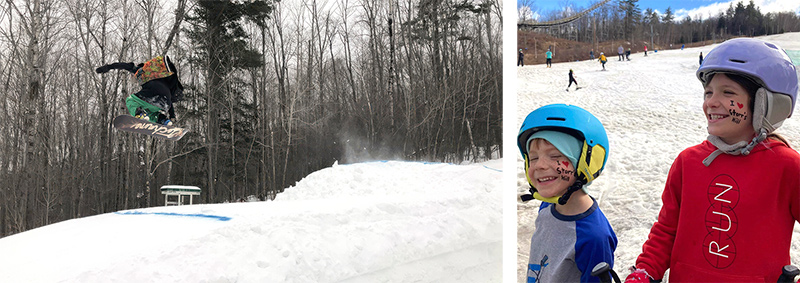
Photos from LOC Facebook page

Photos from LOC Facebook page

The history of Storrs Hill is closely tied to the Lebanon Outing Club. For decades, volunteers from the LOC have operated and maintained the ski area. “The Lebanon Outing Club is a non-profit organization outside of the City of Lebanon, that has to fund the Storrs Hill Ski Area in order for it to be operable,” says Cory Grant. Though one source of funding does come from the City of Lebanon, the LOC must continually seek funds from other sources, such as the Byrne Foundation, to keep operating the ski area each year. Grant says the LOC volunteers spend considerable time writing grants and fundraising for hill operations. Prior to this season, lift tickets and season pass sales also helped run Storrs Hill, though the LOC always kept those prices low to allow as many as possible to use the slope.

“We are still seeking more donations to help with operations; we have to look for business support and community support to keep the ski area functioning,” says Cory Grant, adding, “We have had some unforeseen activities that have cost us a lot this season with snowmaking, and grooming equipment.”

The charitable gift to offer free skiing this winter is not the first time the Byrne Foundation has assisted Storrs Hill. In recent years, the Byrne Foundation provided grants to repair and upgrade equipment and mechanical operations at Storrs Hill.

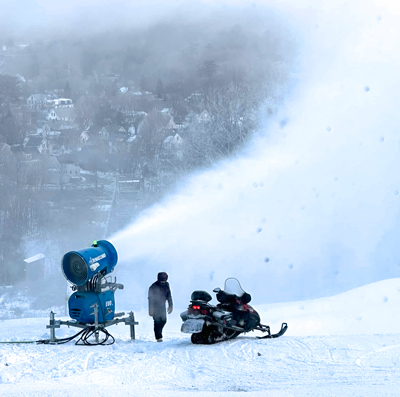
Snowmaking at Storrs Hill ski area, overlooking downtown Lebanon.Snowmaking is one of the many jobs

Snowmaking at Storrs Hill ski area, overlooking downtown Lebanon. Snowmaking is one of the many jobs

With such a dramatic increase in the number of skiers at Storrs Hill this season, it seems natural that more LOC volunteers would be needed to assist in operations. Cory Grant confirms that, saying, “Volunteers are roughly one per top, and one per bottom [on the slope]. Now we are looking to have at least four so we can do shifts and have a couple of people to help at bottom with [those with novice] abilities.”

So with the increased number of patrons, does the LOC welcome more volunteers? “Yes, we are looking for as many volunteers as possible,” Grant says.

Having a local, community ski area, especially one that offers its slopes at no charge, is a rarity. To make that possible, the community must depend on the generosity and goodwill of others. With a little help from volunteers and donors and grateful patrons, Storrs Hill will remain a hidden gem in Lebanon for years to come.

For other winter activities to explore in Lebanon, read “Mastering the Art of ‘Wintering’ in Lebanon” in this issue on page 22-23.

Share:
Reading time: 4 min
All, Local Sports

New Coach, New Era For Lebanon High School Hockey

February 24, 2024 by Frank Orlowski No Comments

Those of us who have ever played sports in high school remember our favorite coaches fondly. At the time they may have seemed too tough, too regimented, or too discipline-oriented, but after some time, we realized the lessons that they taught us were important in negotiating the real world in which we later found ourselves. Those lessons of teamwork, giving it your all, carrying through till the finish, and practice till you get it right are not just applicable to sports, but to almost every aspect of life.

For the players on the Lebanon High School (LHS) Boys Hockey Team, they now have a new coach from whom they’ll learn both the intricacies of the sport and the life lessons of participating on a team. Last year, Dean Cashman assumed the role of head coach of the Raiders hockey team. Now in his first season as Lebanon’s coach, Cashman is far from a newbie to the sport, and coaching.

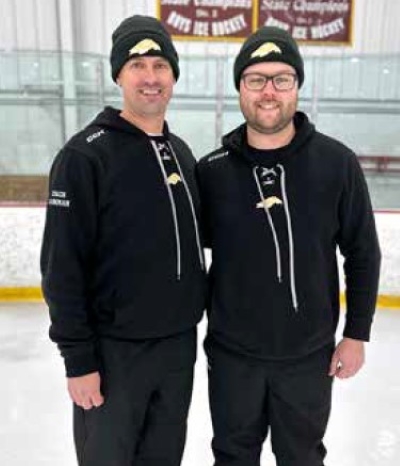
Coach Dean Cashman (left) with assistant coach Ben Peters.

“I played for Dick Dodds at Hanover High, graduating in 1996,” says Coach Cashman. “When I returned home from college, Scott Peters was looking for a youth hockey assistant and Dick Dodds offered up my name. Scott and I have been friends ever since, and I helped him for four years before I eventually ended up assisting Dick (Dodds) for 10 years at Hanover. Last year, I transitioned back to youth as I thought it would be my last chance to coach my boy. I coached the U14 Storm team.”

A big change in the program at LHS was adding Mascoma Valley Regional High School to their co-op arrangement which resulted in a move up to a higher division in high school hockey in New Hampshire, which peaked Cashman’s interest in taking on the coaching vacancy. “With the new co-op alignment of Lebanon-Mascoma-Stevens (high schools) and the bump up to Division 2, there was a clean slate and opportunity to build a new beginning for the Raiders,” says Cashman. In addition, “Five of the kids I coached at the U14 Storm (team) are a part of the team now. Knowing how much they all love the game
motivated me to get involved.”

Familiarity with those involved in the current LHS team extends beyond the players themselves. “Scott Peters’ son, Ben, who I coached for four years, is my assistant now,” says Cashman. Support from parents, and the community in general, is critical for the success of any high school sports team and their coaching staff. Dean Cashman says his Lebanon team is reaping the rewards of that community support.

“A group of proud alumni and parents created a Boosters program to support the boys’ and girls’ teams,” Cashman says. “(Held recently) was the first Winter Classic at Campion rink. The girls played at 10am and the boys at 1:30pm. In between games there was a public skate for families with current Raiders players. All day long the lobby was filled with raffles, concessions, and a side room with little kids coloring and playing. Both (Lebanon) teams won their games but seeing the hundreds of people roll into Campion
throughout the day was the biggest win.”

Cashman says one initiative in particular is creating much goodwill, and bolstering his confidence for the future of the Lebanon program. “Credit to Nenia Ballard for implementing a ‘Kid Captain’ at each home game. Before the game, a local kid gets a gift bag with a t-shirt, puck, and certificate to memorialize the day. They also come down to the locker room with me and take a picture with our Captain, Jack Clary, or some other players they might have a tie to,” Cashman says. “When I get these pictures post-game, it’s a reassurance that we are building a program the community can be excited about.”

At any level, when a new coach comes onboard, they put their own mark on the program by detailing their priorities. Dean Cashman was no different, upon becoming head coach of the Lebanon Raiders. “(We’ve) made a concerted effort in letting the players know from day one that accountability was going to be demanded from the players. The players are all showing up every day, working hard and getting better. They are excited to come to the rink,” Cashman says, adding that he’s always open to a dialog with his players.

“The players know that they can approach me at any time. Coach Peters and I consistently meet with individual players. We discuss school and their other life interests. Whatever they want to discuss. It doesn’t have to be hockey.”

Eventually, it’s the players’ reaction to their coaching staff that helps determine the success of any program. Jack Clary, the Raiders’ team captain, affirms the positive reaction of the players towards Lebanon’s new coaching staff.

“Coach Dean has been met with lots of enthusiasm and has brought so much to the program,” says Clary. “He and I came into this year preaching the importance of discipline and camaraderie, and it has paid immediate dividends. Everyone shows up each day ready to work, and I know we will continue to improve as the season progresses.”

Share:
Reading time: 4 min
All, Good For You

New Ways to Confront Drug and Alcohol Misuse in the Workplace

November 25, 2022 by Frank Orlowski No Comments

Each year, drug and alcohol problems among employees result in the loss of productivity, profits, and a positive working environment for businesses and organizations. In the past, employees dealing with these issues might incur severe consequences from their employers, frequently resulting in termination, which often led to a further downhill spiral in their lives. However, in recent years, many forward-thinking companies and organizations are trying different approaches to support employees facing addiction problems.

One such company in the Upper Valley is the well-respected Hypertherm Associates. Stacey Chiocchio, the community citizenship manager at Hypertherm Associates, explains how this move towards assisting employees with addiction issues, termed a “recovery-friendly workplace”, began at the firm.

“Oftentimes, the way things start is with our associates,” says  Chiocchio. Associates (employees) realized that with the burgeoning opioid crisis affecting so many in New Hampshire and Vermont, the company needed to be proactive in response. So in the mid-2010s,  progress toward a recovery-friendly workplace was underway.

Removing the stigma associated with drug and alcohol problems and building a safe space for recovery at the company was the goal when they first addressed the issue, says Chiocchio. In doing this, the company sought outside support in the process, which included ideas from the Dartmouth Hitchcock Community Health team. Also playing a  major role in this effort is Hypertherm’s own HOPE Foundation. The Hypertherm HOPE Foundation continues to fund nonprofits in this space with programs focused on education to remove stigma and help support recovery.

Though the process of establishing a recovery-friendly work environment began in 2015, it continues to grow and evolve, Chiocchio says. “Every year we’ve added more and more strengths to the (effort)…it’s a journey.”

One key initiative at first was looking at past policies and protocols regarding employees with substance use disorders and then adapting them. In the past, when an employee was experiencing drug or alcohol problems related to work, “often it led to termination,” says Chiocchio. All agreed that this could no longer be the main option; “We needed to do better.” 

Doing better meant supporting these employees going through difficult times. That support includes helping the individual connect with a  licensed alcohol and drug counselor to create a plan. 

Many other company supported assets are now in place to help,  Chiocchio says. These include resource cards found in all of the restrooms, providing employees with a private space in which to learn about their options. The company has also trained associates, termed “champions,” within the company to provide information and resources for those in need. Recently, the company has installed a resource called a “Naloxbox” throughout each of their facilities. When opened, it notifies all that there is a lifesaving measure occurring. The box contains Narcan, a drug that reverses the effects of an opioid overdose. Any associate is able to open the box to administer this lifesaving drug.

“Through the actions we took, we created a recovery-friendly  workplace,” says Chiocchio.

The goal of creating a recovery friendly work environment is not unique to Hypertherm Associates. After Hypertherm began this program, the State of NH began its Recovery Friendly Work Initiative. According to information on the State’s website, “Untreated addiction costs New Hampshire’s economy $2.36 billion. 66% of that cost ($1.5 billion) is incurred by businesses in the form of impaired productivity and  absenteeism.”

The State site goes on further to say, “The Recovery Friendly Workplace Initiative gives business owners the resources and support they need to foster a supportive environment that encourages the success of their employees in recovery.”

The State recognizes Hypertherm Associates as a partner in the  Initiative, along with many other companies and organizations throughout NH. The response to Hypertherm’s recovery friendly effort and initiatives among the staff has exceeded expectations, says Stacey Chiocchio. “This (effort), more than any other, has had such a dramatic effect in a positive way.”

Having this recovery based effort has to some extent changed the  culture at the company, Chiocchio points out. “We like to celebrate  milestones,” she says, such as employees reaching

25 years of service.  Though in the past, those celebrations would often take place at an  establishment where alcohol was served, such as a brewery. Changes to this were inevitable; “That doesn’t feel like it’s supporting all our associates,” says Chiocchio. In response, she says this year’s celebration took place at VINS as an alcohol free event, making it a more comfortable occasion for those in recovery. “We’re really proud of that pivot,” says Chiocchio.

Not only employees at the company benefit from this recovery initiative – family members do as well. “Some (employees) have family  members struggling, they feel supported, and they now feel that they can ask for help for those family members,” says Chiocchio.

Though many companies are realizing a recovery friendly work  environment is important, many more have yet to make that commitment. When asked what companies contemplating a move towards a recovery friendly workplace should do, Stacey Chiocchio offers blunt advice. “Be honest with yourself; don’t be in denial that you have substance abuse within your walls.” 

Share:
Reading time: 4 min
All, Miscellaneous

For Prouty Participants, Giving Is the Goal

June 29, 2022 by Frank Orlowski No Comments

Each year, thousands of Upper Valley residents take part as participants, volunteers, and donors, in The Prouty, the annual fund raising effort for the Norris Cotton Cancer Center (NCCC) at DHMC. This year, the 41st for the event held on July 8 and 9, is no different, as preparations are well underway for another successful Prouty.

Literally thousands of participants take part in the cycling, walking, rowing, golfing and other activities that make up each Prouty event. And each of these participants raise money from friends and family for participating, with the funds raised going towards research, and services for patients at the NCCC. As so many Prouty participants are veterans of multiple years, their efforts must truly be rewarding.

Lebanon resident Ann Greenwald is a great example of a Prouty veteran who finds the event a valued experience. “My husband and I moved to the Upper Valley in 2000 with two little boys and a black dog,” Greenwald explains.

“Rick was busy starting his company, Simbex, and I took jobs at the CCBA as the Aerobics Coordinator and swim team coach. As I integrated into the UV community I began to hear about this big biking event each summer to support the Norris Cotton Cancer Center at Dartmouth. I was especially attracted to the Prouty for the way it started with a group of dedicated nurses who were so inspired by how their patient, Audrey Prouty, handled her fight against cancer that they created a bike ride event where a community could come together to raise money to support research in the areas of cancer diagnosis and treatment.”

As a participant, Ann Greenwald has incorporated many activities into her annual Prouty adventure, including swimming, walking, and cycling. For cycling, she’s done the 25-mile course, the 50 mile course, and the Ultimate, which is a hundred mile ride on two consecutive days, starting in southern NH; the most rigorous of all the Prouty events. These various physical tests result in participants discovering much about themselves, and their desire to help others.

“Every year presents a new learning experience that never fails to increase not only my inner resilience and strength but also my compassion and empathy towards others,” says Greenwald. “Pouring rain, blazing heat, snow flurries, bumpy asphalt, blistered feet, aching back and shoulders… my brain continually asking my non-bike friendly body, ‘Why am I doing this?’ Thank goodness for the SAG stops (the rest stops found along each bike route)! Talking with others, refueling, and noticing the deep connection and sense of purpose for helping and inspiring others is palpable.”

When participating in one of those challenging Prouty events, such as the two day Ultimate ride, or the 100 mile ride on Prouty Saturday, those SAG stop volunteers and the community members cheering on the riders make a world of difference, says Greenwald.

“The young campers working at the Mt. Cube SAG stop (in Orford) are wonderful as they cheer and sing camp songs while handing out PB & J sandwiches. You can’t help but smile. The cold wash cloths at the River Road SAG stop on a blistering hot day saved me numerous times. The steel drummers and encouraging signs carry us all up the last biking hill towards the Richmond Middle School finish line. But my absolute favorite cheering section are the Kendal Residents sitting by their sign at the top of that last hill that reads, ‘You’re over the hill and so are we!’”

After two years of The Prouty being a virtual (and primarily a virtual) event, the 2022 Prouty is back to a July weekend happening. Ann Greenwald says the virtual Prouty proved quite successful in its own right.

“The virtual Prouty was actually great because people could do any event from any where in the world. Simply by holding up the Virtual Prouty banner and sharing their pictures, we could all share in their accomplishments and feel inspired to do the same.”

Virtual, or live on a July weekend, The Prouty is special in its meaning and results. “Cancer touches everyone, including the most important people in our lives,” says Ann. “The phrase, ‘It takes a village to help those afflicted with cancer,’ really rings true for everyone, especially here in the Upper Valley. That’s why I joined The Prouty. The ‘village’ or community engagement around The Prouty event and around supporting not only the patient but their caregivers too, is truly amazing to experience and incredibly important to me.”

Share:
Reading time: 3 min
All, Cover Story

Farm-to-Table Food Movement Changes Consumption Habits

February 24, 2020 by Frank Orlowski No Comments

Growing up in farm country, having foods, particularly produce, go directly from the garden to the dinner table seemed natural to me. If some fruit or vegetable did not come from our gardens, surely a neighbor’s farmstand carried it. Sure, all of our foods weren’t local, and the grocery store was a weekly stop, but having regular access to local foods was common.

In recent decades, we have experienced a revival in the interest among consumers of obtaining foods directly, or indirectly, from local farmers. For a variety of reasons, including product freshness, nutritional value, supporting local farms and businesses, or knowing how and where one’s food is produced, many consumers are active in finding their food products from local sources. In the Upper Valley, consumers are privileged with numerous choices for locally grown produce and locally raised meats. Whether direct from the farm, from the Norwich or Lebanon Farmers markets, stores that sell local foods such as the Lebanon Food Co-op, or area restaurants that serve local products, area ‘foodies’ have many options for foods right here in the Upper Valley.

Norah Lake of Sweetland Farm

Mark Robie, of the Upper Valley’s Robie Farm, markets local meat products to a variety of stores and restaurants. Having the chance to buy local food products, “gives the consumer a say in how your food is produced,” he says. Robie often takes calls and has discussions about the meat and other products, such as cheese, sporting the Robie Farm name. Discussions often center on the health of the animals, and the manner in which they’re raised, he adds. “These conversations offer consumers a connection with the farmer themselves.”

Bill Stinson has a history of raising and selling vegetables for 40 years in New England. He notes that the current farm-to-table movement “hasn’t been around all that long.” Stinson says the late 1970s saw farmers begin expanding their marketing by selling from farmstands and farmers markets. The reason for this was simple for consumers. “It connected people with better food, though the movement was slow to grow, to get momentum,” says Stinson.

Eventually, this farm-to-table food experience took hold. “The buy local food movement has really picked up speed in the last twenty years,” says Robie.

Stinson says in the early 2000s, chefs and restaurants really picked up interest in using locally grown produce in their creations. Area restaurants such as Arianas, the Latham House Tavern, and Molly’s all feature Robie Farm meat products, says Robie. Other area restaurants, such as Lebanon’s Three Tomatoes Trattoria, publicize the fact that they utilize local farm products in their dishes.

The Blue Sparrow Kitchen of Norwich uses a great deal of local produce in the dishes it makes, says owner Amber Bolland. In fact, Blue Sparrow’s menu indicates which dishes feature local produce, and the farms where that produce originates. “We hear a lot of thanks from folks (for using local produce),” says Bolland. “It means a ton to me.” Some of the local produce Bolland uses in her recipes comes from Edgewater Farm of Plainfield, and Sweetland Farm of Norwich. With so much local produce available, Bolland says the Upper Valley is blessed for those seeking local food products. “We live in this amazing area with all these farms.”

One area farm producing locally grown and raised food products is Sweetland Farm. Owner Norah Lake says her farm specializes in selling through CSA (community supported agriculture) shares, and at farmers markets. “We’re just on the cusp of getting into the restaurant market,” she adds. With her farm growing over 100 different varieties of produce, the chances of filling the needs of consumers and restaurants is greatly enhanced.  For the consumer, Lake says buying local foods “is a feel-good purchase,” in supporting local producers, and the Upper Valley economy.  In return, the farm offers the consumer information about the food they eat. “A big part of what we do is education,” Lake says.

Sweetland’s produce does end up in the foods created by nearby Blue Sparrow Kitchen, but for a farmer to make buying arrangements with numerous restaurants or stores, it takes a commitment of time, energy, and resources. In arranging a better, more efficient way to match up the local farmer with the stores and restaurants, enter the Upper Valley’s champion of buying local, Vital Communities.

Last fall, Beth Roy, Vital Communities’ food & farm program manager, says her organization arranged a first ever event designed to match up local farmers with area restaurants, food stores, and grocery distributers. This event, resulting from a grant offered by Vermont’s Agency of Agriculture, allowed local farmers and food producers (such as honey and maple syrup producers), to meet with commercial buyers of their meat, produce, and products. The event resulted “in really positive reactions,” says Roy. “It made it easier for (farmers) to meet these businesses.”

Vital Communities efforts to increase education and realization of the local farm-to-table movement extend well beyond bringing farmers and businesses together. Roy says her organization works closely with area schools to enhance young people’s knowledge and appreciation of nutritious, locally produced foods. Some of these efforts include having schools’ breakfast and lunch programs buy and use foods from local farms, and encourage outdoor classrooms, where students learn about growing and preparing produce, and care for on-site gardens. Roy mentions the Lebanon Schools are particularly involved with the outdoor classroom gardening experience.

Roy says she also works closely with the area farmers markets, to enhance the experience for both consumers and the vendors. In this effort, Vital Communities established the Upper Valley Farmers Market Collaborative, working with numerous farm market managers, including those from Lebanon and Norwich, to help grow these markets. Some of the ideas coming out of this effort include the Power of Produce Clubs, which allows “kids to connect with the farmers market,” says Roy. This program encourages kids to visit the various farmers and vendors at the market, garner information, and in return receive market dollars to spend at the market on healthy offerings.

Other ways they help the viability of the markets includes assisting vendors in designing customer friendly booths and encouraging the use of SNAP benefits at the markets, allowing lower income folks the ability to buy fresh, local produce.

Making locally grown food accessible to lower income people should be a key goal, says long-time farmer Bill Stinson. “Some think it’s only for wealthier folks… it doesn’t reach a large enough volume of people.” Sweetland Farm’s Norah Lake points to programs now in effect that assist lower income consumers to buy subsidized CSAs from farmers, and organizations such as Willing Hands, which get local produce in the hands of more people, particularly those in need.

Beth Roy notes that both the Norwich and Lebanon markets are particularly successful in bringing together consumers with local farmers and producers. “The Lebanon market is lovely, with all the prepared foods and entertainment offered,” says Roy.

Local farmer Norah Lake of Sweetland Farm further endorses the work of Vital Communities in promoting local food production, and the farm-to-table movement. “Vital Communities is pretty amazing to work with,” says Lake. “Their promotion of local food in the Upper Valley has been key.”

CSA shareholders selecting their produce right from the field


Co-op Food Stores Partner with Local Egg Farm to Offer Reusable Egg Cartons

The Co-op Food Stores in Lebanon, Hanover, and White River Jct., in conjunction with Pete and Gerry’s Organic Eggs of Monroe, NH, instituted a program whereby customers may purchase a reusable egg carton for unlimited use. This pilot program, if proves successful, will make a significant impact in the waste stream. It’s estimated the average person consumes 23 cartons worth of eggs each year. Most of these cartons are now produced from Styrofoam, or molded pulp. The new reusable cartons are composed of 100% recycled plastic. “We continue to challenge ourselves to find even better ways to improve our environmental stewardship,” said Jesse Laflamme, CEO of Pete and Gerry’s Organic Eggs.

The Food Co-op’s Allan Reetz credited the Co-op’s flexibility in taking on a program such as this. “We’ve been early adopters of great products for… years,” he said. “Today… we’re big enough to put innovations to the test, and small enough to swiftly help forward-thinking leaders like Pete and Gerry’s.”

Share:
Reading time: 7 min
All, Cover Story

This Eagle Will Soar

December 5, 2017 by Frank Orlowski No Comments

Achieving the rank of Eagle Scout is a goal of many who enter the Boy Scouts, but one not easily attained. According to the National Eagle Scout Association, only about five percent of those in the Boy Scouts achieve the Eagle Scout designation. Along with amassing various merit badges to become an Eagle Scout, candidates must complete a service requirement to achieve that status.

Eagle Scout Justin Rogers

Lebanon resident Justin Rogers recently was awarded the honor of becoming an Eagle Scout, and in achieving the honor, Justin helped students and teachers at the Mt. Lebanon Elementary School by performing his service work component at that school. Specifically, Justin designed and created a trail, and outdoor education area for classes at the school to use.

Completing his service project at the Mt. Lebanon School was particularly important for Justin, as not only did he attend the school, but also his early days with the Cub Scouts often involved meetings at the school.

Working closely with the school’s principal, Eloise Ginty, Justin planned and designed the project, and organized the work crew that brought the project to fruition. Justin’s mother, Christine Rogers, says “It was his initiation, his planning,” in formulating the outdoor classroom project, adding she had great confidence in Justin’s ability to see it through. “I knew he would get it done,” she says.

Justin says he met with Principal Ginty to discuss where and how the outdoor trail and learning space should be designed and located. After the consultation, he developed the plan for creating the space. Ginty asked that any components used in creating the space be from school property. This included the logs used for the benches at the learning site, and the steps created to access the site.

Ginty says she is thrilled the concept of an outdoor class space became a reality. “I had the idea to have an outdoor classroom,” says Ginty, adding that the final product is what she hoped for. With the outdoor class space in place, Ginty says that each week a kindergarten class and a first grade class take advantage of using the site. While using the outdoor classroom, the students “focus on nature,” says Ginty. This focus includes incorporating a seasonal science theme to the classwork, she says. Ginty adds that the outdoor site is also a great place for the students to observe some quiet time while taking in their surroundings.

Children learning and enjoying the outdoors

Justin says the actual physical work needed to create the space took place over two summer weekends. The future Eagle Scout headed up the work crew, though he had plenty of help doing the actual trail and class site construction. All the scouts in his troop, and many parents, helped in the work, says Justin who belongs to Troop 279 of the Sunapee District. The physical work performed by the scouts and parents included clearing the area, creating a fire pit and log seats, and creating steps on the trail that leads to the class site. Justin says creating the steps was one of the more challenging aspects of the job. The trail itself was designed in a “Y” formation, with two different forks accessing the classroom site. Ginty has a great appreciation for the work done by Justin and his crew. “It was quite a lot of work,” she says.

Overall, Justin says he and his crew found the work rewarding. “It was a lot of fun. Everything went smoothly; I really enjoyed it.” A junior at Lebanon High, Justin is no newcomer to volunteer service work; he has helped with many service projects through his church.

Working with Justin was a positive experience, Principal Ginty says. “He was excellent, and our communication was great,” she says. Ginty adds that representatives from other elementary schools have inquired about the project, hoping to do something similar at their schools.

Volunteers who helped create the new outdoor space

The finished project is a big hit with the students as well. When a class uses the trail, and the outdoor class site, “The kids say it’s their favorite part of the day,” says Justin.

Not surprisingly, Christine has great admiration for her son, and the project he undertook. “I’m extremely proud of him becoming an Eagle Scout, and this project was a blessing,” she says.

Share:
Reading time: 3 min
All, Cover Story

Storrs Hill Ski Area
A Community Tradition Lives On

August 16, 2017 by Frank Orlowski No Comments
Erling H. Heistad, in front of the jump designed by his father

In recent years, the trend in the ski industry is for major corporations to own most of the country’s ski resorts. Companies such as Vail Resorts, Peak Resorts, and Boyne USA own resorts across the United States, and even internationally. Yet a few independent mountains still operate, drawing local residents and visitors alike, who like the idea of supporting a locally run, locally managed ski operation.

New England once was home to numerous small, local ski operations. Many of these have disappeared over the years, victims of the appeal of huge ski resorts with dozens of trails, major snow making capabilities, and numerous amenities, such as waterparks, hotels and conference centers, and multiple restaurants.

One small, local, and independent ski area that still exists is here in Lebanon; the Storrs Hill Ski Area. Located right in the heart of the town, Storrs Hill affords local skiers, youth groups, and school teams the luxury of a ski experience close to home.

Erling Heistad at the dedication of the Heistad Hill in 1954; plaque now mounted on the front of the takeoff

Erling Heistad at the dedication of the
Heistad Hill in 1954; plaque now mounted
on the front of the takeoff

Storrs Hill’s history goes back to the 1920s, when a Norwegian immigrant to the area, Erling Heistad, had a plan to develop ski jumping as a sport in New Hampshire. Heistad created the first ski jump on the hill, and also was instrumental in clearing the first ski trail. As skiing grew in popularity in the 1930s, a rope tow was installed on the hill, allowing skiers and jumpers to take greater advantage of the area.

Heistad’s son, current Lebanon resident Erling Heistad, says his father was dedicated to introducing ski jumping to the young people of Lebanon. “He was an engineer, and very interested in the design of ski jumps,” says Heistad of his father.

The elder Heistad built his first jump at Storrs Hill in 1923. That first jump was located further up the hill from the current 50-meter jump. Along with constructing that first jump, the elder Heistad founded Lebanon’s first outing club, enlisting high school students in the effort to construct, use, and maintain that jump. The ski jump at Storrs Hill was not the only one his father constructed, says Heistad. “He had a goal of a jump in every neighborhood in town,” Heistad says.

Giving Lebanon’s children a winter recreation opportunity was important to his father, Heistad says. “He was really interested in the kids.” Even today, evidence still remains of those early neighborhood ski jumps Heistad and his students built.

After construction of that first ski jump at Storrs Hill, other jumps were built over the years at Storrs Hill, including the current 50-meter jump, first constructed in the 1950s. “He designed them all,” says Heistad of his father.

The ski area at Storrs Hill was operated by the city of Lebanon for many years; however, by the mid 1980s, the cost to the city of operating the hill became too expensive. From that point on, Storrs Hill fell under the supervision of the Lebanon Outing Club (LOC). A volunteer effort, the LOC members work year-round to keep the local ski slope open and running.

Cory Grant, president of the LOC, and Ryan Cilbrith, director of the Ski Patrol at Storrs Hill

Cory Grant, president of the LOC, and
Ryan Cilbrith, director of the Ski Patrol at
Storrs Hill

Cory Grant, LOC president, says operating Storrs Hill is a labor of love for the members of the group. During the ski season, Grant estimates that 8 to 10 volunteers work at the hill each day. Volunteers perform all the functions normally associated with running any ski slope. Those functions include snow making, grooming, operating the lifts, ticket taking, and coaching. Grant says he puts in an average of 25 to 30 hours each week helping to keep the hill operating in the winter. The work does not end during the summer, either. Volunteers spend time on course and equipment maintenance, as well as grant writing and fundraising during the off-season.

Of course, skiing is not the only activity at Storrs Hill. Ski jumping remains an important part of this local venue. Storrs Hill has a storied history as a ski jump area, and that activity continues today, with many high school meets held there. In fact, New Hampshire is the only state that offers competitive ski jumping as a sport for high school students. Other towns in New Hampshire that offer ski jumping for competitors are Newport, Plymouth, Andover, and Hanover.

Storrs Hill boasts a 25-meter jump, and a 50-meter jump, along with a beginners 10-meter, in-ground jump. School meets and ski jumping tournaments take place at the Storrs Hill jumps during the season. Some veterans of ski jumping at Storrs Hill go on to bigger and better things – Lebanon’s Nick Alexander learned the art of ski jumping at Storrs Hill as a child, and went on to be a long time member of the U.S. ski jumping team, appearing in two Olympics.

What is it like learning to ski jump at Storrs Hill? Former Hanover resident and high school ski jumper, Robin Colt, first experienced jumping at the Lebanon hill in the 1990s. At around age 10, Colt first tried jumping on the hill’s smaller 10-meter jump. She says she found that experience similar to going over hills while alpine skiing. The next step was moving to the 25-meter jump. Colt says climbing to the top of this jump, and preparing to take off, caused the adrenaline to pump. “You have a pit in your stomach,” says Colt.

One of the most important aspects of learning to jump is practicing your form, Colt says. She adds the instruction she received at Storrs Hill was great. “The coaching there was unbelievable,” she says, giving special accolades to her father, Rick Colt, and John Farnham, long-time manager of the ski area, and ski jumping coach.

Erling Heistad says his father continued to work with young ski jumpers throughout his life. When a new jumper was hesitant to make a jump, the elder Heistad would issue a challenge. “He would say, ‘if I go off, will you go off?”’ Usually the challenge worked. Heistad said his father continued ski jumping until age 69.

Operating a ski area is a daunting proposition. Despite relying on volunteers for much of the labor at Storrs Hill, there are considerable operating costs in running the ski area. Grant estimates the annual budget for operating Storrs Hill is around $85,000. The City of Lebanon (which owns the Storrs Hill property) provides some funding for operations to the LOC. Grant says the LOC also relies on an endowment for some of the budgetary needs, but his group also spends considerable time writing grants and fundraising for hill operations. Lift tickets and season pass sales also help run Storrs Hill, though the LOC keeps prices low on these to allow as many as possible to use the slope.

Besides the normal costs associated with operations, certain capital improvements are necessary from time to time. Last year, Grant says the LOC needed a new pump for snow making operations; the contractor involved afforded them a great discount, but the pump still cost $20k. This year, Grant says they are making lift and cable upgrades, along with replacing the windows in the lodge, which are failing. New stainless steel track for the 25- and 50-meter jumps are another addition.

The Ring of Fire is the closing of the jumping program, typically the last scheduled competition for the year. All participants are welcome to ski through the ring of fire at the end of the event.

The Ring of Fire is the closing of the jumping
program, typically the last scheduled
competition for the year. All participants
are welcome to ski through the ring of fire
at the end of the event.

Not only local skiers take advantage of the ski facilities at Storrs Hill; local school teams practice there. Grant says teams from both Lebanon High and Hanover High practice on the slope. Open skiing and lessons are available; the Lebanon Recreation & Parks Department offers youth ski and snowboard lessons at Storrs Hill. Grant says lessons are also available for those brave enough to try their hand at ski jumping. Storrs Hill also offers weekend night skiing.

Despite being a small ski area, Storrs Hill does have a big claim to fame. World Cup and Olympic slalom champion Mikaela Shiffrin spent some of her early years skiing at Storrs Hill, before moving on to Burke Academy and the U.S. Ski Team. In the mid 2000s, Shiffrin could often be found practicing for hours on the Storrs Hill slopes.

Sometimes small-town dedication creates the most far-reaching results!

Share:
Reading time: 7 min

Our Latest Issue

The Lebanon Times is delivered to every mailing address in Lebanon.

  • Subscribe at an out of town address!
  • Pick up a copy!

© 2024 copyright Greater Good Media. All rights reserved.