Home
Our team
Content
    Cover Story
    All Articles
    Animals Rule!
    Around Town
    Cityscapes
    Community Impact
    Elder Profile
    For The Love Of It
    Good For You
    Goodness InDeed
    Green Page
    History
    Local Sports
    Meet your Neighbor
    Miscellaneous
    Spotlight on our Sponsors
    The Arts
    Your Green Spaces
Advertise
Archives
Donate
Contact


The Lebanon Times - Good people, good places and good things happening
  • Home
  • Our team
  • Content
    • Cover Story
    • All Articles
    • Animals Rule!
    • Around Town
    • Cityscapes
    • Community Impact
    • Elder Profile
    • For The Love Of It
    • Good For You
    • Goodness InDeed
    • Green Page
    • History
    • Local Sports
    • Meet your Neighbor
    • Miscellaneous
    • Spotlight on our Sponsors
    • The Arts
    • Your Green Spaces
  • Advertise
  • Archives
  • Donate
  • Contact
All, Cover Story

Community-Wide Involvement Sacred Heart’s Thanksgiving Meal Supports 1000 Lebanon Seniors Annually

October 20, 2025 by Isabella R. Vanasse No Comments

Half a century ago in the 1970s, Lebanon’s annual charitable Thanksgiving Meal began. Run by Sacred Heart Catholic Church, this Thanksgiving service tradition has been providing roughly 800 to 1000 meals each year of late to the elderly of Lebanon. For several years, the meal count was over 2,000, delivering to personal residences throughout the far reaches of the region on Thanksgiving Day, without question.
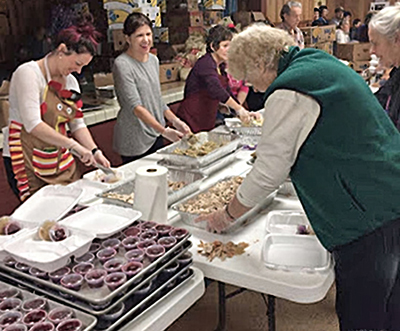
Hands and hearts from organizations and families across the Upper Valley makethis high-yield service feat possible

Hands and hearts from organizations and families across the Upper Valley make this high-yield service feat possible

Volunteer chefs, students, parish members, area citizens, and financial donors from throughout the Upper Valley provide essential contributions – making it a cross-community act of service.

Len Angelli, a career-long Cardigan Mountain School (CMS) educator, was tapped to direct the process 17 years ago. “Father William Kaliyadan invited me to attend a committee meeting on the Thanksgiving Meal,” he recounts. “The meeting begins, and suddenly Fr. William announces that I am the Director –  in perpetuity.”

Angelli has not looked back. In recent years, 30-40 volunteers have worked behind the scenes on-site – on Tuesday, Wednesday, or Thursday as able; others for a whole week. Some years over a hundred volunteers pitched in altogether.  Angelli himself puts in a sizable amount of hours weeks and months before – while others are still dipping toes into ocean tides and diving into pools.

John Pomeroy, the Volunteer Coordinator for the last several years, takes the entire week off from work. Pomeroy is also the Grand Knight for the Lebanon council of the Knights of Columbus, a global community service organization charged with caring for families in crisis and the elderly. Pomeroy is one of many Knights who volunteer for the Thanksgiving Meal annually, and in many other charitable capacities in Lebanon. The Upper Valley’s four area Knights councils altogether contribute tens of thousands of dollars annually to Upper Valley food banks and Lebanon-based agencies supporting families in crisis. In the state of New Hampshire overall, Knights councils contribute millions annually to charities serving children, families, and the elderly.
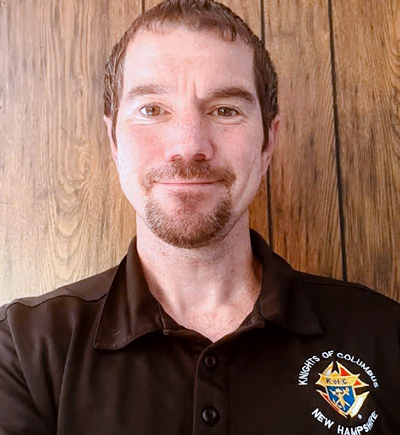
John Pomeroy, Volunteer Coordinator ofthe Thanksgiving Meal for 3 years and
Grand Knight of the Lebanon Knights of
Columbus council, a global community
service organization.

John Pomeroy, Volunteer Coordinator of the Thanksgiving Meal for 3 years and Grand Knight of the Lebanon Knights of Columbus council, a global community service organization.

Pomeroy, a citizen of Lebanon for 14 years, is a network engineer by day, developing blueprint schematics for the crews of Consolidated who lay fiber optic cable.  A military kid to a career Marine Corps officer pilot, Pomeroy has lived on both the West and East Coasts of the United States. He also served in the Marines. “Our Lebanon council volunteers throughout the year wherever we are needed. The Thanksgiving Meal program is certainly a well-oiled machine,” he describes. “An incredible system.”

He paints a picture of chefs at Dartmouth Health, Alice Peck Day, Kimball Union Academy and CMS preparing and delivering food back to Sacred Heart. Innumerable restaurants, grocery stores, banks, and families give hefty sums and provisions. Pomeroy’s three children attend Lebanon public schools. Depending on one’s experience in the military and with parenting, life post-military as a father and community service leader has been more peaceful. He knows first hand it takes a village to raise kids – and take care of the elderly.

“Roughly 60% of the volunteers are not from the Sacred Heart parish,” he notes. Pomeroy is quick to pay tribute to the employees at Dartmouth Health and Alice Peck Day who read the posted flyers and call in to volunteer each year; to Paul, a local mail delivery driver, who volunteers annually; and to Jorge, a volunteer who, for years, created the vast driving routes for all meal deliveries.  Lastly, Angelli credits Father Charles Pawlowski, who pastors at Sacred Heart, whom Angelli describes as “my rock.” Fr. Pawlowski also serves as Executive Director behind the scenes, shaping the program’s direction and vision.

This coming-together demonstrates love in action, a full unity of hands giving to bodies and hearts most in need.
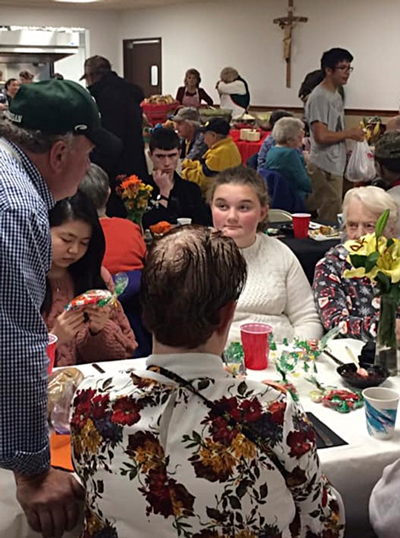
Len Angelli has directed the ThanksgivingCommunity Meal for 17 years running.

Len Angelli has directed the Thanksgiving Community Meal for 17 years running.

Ryan Sinclair, who along with Angelli, has been a career-long educator at CMS, brings a dozen young men annually to volunteer. These international students of ages 11-15 under Sinclair’s own program, develop hands quick to serve others less fortunate.

How do Angelli and Sinclair culminate the high-intensity week of Thanksgiving orchestrating a large scale food operation and mentoring youth on leading by serving?

By sitting down with their international students over a traditional Thanksgiving meal in a home setting –  perhaps a once-in-a-lifetime chance for kids who might soon be returning abroad following boarding school.

After the two educators finish sharing this time-honored American tradition, they start a campfire for the boys.

A campfire on Thanksgiving…?

Why not?

Sinclair is no stranger to crafting memorable experiences for youth. He watched his own parents devote themselves to teaching as well. Sinclair arrived in the Upper Valley in the autumn of 1998 to study at Dartmouth and played Division I hockey as a forward. Originally from a small town in northern Ontario, Sinclair became close with his Dartmouth teammates, many also Canadians. Four years later, Sinclair graduated with an Ivy League degree and a season under his belt studying in South Africa. But he refused to join his best friends in New York City, Boston, or San Francisco where high-yield corporate careers beckoned. This regardless of the scale of that track’s possibilities, a path reserved for elite higher education all-stars, considered by many the penultimate opportunity, nearly guaranteeing an elite lifestyle.

Where does he stand today on this choice?  “I feel genuinely happy,” reflects Sinclair. Sinclair has lived on the boarding school campus in Canaan with his wife, Sarah, and two pre-teen boys for all but two years of their marriage. Early on in their relationship, the couple spent those two years out of the Upper Valley in Grenoble, France to obtain his MBA, funded by a Rotary scholarship.

Though rooted here throughout his adult years, Sinclair has explored across 70 countries. During the much awaited summer holidays when other educators are catching their breath and families are packing for vacations or camp, Sinclair packs his passport and kisses his family farewell. Since 2009 he has directed his own month-long operation that has grown by leaps and bounds: a South African service and cultural exploration trip; also through his brain-child program, Ivy Leader.
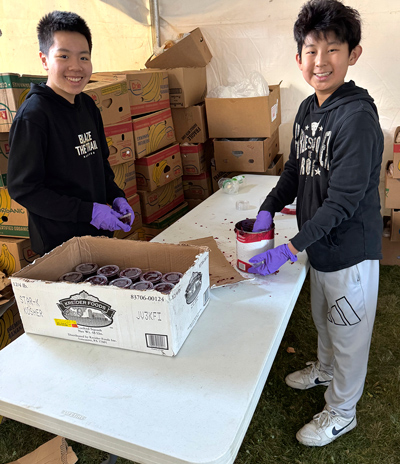
Ivy Leader’s international students wrap up their volunteering experience with a home-style Thanksgivingexperience... and a campfire.

Ivy Leader’s international students wrap up their volunteering experience with a home-style Thanksgiving experience… and a campfire.

His program’s students safari one week and serve young children in disadvantaged schools the next.

So serving in Lebanon is the tip of the iceberg for these “future leaders” that Sinclair mentors; Serving in Lebanon one season and in South Africa another— as though the limits of one’s impact are but a mental construct.

Seven years back, Sinclair received the Distinguished Class of ‘02 Award by Dartmouth College, in recognition of service to others.

Altogether, Sacred Heart parish members, international middle schoolers, and other volunteers come out in large numbers to spend hundreds of hours dicing, baking, packaging, and cleaning. One full day is devoted to simply roasting, deboning, and packaging turkey. Calls used to be put out to Catholic church parishioners from Lebanon to Enfield and Canaan and beyond to take home a turkey from Sacred Heart to bake and bring back – or to provide a homemade pie – or three.  “We used to make homemade stuffing and pies, too,” Angelli remembers.

Because Sacred Heart’s food delivery service was stretched beyond capacity for several years running, it became necessary to streamline the process. As such, the program began soliciting donations of baked goods and rolls. Angelli also began using donations to purchase pre-made mashed potatoes and squash.

Still, how is this grand-scaled operation feasible? “A refrigerated food truck rests outside Sacred Heart for a full week,” Angelli shares. Various mechanical systems can make refrigeration possible while a vehicle engine remains off. Now, senior centers throughout Lebanon and West Lebanon receive an abundant meal of mashed potatoes, stuffing, cranberries, squash, desserts, rolls, and main course items.

Though Angelli organizes and directs the bulk of this colossal operation himself over a four month stretch, a bedrock of parish members and community members return annually. Altogether, he recognizes, “we at Sacred Heart couldn’t do it without the full community’s support.”

Note: Sacred Heart Catholic Church is always looking for volunteers and donations. Please contact Len Angelli at mailto:langelli@cardigan.org to support the cause financially or logistically, as an individual, family, organization, or business.

Share:
Reading time: 7 min
All, Cover Story

Striking at Success on the Playfields: Lacrosse Club Propels Local Athletes to High Levels

March 5, 2025 by Isabella R. Vanasse No Comments
Coach Taylor Miller and Lebanon resident, Caroline Knittle.

In the spring of 2022, the former director of the local girls athletics program, Echo Lacrosse, announced she was moving out of the area. When parent and educator Vicki McCorkle heard this, she immediately stepped up to the plate. She knew she wanted her three young daughters, and the broader Upper Valley community, to continue to benefit from a competitive youth lacrosse program. “I’ll do whatever it takes,” McCorkle had reported to the former director, expressing her intentions to keep the program going.

So after Vicki McCorkle expressed her willingness to lead, the former Echo Lacrosse director “paired [me] up” with another parent and educator, Kim Higgins, she says. Higgins had played Division I college lacrosse at Virginia Tech.

Morgan Fitts and Vera Linter at Echo Lacrosse summer camp in Lebanon.

Morgan Fitts and Vera Linter at Echo Lacrosse summer camp in Lebanon.

Higgins became the new head coach of the Lebanon-based program, while McCorkle became its director of operations. Like McCorkle, Higgins is also a mother of three growing daughters, so they had seen each other on the sidelines from afar prior to their newfound partnership.

McCorkle attests that Higgins has become “a friend I never knew I needed…We both saw the value in this program to the community.” Both have certainly shown unflagging commitment to Echo Lacrosse. Over the years, it has grown from a small exclusive program, serving primarily the Hanover and Norwich communities, to an organization that draws girls and boys from all over the Upper Valley, including seven towns last season, with many players hailing from Lebanon.

The expanded program now offers year-round programming for girls in grades 3-12: from a club team in the spring, camps in the summer, Sunday drill sessions in the fall, and indoor skill development in the winter, to keep development of technical skills sharp. Boys in grades 3-12 now too benefit from a high level of competition and offerings three seasons a year, including camps, fall Sunday drills, and competitive spring club teams, with all play rooted in New Hampshire.

In the winter, girls’ programs practice indoors at the CCBA (Carter Community Building Association), a nonprofit recreation and fitness organization in downtown Lebanon. Why continue with lacrosse in the winter if girls are already committed to their ice hockey or basketball teams? To Nordic or Alpine skiing organizations? Higgins paints the landscape: The sport of lacrosse is growing in regions of the country, and world, with prolonged outdoor play. “It’s an incredibly technical sport in terms of hand-eye coordination,” she says. “If you’re able to play lacrosse year long, you have a technical advantage.”

In the warmer months, athletes practice on the CCBA-owned fields behind the brick and mortar facility. CCBA “has become a pivot point for us,” explains Higgins. “It’s centrally located, so people can see what lacrosse looks like out here on the fields…there’s still a lot of people who don’t know what lacrosse is…and the staff have become a great partner supporting us any way they can.”

Team cheer at the end of practice.

Team cheer at the end of practice.

But Echo Lacrosse is more than a recreation outlet for Lebanon youth and their neighboring p eers. The organization’s directors have aimed to develop an extraordinarily high level of competitive play that stays as local as possible – a gem of an offering these days.

Competing on a club team for young athletes of the Upper Valley typically requires families to commute to Manchester or Boston, just for practices. Club team travel for away-games stretches to the far reaches of the Northeast: for lacrosse, the hotbed communities are Maryland, Philadelphia, and Long Island. Game and tournament travel to these locations, or Florida or Texas, typically occurs eight to a dozen times annually.

That’s why Higgins and McCorkle set as a top intention for their program to provide local lacrosse players with a high level of competitive play and multi-season skill development within their own broader Upper Valley community.

Enter Echo Lacrosse’s spring club program: Echo’s primary season of operating center-stage. The eight boys’ and girls’ Echo Lacrosse teams compete against other New Hampshire club teams through the New Hampshire Youth Lacrosse Association (NHYLA). Echo hosts its home games at the Kimball Union Academy (KUA), also a fairly central location for its Lebanon High School, middle school, and elementary athletes.

“It’s been a labor of love,” recounts McCorkle. Beyond serving their daughters, McCorkle and Higgins have been able to help Upper Valley families stay in Lebanon and Meriden for a high-level of competitive play during the travel club season, and in keeping their hands on the stick in the off-season.

Juggling eight spring teams and year-round programming, Higgins and McCorkle are far from a two-woman show. Many layers of collaborative and selfless contribution have watered and fed Echo’s profuse and quality expansion. Higgins and McCorkle are quick to spread the credit around the table: Higgins opens by noting, “We inherited a very nice program.” What’s more, Echo receives a steady amount of support from a vast and impressive array of coaches, guest speakers, and supporting organizations, such as Lebanon’s CCBA and Empower Lacrosse.

Yes, Echo Lacrosse skillfully “leverages” the incredible array of coaching and educational resources within the Upper Valley community. But much more than this, Higgins continues, “in this community, there’s a lot of willingness: [people routinely ask] ‘how can we help?’”

For instance, Echo has benefited from a cast of coaches that includes former and current Division I players – from Dartmouth College and elsewhere – former high school players, and expert teachers: Taylor Miller, for one, a current medical student at the Geisel School of Medicine and graduate of West Point. She played goalie on the military university’s Division I lacrosse team and now presently coaches goalies for Echo Lacrosse.

The diversity of contribution has also come from local sports psychologists, who talk to the players about balance and emotional well-being, and coaches who are trained or experienced educators – who know the ”science of learning.” Higgins clarifies, “educators know that learning a technical skill like lacrosse is not a linear path. There are plateaus, there are dips when new skills are acquired.” Even more than this, the Echo Lacrosse directors work to educate their experienced lacrosse coaching staff with teaching principles, and their experienced educator coaching staff with the principles of the game. “We have a good balance [of type of coaching expertise] on most of our teams,” Higgins describes.

Support has also come from the distinct complementary organization, Empower Lacrosse, which exists exclusively to offer financial support to Upper Valley players, and their families. Proof of income is not even required. According to Higgins and McCorkle, the Upper Valley Lacrosse community really wants everyone to be able to play lacrosse.

Empower Lacrosse is not the only player committed to keeping the sport financially accessible. Echo itself recently paired up with CCBA to offer a gear swap to make “this expensive sport accessible to everyone.” Higgins continues to marvel at the behind-the-scenes collaboration: the dynamic with CCBA and Kimball Union has always been one of mission-oriented problem-solving, she reports. “The conversation with them will start with the query, ‘we’re thinking about …a gear swap (for instance); there’s a need…’ So we sat down and had a problem-solving meeting.” The response is always unequivocally, “‘sure, let’s think about this.’”

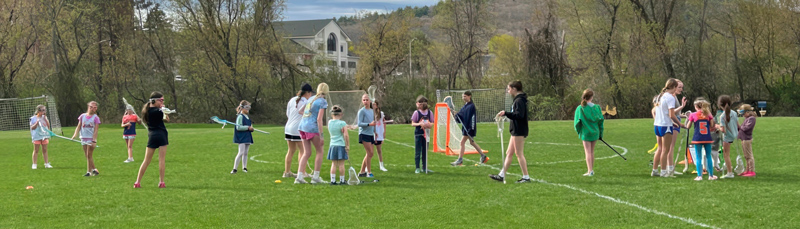
Echo Lacrosse practicing on playing fi elds at the CCBA in Lebanon.

Echo Lacrosse practicing on playing fi elds at the CCBA in Lebanon.

Another noteworthy contribution from the leadership at CCBA has been to support Echo’s three weeks of half-day summer camps by partnering to provide wraparound childcare.

For their own part, Higgins and McCorkle strive to collaborate beyond Echo’s domains as well. When winter snow flurries begin to fly, Higgins and McCorkle reach out to query how to best support the high school lacrosse teams during Echo’s off-season development program. Higgins recounts, each year at this time, “[We] contact the high school coaches to ask, ‘How can we support you? Is there any [specific skill] you need us to work on [with] your players? How can we help your players get ready?’” What other types of support do your players need?

This cycling back to reflecting on how to best support the personal development of young athletes weaves throughout this interview for the Lebanon Times. McCorkle opened our evening’s conversation at CCBA musing, “We talk about this a lot. How to help each child develop not just as an athlete, but a person and a friend.” Higgins concurred: “We focus a lot on the intangibles…We encourage whatever [activities] a child is interested in…We also talk about how to hold each other and ourselves to high standards, standards of excellence…in a non-confrontational way.”

The focus and commitment of Echo’s second phase, with McCorkle and Higgins at the helm, has paid off: in their community-wide relationships, their friendship and professional collaboration with one another, their impact upon countless Lebanon youth, in the saving of innumerable Lebanon families from extensive driving beyond state limits; and not least of all, with the successes of their own daughters on the lacrosse field.

Lena Braga and Maddy Pearce at Echo summer camp in 2024.

Echo Lacrosse practicing on playing fi elds at the CCBA in Lebanon.

Higgins’ eldest, Sadie, is beginning her first year playing lacrosse for the Naval Academy. Her middle, Maggie, is a junior lacrosse player at Holderness Academy. The youngest daughters of both directors, Campbell and Clare, play on the eighth grade teams and help with the younger Echo Lacrosse groups.

McCorkle’s middle daughter, Allie, is a current player at the University of Colorado, another hotbed lacrosse region of the country. McCorkle’s eldest daughter, Maddie, just completed her tenure as a standout on the starting roster for Duke University, her father’s alma mater. She’s now working toward a master’s degree at the University of Virginia, studying public policy, with an interest in sports leadership. Maddie looks at sports philosophy underpinnings: how to help all players, not just the standouts, to feel belonging?

Both McCorkle and Higgins, as current and former educators, both know the importance of respectful and positive interactions. At the Ray School in Hanover, where McCorkle is a speech language pathologist, the philosophy of respectful interactions predominates their educators’ perspectives: at the Ray School as at Echo, “How can everybody feel seen? Everybody [needs to] get a greeting …Every single person should get a touch point, (for example) ‘I’m so glad you’re here,’ explains McCorkle. “People need to feel seen and valued for more than being …the best [at a sport].”

The focus on steady service, focused contribution, and the whole child’s well-being seems to be bearing fruit for many.

When Higgins observed the girls arriving at the first session of the winter program, returning to Echo Lacrosse and CCBA after a month away, she heard exclamations of greetings between not just teammates, but friends. “We’re building something special.” McCorkle nods in agreement: “you get a sense we’re their people. We are their community.”

“It’s about so much more than lacrosse,” McCorkle summarizes. “It’s about community and learning about yourself, as a person and a teammate.”

During all seasons of the calendar, from the neighborhood gym and fields of CCBA, young Lebanon athletes are maneuvering, spinning, pivoting, and stretching their lacrosse sticks – and spirits – towards their goals, and their own personal best.

Share:
Reading time: 9 min
All, Miscellaneous

Running Ahead to Win Together

June 6, 2023 by Isabella R. Vanasse No Comments

In 2008, Paul Coats discovered a trail running race in Newport, NH that caught his attention. The longtime director of the Lebanon Recreation, Arts, and Parks Department – and a serious runner himself – Coats knew competitive athletes expect professional timing and precise distance measurements. These quality characteristics found at the Newport Recreation trail race were usually reserved for events abutting metropolitan areas. In a few short years, a wide-ranging host of trail and road running events for all ages and abilities would be brought to the Upper Valley, in large part thanks to Lebanon Recreation, Arts, and Parks.

In the early 2000s, trail-running competitions nationwide exclusively spanned lengths far beyond that of a marathon. Significantly more lengthy – and technical – trail running “ultras” made road marathons look like speed walks in the park.

Coats joined forces with fellow competitive runner Chad Denning, former associate director of Hanover Parks and Recreation. Coats recounts, the two had “become fast friends as work colleagues, and were dedicated to collaborative programming that would inspire people to play outside.”

Denning had built a repertoire of race-directing acumen while working and racing in Colorado. They networked with current and former Newport, Claremont, and Sunapee directors, P.J. Lovely, Scott Hausler, and Jon Reese, respectively, to create the Western NH Trail Running Series. “It was truly a collaborative effort from the beginning,” explains Coats.

The Western New Hampshire Trail Running (WNHTR) Series – primarily of four to eight-mile races – culminates on September 23rd with Lebanon’s Farnum Five, held uphill from the Lebanon Police Department Headquarters and across the street from Poverty Hill Orchards – a venue that opens runners and supporters following the race.

Sadly, Denning died just a few years after these collaborative efforts bore fruit. Aged 39 at the time, this local legend has been duly honored by subsequent race directors. 

But the spirit of race directing that Coats and Denning ignited in Lebanon and the surrounding Upper Valley region still lives on. “It’s incredible what happens organically when the right people… come together,” reflected Coats, because their story of collaborative event planning was just warming up. 

Within one year after the inception of the trail running series, the Upper Valley Running Club was born. Two years later, that club launched a series of road races certified for professional timing and accurate race lengths. For both, Lebanon Recreation was behind the scenes – the discreet linchpin and financial account holder. 

An original and ongoing Board member of the Upper Valley Running Club and Upper Valley Running Series Coordinator, Geoff Dunbar, recalls, “Paul stepped up and said, ‘You can be a program [of Lebanon Recreation].”

Dunbar explains that this type of marrying is “very unusual.” According to Dunbar, Coats offered insurance and registration through Lebanon Recreation. It was a similarly supportive conversation with starting the racing series.

UVRC members pause for a pre-race photo at the Shamrock Shuffle

Although “Lebanon has taken a leadership role, Lebanon is not in the name of any of these programs,” explains Coats in characteristic, tell-tale humility. “We take pride that we take part…But we’re not so prideful that we have to be one-on-one associated,” with originating or continuing to support these wide-ranging events and programs. 

This season, Lebanon hosts the Upper Valley Running Series’ four-miler Skip’s Run on June 18th and the 10k Downriver Rail Run on October 7th.

To wrap in more participants, the thriving running club launched another successful offering – the “Couch to 5K” program. “We help anyone [run],” exclaims Dunbar. 

Originally an opportunity for individuals to safely begin a fitness regimen with coaching support, the Couch to 5k program provided a critical community for individuals otherwise isolated during the pandemic. 

“Anytime you’re bringing [together] a group of people, [the shared passion] crosses all those boundaries of who you vote for, any other civic organizations you’re in, [or]…what high school you went to,” Coats says. 

And that experience is meeting the objectives Lebanon Recreation set out to achieve: “Our objective, our mission,” according to Coats, “is to build community in Lebanon.” And more than that even: “We want people from the bigger metropolitan areas to think, ‘I can move to that area…and call it home.’ That’s part of our charge.”

These programs, labors of love, fruits born of countless hands, started from the tipping point of just a few. As author Malcolm Gladwell explains, the influence of even one individual can be understatedly powerful. “I do love what I do,” admits Coats with a smile. And it shows.

Share:
Reading time: 3 min

Our Latest Issue

The Lebanon Times is delivered to every mailing address in Lebanon.

  • Subscribe at an out of town address!
  • Pick up a copy!

© 2024 copyright Greater Good Media. All rights reserved.