Home
Our team
Content
    Cover Story
    All Articles
    Animals Rule!
    Around Town
    Cityscapes
    Community Impact
    Elder Profile
    For The Love Of It
    Good For You
    Goodness InDeed
    Green Page
    History
    Local Sports
    Meet your Neighbor
    Miscellaneous
    Spotlight on our Sponsors
    The Arts
    Your Green Spaces
Advertise
Archives
Donate
Contact


The Lebanon Times - Good people, good places and good things happening
  • Home
  • Our team
  • Content
    • Cover Story
    • All Articles
    • Animals Rule!
    • Around Town
    • Cityscapes
    • Community Impact
    • Elder Profile
    • For The Love Of It
    • Good For You
    • Goodness InDeed
    • Green Page
    • History
    • Local Sports
    • Meet your Neighbor
    • Miscellaneous
    • Spotlight on our Sponsors
    • The Arts
    • Your Green Spaces
  • Advertise
  • Archives
  • Donate
  • Contact
All, History

The Architect of Lebanon and Pomona: Ferdinand Davis

June 7, 2026 by Nicole Ford Burley No Comments
A black and white historical photo of a city street with a large building in the background. There are several cars parked along the street, and a clock is visible in the foreground.

On May 30, 1886, the cornerstone of the Soldiers Memorial Building on North Park Street was laid, initiating construction of the remarkable building designed by Lebanon architect Ferdinand Davis. It was an important milestone for the architect; it had taken five years to raise enough money to start construction. More importantly, however, the architect was a veteran of the Civil War, and the Soldiers Memorial — believed to be the first such building in New Hampshire — was built to honor him and his fellow veterans.

A man with a beard and mustache is wearing a suit and tie.

Ferdinand Davis, 1880 (Lebanon Historical Society)

Ferdinand Davis was born in Maine in 1840 and as a young man trained as a carpenter. He first came to Lebanon at the age of 18 in 1858; two years later, he enlisted in the Union Army and fought in the 7th New Hampshire Infantry Regiment. After the war’s conclusion Davis returned to Lebanon and married Eliza Thompson. Though carpentry work must have been plentiful in Lebanon’s post-war industrial boom, Davis wasn’t content with his line of work, and he eventually spent a year in New York City studying architecture.

The Soldiers Memorial may have been Ferdinand Davis’s highest profile work in Lebanon, but it wasn’t his first or only design in town. In 1881, he drew up plans for the Whipple Block at the corner of West Park Street and Hanover Street (today the pedestrian mall). That same year he designed a state-of-the-art mill for Frank Kendrick and the Mascoma Flannel Company — Lebanon’s first woolen mill, and the only one to survive the 1887 fire that destroyed most of the central village. Davis’s mill has been substantially enlarged over the years, but it still stands as part of the Rivermill Complex on Mechanic Street.

By 1884 Davis was designing buildings outside of Lebanon’s borders, including the Union Block in Bradford, Vermont, and an elaborate Queen Anne house for Horace Pease in Hartford, Vermont. Union Block, Bradford’s The United Opinion extolled, was “one of the handsomest and most commodious buildings to be found in this section of the state.”

Ferdinand Davis’s growing architectural success in the Upper Valley abruptly ended in 1887, however, when Ferdinand and Eliza moved to Pomona, California. At the time, Pomona was home to fewer than 4,000 residents (roughly equivalent to Lebanon’s population), and the town wouldn’t be incorporated until the following year. The rapid growth of southern California at the beginning of the 20th century quickly made Pomona an attractive place to be, however, and Davis’s architectural career soared in his new community.

A large building with a flag on top of it.

Lebanon Soldiers Memorial, 1911 (Lebanon Historical Society)

Only two years after settling Pomona, Davis designed the city’s First National Bank. His architectural style and talent must have suited the region, and Davis produced a bevy of buildings throughout southern California over the next three decades. Among his many designs were the Seventh-Day Adventist Church (1895), Currier House (1907), Barbara Greenwood Kindergarten (1907), Orange Grove Meeting House (1908), Pomona Masonic Lodge (1909), Pomona City Stables (1909), Pilgrim Congregational Church (1910), Pomona Ebell Clubhouse (1910), and several residences in the Lincoln Park neighborhood. Many of these structures remain striking and historically significant buildings, and several are listed on the National Register of Historic Places.

Ferdinand Davis passed away in Pomona at the age of 81. Upon his death, The Pomona Progress claimed that Davis “drew plans for every business block on the north side of Second Street from Garey Avenue to Main Street.” Nearly two decades later, the paper further observed that “more of the public buildings, office structures, and residences of the valley were designed by him than by any other man.” While the same cannot be said of Davis’s work in Lebanon, it’s hard to imagine three more significant structures to carry on his legacy in Lebanon than the Whipple Block, the Mascoma Flannel Mill, and the Soldiers Memorial.

Share:
Reading time: 3 min
All, Cover Story

Water for Elephants: Presented by LHS Wet Paint Players and Upper Valley Circus Collective

December 11, 2025 by Lisa Lance No Comments

The Wet Paint Players, Lebanon High School’s drama club, is  partnering with Upper Valley Circus Collective (UVCC) for its production of “Water for Elephants.” The show will be performed December 5-7 at Lebanon Opera House.

Set during the Great Depression and told through memories and flashbacks, this musical adaptation of the 2007 novel by Sara Gruen tells the story of student veterinarian Jacob Jankowski who joins a circus and falls in love.

Charli Swan

Charli Swan

The show is brought to life through a mix of acting, vocals, choreography, and circus elements. For the past few months, the students have split their rehearsal times between Lebanon High School and Northern Lights Gymnastics in White River Junction.

“When I found out we had plenty of kids in the school that do circus, I got really excited,” said Shannon Aridgides, Lebanon High School’s music and theater teacher and the show’s director. “These kids really do circus. We’re talking silks and lyras and crazy acrobatic and aerial stuff.”

“Our coaches are amazing,” said Meg Tenney, director of Upper Valley Circus Collective. “We have a bit of a tag team. They’re all either professional performers or in a professional program themselves right now.” She said three coaches did the choreography for the first 10 weeks and two coaches will oversee safety and rigging changes. “We have a large team behind all of this.”

“Wet Paint Players has never partnered with another group like we are with UVCC,” said Ollie Hermanson, a senior at Lebanon High School and the show’s stage manager. “This is brand new, and it allows us to explore this territory and open up new opportunities in the future.”

Creating Community

Although this is the first collaboration between the Wet Paint Players and Upper Valley Circus Collective, many of the students in the show have been involved in theater or circus arts for years.

Blaise Yuan (pointing) playing August and Sam Smith (R) playing Jacob and cast

Blaise Yuan (pointing) playing August and Sam Smith (R) playing Jacob and cast

Junior Rachel Horak started attending circus camps when she was seven or eight years old. After a five-year break, she got involved again and is happy she did. “It’s my favorite place to be,” she said. “I love to move, and I love when people get to watch us and be amazed. It feels really cool.”

Sophomore Gardell Wetherington started in theater and then found circus at the age of 10. “I just like the idea of getting to do what I love and then sharing it with people who go to the show,” he said.

This is Blaise Yuan’s first theater production. “I do it because my friends are doing it,” he said. “And I thought it’d be fun.”

“Community is a really big part of it,” said Hermanson. “It’s such a tight knit community, we’ve become basically like family.”

Junior Caroline Cloud, who has been doing circus for nine years, agreed. “My favorite thing about rehearsals is getting to be with everyone,” she said. And her favorite part of performing? “Getting to show everyone what we worked so hard to do.”

A Pioneering Production

The high school version of Water for Elephants only recently became available for production in the fall of 2025, so Lebanon High School is one of the first schools to perform the show.

Abigail Tremblay and Blaise Yuan

Abigail Tremblay and Blaise Yuan

The script offers suggestions for incorporating circus elements, but it also allows for a lot of freedom depending on a school’s available resources.

Aridgides said the first few pages of the script offer guidance for staging the show, but it’s not prescriptive. “It says this is a memory play, Mr. Jankowski is remembering things, so it can be abstract,” she explained. “We understand you’re a high school, we understand you’re all from different places with different opportunities. Maybe it’s your local gymnastics team, and that’s what you’re going to showcase… We do have circus people and, not only that, they’re good.”

“Do they say the silks or the lyra or the tumbling pass will be here? No, but it lends itself perfectly to it. It’s a perfect marriage,” said Susan Lamontagne, the show’s choreographer.

“I think it’s really, really cool that we get to do something new and especially something so cool that we get to invite the UVCC circus and get to work with them,” said Abigail Tremblay, a senior. “It’s a little challenging at times, though, with so little character studies, never having seen the show, and then not having many references to go off of. It’s a lot off the top of your head. A lot of research. I’m digging around for interviews on the actors and characters to work on certain scenes. But it also feels kind of special, and I really like that.”

Junior Sam Smith agreed. “Since the only people who have performed this were on Broadway, we don’t have a lot of information on how the show actually works, which is bad but it’s also good because we can make it our own,” he said. “Especially with all the circus stuff… we can do cool, special things because there’s no rules.”

The performers all have their favorite parts of the production.

For Tremblay, it’s the music. “I feel like there’s not enough folk and bluegrass on Broadway, especially not in high school shows,” she said. “I feel like it’s underrated. I love every single banjo moment in this piece, but I also like that it dips into a rocky feel sometimes when it gets angry. The composition is so amazing.”

“I really like to see how everything grows and grows and grows,” said Simon Trussell, a junior.  “We start out with nothing. Just like, what show is it going to be? Then we’re casting the actors, and we’re learning the songs, bringing in the props, getting the costumes, and then we’re getting on stage. And it’s really cool to see little by little how we’re building this whole show up from scratch more or less. That is awesome.”

“I’m so excited for the audience that isn’t really ready for the circus stuff to be so amazed,” said Horak. “I really hope it gets more enjoyment in circus in general, because I think circus is really cool.”

Something for Everyone

“I picked the show because once I knew we had the cast for it, it has something for everyone,” said Aridgides. “You can be someone who hates musicals and you can still have an awesome experience with the show.”

Meg Tenney, Shannon Aridgides, and Susan Lamontagne

Meg Tenney, Shannon Aridgides, and Susan Lamontagne

Tenney has read the book twice and loves the story. “I’m the sappy one – as soon as the show starts, I’m going to cry,” she said. “The end of this show really gets me every time.”

Smith appreciates that the show allows many performers to take the spotlight. “Oftentimes with musicals it focuses on three or four people and everyone else is an ensemble, but I feel like in this musical there’s at least 10 people who all get their own song and get to show off how really good they are at acting,” he said.

“No matter what scene, no matter where you’re sitting, there’s something everyone will enjoy,” said Hermanson. He described a typical scene that includes dancing, singing, and circus, all while platforms and lighting are moving and changing. “Even if you’re not a theater lover, even if you’re not a circus lover, there’s something that you will enjoy on stage.”

Lamontagne said one of the most rewarding parts of this production has been working with the students. “Getting to work with kids that are young, relatively inexperienced and getting to teach them steps, musicality, characterisms, some of the things they’ve learned through circus, and watching their confidence in themselves grow, watching them start to create these characters and become the show – watching it build, for me, will always be the most wonderful thing to be a part of,” she said.

Many of the students in the show have been involved in theater or circus arts for years.

Many of the students in the show have been involved in theater or circus arts for years.

Presented by Lebanon High School’s Wet Paint Players and Upper Valley Circus Collective, Water for Elephants will be performed at Lebanon Opera House on Friday, December 5 at 7 p.m., Saturday, December 6 at 7 p.m., and Sunday, December 7 at 1 p.m. Tickets, by donation (suggested $5-10 per person), will be available at the door. Cash and check accepted.

For more information, visit: lebanonoperahouse.org/events/water-for-elephants.

Share:
Reading time: 7 min
All, Cover Story

Lions Club Members Want To See… How Lebanon “Decks The Halls” This Christmas Season

by Frank Orlowski No Comments

Chances are we’ve all viewed that hilarious scene in National Lampoon’s Christmas Vacation in which Clark (Chevy Chase’s character) connects the extension cords and illuminates his house with 25,000 Christmas lights, with which he painstakingly decorated the exterior. Clark’s lighting display temporarily blinded his neighbors, caused the electric meter to go into overdrive, and likely could be seen from space.

Now none of us have the time, patience, or forgiving neighbors (let alone the funds to cover that December electric bill) to match Clark Griswold’s extravagant light show, but many of us do enjoy having a more modest lighting display over the holiday season. After all, when it gets dark at 4:30 in the afternoon, who doesn’t like a little extra exterior lighting?

Roadside pick-up crew: (L-R) Mark Kimak, Peter Bickford, Paul Dalton,Tom Zuttermeister, Chris Herring, Catherine Herring, and Geoff Tomlinson

Roadside pick-up crew: (L-R) Mark Kimak, Peter Bickford, Paul Dalton, Tom Zuttermeister, Chris Herring, Catherine Herring, and Geoff Tomlinson

The local Lebanon-Upper Valley Lions Club sure does, and they’re proving it by offering their first-ever Holiday Light Display Contest during the month of December. The Lions are challenging residents and businesses in Lebanon and West Lebanon to decorate their dwellings, offices, and stores in their holiday finest, featuring festive lights and accompanying decor. Photos of the displays then may be sent to the Lions, and a committee of Lions members will choose the winner and two runners-up.

The idea for this contest originated with long-time local Lions Club member Tom McGonis. His objective in proposing this new contest? “It’s a chance to build community spirit.”

The next step was proposing the idea to the Lions Club members. They proved to be receptive to the idea, so the contest was on. The members feel the contest is a perfect fit for the holiday season. “We wanted to choose an idea that would excite the community and light up Lebanon,” McGonis says.

The rules of the contest are simple and straightforward. Homes and businesses are both open to compete. Decorate the building (and possibly the adjoining yard) with your best holiday decor, featuring a festive light display, take a photo (or photos), and send them via email or the post office to the Lions Club. Club members will then judge the photos, and pick a winner and two runners-up. The three chosen will each be awarded a prize from a local business: Katie’s Cookies of Lebanon is providing the prizes. The contest is only open to Lebanon and West Lebanon homes and businesses, and runs from December 1 to December 31.

Any expectations of how many homes and businesses will enter this contest? “We have no idea, being our first time,” says McGonis, though he adds that the hope is they will have many participants.
Hosting a pizza party for the Lebanon Girl Scouts

Hosting a pizza party for the Lebanon Girl Scouts

Promotion of the contest includes signs and posters around town, news stories in local media (such as this article in the Lebanon Times), and word-of-mouth, says McGonis. As is true with all the programs the Lions undertake, they are always happy to accept corporate sponsorship from local businesses, though, “The contest is not a fundraiser,” he adds.

The Lebanon-Upper Valley Lions Club is involved in a wide variety of philanthropic work and projects. They provide assistance to well-respected Upper Valley organizations such as David’s House, Listen, and The Haven. In addition, they perform community work, such as clean-up on their one-mile stretch of Route 120, and they assist in keeping Lebanon’s fire hydrants clean and working properly during the winter months – so important when winter structure fires occur, and ice and snow can interfere with hydrant operation. Lions members take part in holiday food distribution efforts, and offer scholarships to high school students. They even pair with other organizations in fun and educational events. Tom McGonis says the Lions recently teamed up with a local Girl Scouts troop to put on a pizza party.
Of course, they are involved with the major function of all Lions Clubs – that being assisting with those facing eyesight issues. Eyeglass collection, sight screening and education, support of those providing seeing eye dogs, and financial support for those in need facing vision problems, continues to be a mainstay of all Lions Clubs.
Tom McGonis says the Lebanon-Upper Valley chapter of the Lions consists of, at various times, between 10 and 20 members. Several members have devoted years of service to Lions Clubs; McGonis first became a Lions Club member in 1972, and Paul Dalton, who is involved with the Holiday Lights Contest, also has several decades of service in area Lions Clubs.

This December, whether you’re a Clark Griswold holiday-lights-extravaganza-wannabe, someone who puts an effort every year into a tasteful holiday light show, or someone who’s always wanted to dress up your home or business in a festive holiday light theme, why not be a part of this first-ever Lions Club contest? Again, the rules are simple – your lights display must be in Lebanon or West Lebanon, and you need to send the photos of the display to the Lebanon-Upper Valley Lions Club during the month of December. You may win, “A major award,” (as did the father in another popular Christmas movie), but you will, “show that our community has holiday spirit,” says McGonis. Good luck!

Want more information about the Lions’ Holiday Light Display Contest, or the Lions Club in general? Just visit the Lebanon-Upper Valley Lions Club website.

Share:
Reading time: 4 min
All, Miscellaneous

Lebanon School District: Living our Vision

December 9, 2025 by Greater Good Media No Comments

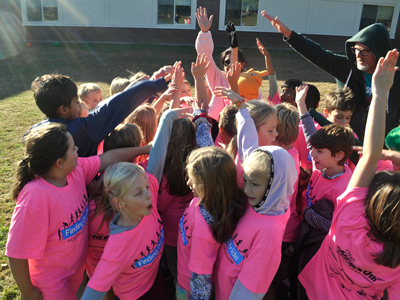
On a brisk, clear fall afternoon, a group of 32 Mount Lebanon Elementary School students huddled up on the playground after practice. On the count of three, they burst into their group motto: “You don’t have to win the race, you just have to be in the race!”

The students, along with their coaches  –  Donna Soucy, Nina D’Cruze, Jon Grobe and Alan Palmer  –  formed Mount Leb’s Finding our Stride team this fall. The nonprofit afterschool program partners with more than 30 schools throughout the Upper Valley (including Hanover Street School) to help kids get active and develop positive traits like resilience and empathy.

“They encourage the kids to run and be active,” Principal Katie Roach said of the coaches at Mount Lebanon. “They play collaborative games and teach social skills to the kids about acceptance, trying hard things, not giving up, and supporting your teammates!”

Finding our Stride is one of the many ways that Lebanon School District students, with the support of their families and our dedicated staff, embody our Vision of a Learner. We are dedicated to educating students who are effective and collaborative communicators, critical and creative thinkers, responsible local and global citizens, and empathetic and resilient individuals.

This vision is the foundation of our Strategic Plan, which we detailed in the last edition of the Lebanon Times. As we approach the halfway point of the school year, here are some of the many ways we are taking action on this plan for guiding our growth as a school community.

Hanover Street School Map Making

Hanover Street School Map Making

Effective and Collaborative Communication

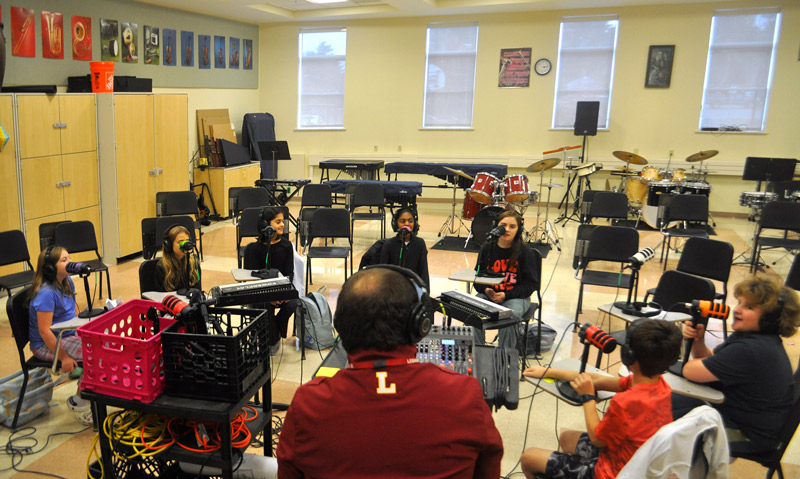
Every Thursday, a group of about 10 Lebanon Middle School students gather after school in the band room for Podcast Club. Last year, the inaugural season of the LMS Podcast featured more than 20 episodes, covering a wide range of topics and a few featuring special guests such as PTO members, school district staff and area leaders.

“Students have liked the idea that they can talk about almost any topic, and learn about different topics they may not be as familiar with,” said Christian Terry, LMS music teacher and the club’s moderator.

Students often talk about their favorite movies, books, sports, or current trends, but recent topics also have included lessons on friendship, what students think their lives will be like in 20 years and what a world without screens would be like.

“Students who might not find their voice in the classroom or on the sports field have an opportunity to do so through this co-curricular activity,” Mr. Terry said.

During a recording session in late October, students also said they like working with the technical equipment used to record the podcast. They added that they are developing public speaking and conversation skills through the club.

“The big takeaway is hearing others’ perspectives, having healthy debate, turn-taking, and listening skills,” Mr. Terry said.

All episodes of the LMS Podcast are available at www.youtube.com/@LMSPodcast/videos.

Lebanon Middle School Podcast

Lebanon Middle School Podcast

Critical and Creative Thinking

Fourth graders at Hanover Street School started the school year with a project that combined social studies and art to help them better understand New Hampshire’s landscape. Each student created a 3D map that ultimately will go on the cover of books students are creating throughout the year showcasing the state’s history.

The project started with sketches of the landscape around Hanover Street School, then moved on to labeling and coloring 2D maps of New Hampshire that highlighted important geological features and landmarks across the state before building a clay model of the state’s landscape. Their next step was casting their models with plaster, which was a great outdoor activity. They wrapped up their project by painting their plaster maps.

Students said they loved the hands-on project, and the sensory experience of working with the clay and plaster. The experience of making their 3D maps allowed them to develop a deeper understanding of the changing elevations across the state. The details they included were unique to each student. For instance, some used color to distinguish the varying elevations. No matter the approach, though, students said the project helped them learn creatively.

Responsible Local and Global Citizenship

Mount Lebanon School Finding our Stride

Mount Lebanon School Finding our Stride

For one Tuesday in late October, 128 Lebanon High School students stepped out of their daily routine, and into the community. They spread to 24 sites throughout the Upper Valley for the school’s annual Day of Work.

The event’s history stretches back more than 20 years, and serves as a fundraiser for the Student Council’s grant fund, which supports co-curricular activities throughout the school.

Groups of students volunteer to help with projects at homes throughout the community, like raking leaves, prepping for winter or moving furniture. Residents who sign up for these services pay by donating to the school.

“It’s a good way to give back to the community because they do so much to help us,” sophomore Claire MacMartin said.

This year, juniors and LHS Council members Mikko Andres and Ian Danen-Lucier returned to the same West Lebanon house where they helped at last year’s Day of Work. The homeowner even called them over the summer to help with some additional yard work.

“It helps build a relationship between students and the community,” Andres said.

LHS Paraeducator Bradley Cantlin, the Council advisor, added, “I think Day of Work is really about the connections they make in the community. That’s really valuable.”

Empathetic and Resilient Individuals

Back at Mount Lebanon School, on the last day of Finding our Stride’s fall season, students are reflecting on the goals they set at the beginning of the program: get better and stronger, set their own pace, build stamina and perseverance.

Their coaches asked, “If we couldn’t do it, what did you tell yourself, or your friends?”

“You can do it,” one student exclaimed. Another chimed in, “Don’t give up, you’ve got this!” While another runner added, “You’re doing a good job!”

After the pep talk, the group took off on a roughly quarter-mile run through the West Lebanon neighborhood surrounding the school. Students who finished first stayed and cheered on their teammates until the very last person crossed the finish line.

“We want students to develop positive feelings about physical activity and perseverance,” Coach Soucy said. “And also, we just want it to be really fun.”

A few days later, many of the students participated in the CHaD Hero race in Hanover, raising money for Dartmouth Health Children’s and the Children’s Hospital at Dartmouth-Hitchcock Medical Center (CHaD).

Across all of its schools, the Finding our Stride program was the top fundraiser for the event, collecting more than $60,000 in donations and helping the event surpass $1 million for the first time in its 20-year history.

Share:
Reading time: 5 min
All, Cityscapes

Participants Go ‘All In’ at Lebanon’s Citizens Academy

by Lisa Lance No Comments

Corinne Alfeld

After moving from Silver Spring, Maryland, to West Lebanon in 2021, Corinne Alfeld and her husband, Greg Ericksen, wanted to get involved in the community and learn more about their local government. The Lebanon Citizens Academy provided the perfect solution.

© Christopher Johnson

© Christopher Johnson

“Because New England states are run so differently from other states I’ve lived in, and because I was interested in how a small city operates, I jumped at the chance to participate in the Lebanon Citizens Academy,” said Alfeld. “After the first session, I was so excited about what I was learning that I convinced my husband to attend, as well.”

Participants met weekly to learn about different city departments, such as City Management, Library Services, Public Safety, and Recreation and Parks Services.

“It was a great group of people, mostly long-time residents but some newcomers, and a range of ages,” said Alfeld. “The employees of the City of Lebanon were all so knowledgeable about their areas. The expertise of the water management staff was especially impressive! And did you know that Lebanon has 99 miles of roads to upkeep?”

“I feel really lucky to live in a place with such dedicated city employees, who keep everything running smoothly,” Alfeld said. “Residents sometimes complain about things, but they don’t know how much work—including budgeting, planning, and implementation—goes into it. I remind myself of that every time I see road work or hydrant flushing going on around the city.”

© Christopher Johnson

© Christopher Johnson

Alfeld emphasized the importance of showing up to each session. “There is so much to learn, and the staff takes time to prepare and be there after hours to provide detailed information about what they do and how they help your city,” she said. “The second piece of advice is to ask questions! Sometimes the most interesting parts of the session were the staff’s answers to participant questions.”

After completing the 2024 Citizens Academy, Alfeld joined the West Lebanon Revitalization Committee in 2025, which has recently focused on repairs to the pipes, roads, and sidewalks on South Main Street. City residents are welcome to attend any of the various Lebanon committee meetings virtually or in person. A calendar and information about meeting access can be found at lebanonnh.gov/1359/Lebanon-Live-Meetings.

Andrew Faunce

Andrew volunteers for the city in many capacities in his retirement

Andrew volunteers for the city in many capacities in his retirement

Andrew Faunce was already involved in the local community in several ways when he enrolled in the Lebanon Citizens Academy, a series of educational, hands-on courses that provides residents with insight into city departments and civic affairs. He volunteers and is a member of the board at AVA Gallery and Art Center, he is chair of the Lebanon Planning Board, and he serves on the Lebanon Housing Task Force and the West Lebanon Revitalization Advisory Committee. “On my retirement, I became invested in volunteering for the city in any capacity that I can,” he said.

His participation in the Lebanon Citizens Academy gave him an even greater appreciation for how the local city government operates. “It really introduced me to how much a relatively small set of city staff does on behalf of the residents,” he said. “I have a tremendous respect for what’s offered here.”

Some of the highlights his cohort experienced included meeting with the Police Department and learning about the K-9 Unit, operating a fire hose and participating in a mock live fire drill with the Fire Department, and visiting the Solid Waste and Recycling Facility and creating a mini landfill out of clay, stones, sand and water.

© Christopher Johnson

© Christopher Johnson

In addition to learning about city operations, he also gained a better understanding of the people on the municipal team.

“There’s lots of ways that folks can not only learn about the departments, but also experience the sorts of things that the folks that work in those departments get to experience, and it just gives you a new perspective on some of your neighbors,” he said.

He noted that the Citizens Academy is a good way to learn more about issues affecting residents and to make contacts to check in with later on. “It’s an advantage of being in a relatively small community, where you can get to know the people that are making the decisions that affect your experience,” he said.

Faunce’s advice for other Lebanon residents considering the Citizens Academy? “If you’ve heard about it and are on the fence about it, by all means apply for it, commit to it,” he said. “It’s a really great experience.”

More information about joining the 2026 Citizens Academy can be found at lebanonnh.gov/220/About-Citizens-Academy.


Share:
Reading time: 3 min
All, Cover Story

Horseshoeing Around: The Lebanon Horseshoe League Finds Camaraderie at Riverside Community Park

October 20, 2025 by Lisa Lance No Comments

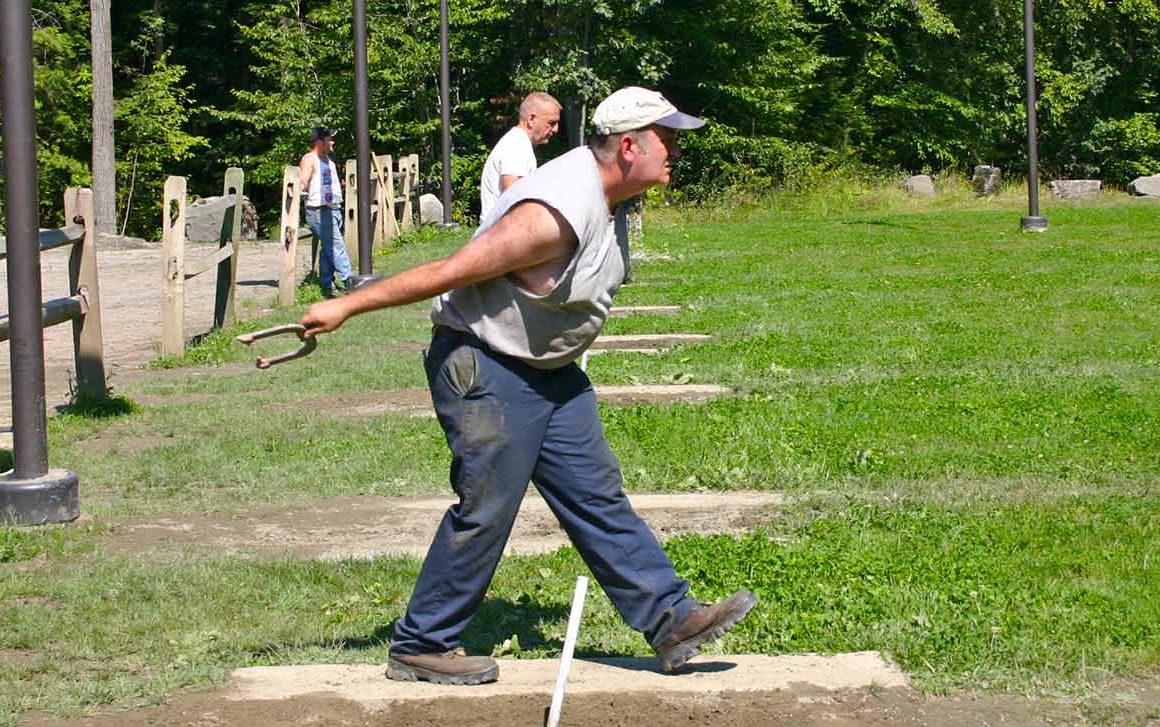
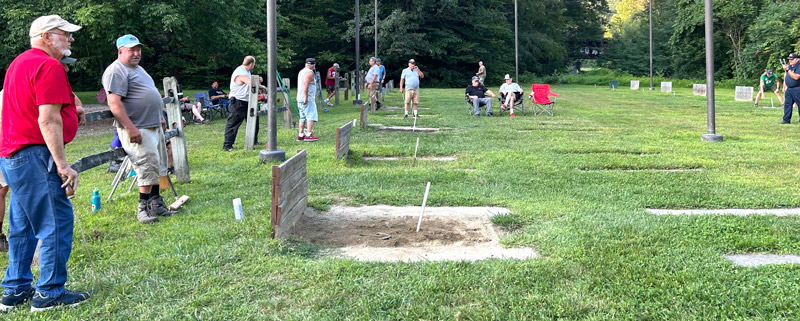
On a warm sunny weeknight in August, a crowd of people gather at the horseshoe pits at Riverside Community Park on Glen Road in West Lebanon. Some people have folding lawn chairs, and others wield long metal hooks for picking up shoes. An enclosed bulletin board houses the weekly team lineup with each player’s average and total shoes thrown, scoresheets, and the club’s bylaws. The pitching platforms in the pits face each other, 40 feet apart. Each has a metal stake surrounded by sandy soil, a wooden backboard, and a cement slab. Laughter, cheers, and the clanking sounds of metal on metal ring out as horseshoes hit the stakes.

Everyone is relaxed and conversational. Sayward “Shep” Shepard, the league’s vice president, said his favorite part about the league is the camaraderie. “We’re friends for many, many years and when something happens with one of our members, whether it be the member or a family of the member, we all pitch in if we can,” he said. “We go to funerals. We step up and support the people we enjoy being with.”

“We’re like one big, happy family,” said Tom Schwarz, the league’s president.

“On top of the camaraderie, which I agree with you on, is the fact that we make jokes across the pits all night long,” added Rick Paul, the league’s secretary. “Because we all realized, yeah, do we want to play well? Do we get angry when we don’t play well? But in the end, we all have to go to work, we all have families, we all have that. And it’s just a game. Everybody shakes hands after a game.”

Why horseshoes?

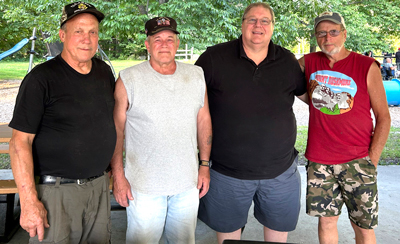
The four offi cers of the league: (left to right) Shep, Tom Schwarz, Rick Paul, Foster Moodie

The four offi cers of the league: (left to right) Shep, Tom Schwarz, Rick Paul, Foster Moodie

“Why not?” said Shep.

“Back in the day when we started, it was the only sport where you could get together like this. Cornhole wasn’t a thing. They were outlawing lawn darts,” said Rick. “I started playing at the age of 11 in my hometown of Belmont. When I came up here, right out of college, I met Shep and we started throwing in the White River league. That was 1985. A lot of us have been throwing a long time.”

The league has six teams of four people each, plus eight subs. The players bring their own horseshoes. “Everybody pretty much has their own shoes that they prefer to play with,” said Shep. Traditional-style horseshoes are flat on one side with three cleats on the other side, and are thrown through the air like a frisbee. Flip-style horseshoes have a reverse center “thumb cleat” and two end cleats, and are tossed end-over-end.

A game consists of 50 shoes thrown by two players and a match consists of four games, so each player throws 100 shoes total. Teams play in a round-robin format throughout the season. The league plays by National Horseshoe Pitchers Association (NHPA) rules, unless they have incorporated changes into the league’s bylaws. Players shoot from 40 feet (the distance between stakes), with a few exceptions. Women can choose to shoot from 30 feet, as can players over the age of 65 or those who have a medical exemption.

Finding a Home in Lebanon

Many league members volunteered their time and skills to help build and prepare the horseshoe pits area (withLebanon Rec’s permission) at Riverside Community Park.

Many league members volunteered their time and skills to help build and prepare the horseshoe pits area (with Lebanon Rec’s permission) at Riverside Community Park.

The sign at Riverside Park says “Home of the Upper Valley Horseshoe League,” but since moving from White River Junction to Lebanon in the 1990s, the official name of the group is now the Lebanon Horseshoe League. Established in 1979, the league met at different venues, including Storrs Hill Ski Area, until it found its home at Riverside Park in 2002.

Shep said league members pitched in to build the horseshoe pit area in the park. “Lebanon Rec wanted to utilize this area, but they also wanted to put a skate park in,” said Shep. “So, I went to the town and talked to Lebanon Rec and I told them let me have the place and we’ll build it and we’ll take care of it.”

League members built the pits and volunteered to install lights and the cables to power them. “We had a lot of different occupations [among the players],” he said. “We had electricians, we had concrete guys, backhoe operators. We dug the ditches, ran all the wires out along there.”

Building Community

The league meets every week from the first Wednesday in May to the last Wednesday in August. They hold an end-of-year banquet with awards for the top two finishing teams, top high average players, top ladies’ average players, Rookie of the Year, Most Improved Player, and the Art King Sportsperson of the Year.

The league currently has 24 regular shooters and eight to 10 subs. Anyone over the age of 16 can join the league. Most new members are recruited by word of mouth, but the league also has a social media committee that is working to bring more awareness to the league.

“We’d have a losing battle to cornhole,” said Rick. “Cornhole, I mean, you don’t have to throw metal objects, and instead of throwing from 30 or 40 feet, you throw from 27 feet.”

“It’s a family sport,” added Tom.

Shep credits the league’s sense of community with improving players’ skills. “The thing with players that are new to the league, it has some psychological effect, I think, because as people get more comfortable with the people they’re playing and the game – regardless of whether they’ve played the game for years – it’s getting used to the people,” he said. “And everybody gets along great. And once somebody gets along with people well, their numbers start going up.”

“What we’d like to instill in people’s minds is that this is a camaraderie,” said Shep. “Everybody gets along. It’s a well-controlled game and everybody’s welcome. [Ages] 16 and up, men, women. We’d like to fill up the horseshoe pits.”

Share:
Reading time: 5 min
All, Cover Story

Community-Wide Involvement Sacred Heart’s Thanksgiving Meal Supports 1000 Lebanon Seniors Annually

by Isabella R. Vanasse No Comments

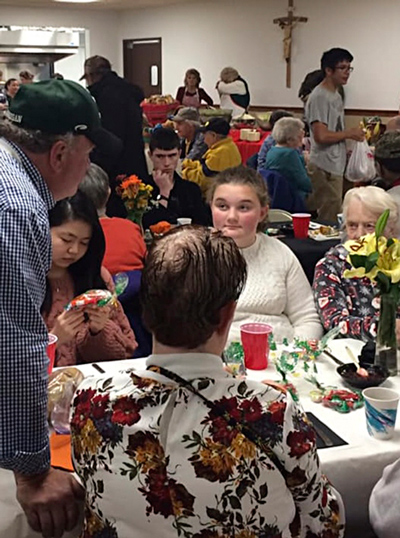
Half a century ago in the 1970s, Lebanon’s annual charitable Thanksgiving Meal began. Run by Sacred Heart Catholic Church, this Thanksgiving service tradition has been providing roughly 800 to 1000 meals each year of late to the elderly of Lebanon. For several years, the meal count was over 2,000, delivering to personal residences throughout the far reaches of the region on Thanksgiving Day, without question.

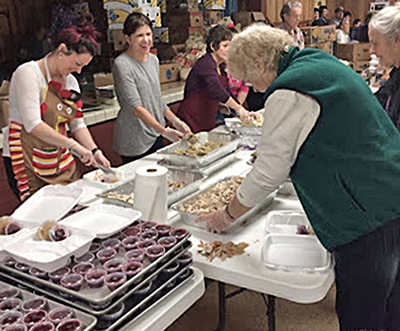
Hands and hearts from organizations and families across the Upper Valley makethis high-yield service feat possible

Hands and hearts from organizations and families across the Upper Valley make this high-yield service feat possible

Volunteer chefs, students, parish members, area citizens, and financial donors from throughout the Upper Valley provide essential contributions – making it a cross-community act of service.

Len Angelli, a career-long Cardigan Mountain School (CMS) educator, was tapped to direct the process 17 years ago. “Father William Kaliyadan invited me to attend a committee meeting on the Thanksgiving Meal,” he recounts. “The meeting begins, and suddenly Fr. William announces that I am the Director –  in perpetuity.”

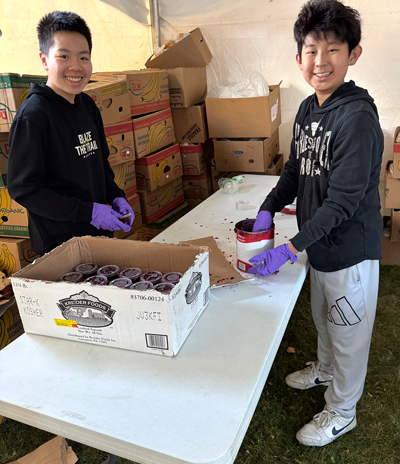
Angelli has not looked back. In recent years, 30-40 volunteers have worked behind the scenes on-site – on Tuesday, Wednesday, or Thursday as able; others for a whole week. Some years over a hundred volunteers pitched in altogether.  Angelli himself puts in a sizable amount of hours weeks and months before – while others are still dipping toes into ocean tides and diving into pools.

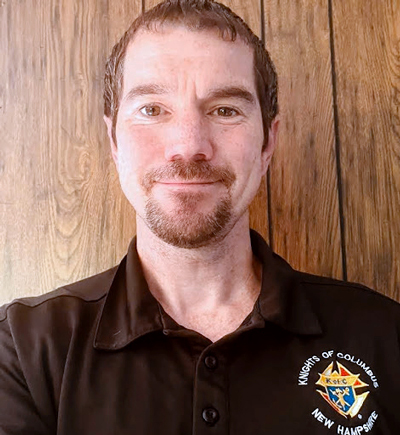
John Pomeroy, the Volunteer Coordinator for the last several years, takes the entire week off from work. Pomeroy is also the Grand Knight for the Lebanon council of the Knights of Columbus, a global community service organization charged with caring for families in crisis and the elderly. Pomeroy is one of many Knights who volunteer for the Thanksgiving Meal annually, and in many other charitable capacities in Lebanon. The Upper Valley’s four area Knights councils altogether contribute tens of thousands of dollars annually to Upper Valley food banks and Lebanon-based agencies supporting families in crisis. In the state of New Hampshire overall, Knights councils contribute millions annually to charities serving children, families, and the elderly.

John Pomeroy, Volunteer Coordinator ofthe Thanksgiving Meal for 3 years and
Grand Knight of the Lebanon Knights of
Columbus council, a global community
service organization.

John Pomeroy, Volunteer Coordinator of the Thanksgiving Meal for 3 years and Grand Knight of the Lebanon Knights of Columbus council, a global community service organization.

Pomeroy, a citizen of Lebanon for 14 years, is a network engineer by day, developing blueprint schematics for the crews of Consolidated who lay fiber optic cable.  A military kid to a career Marine Corps officer pilot, Pomeroy has lived on both the West and East Coasts of the United States. He also served in the Marines. “Our Lebanon council volunteers throughout the year wherever we are needed. The Thanksgiving Meal program is certainly a well-oiled machine,” he describes. “An incredible system.”

He paints a picture of chefs at Dartmouth Health, Alice Peck Day, Kimball Union Academy and CMS preparing and delivering food back to Sacred Heart. Innumerable restaurants, grocery stores, banks, and families give hefty sums and provisions. Pomeroy’s three children attend Lebanon public schools. Depending on one’s experience in the military and with parenting, life post-military as a father and community service leader has been more peaceful. He knows first hand it takes a village to raise kids – and take care of the elderly.

“Roughly 60% of the volunteers are not from the Sacred Heart parish,” he notes. Pomeroy is quick to pay tribute to the employees at Dartmouth Health and Alice Peck Day who read the posted flyers and call in to volunteer each year; to Paul, a local mail delivery driver, who volunteers annually; and to Jorge, a volunteer who, for years, created the vast driving routes for all meal deliveries.  Lastly, Angelli credits Father Charles Pawlowski, who pastors at Sacred Heart, whom Angelli describes as “my rock.” Fr. Pawlowski also serves as Executive Director behind the scenes, shaping the program’s direction and vision.

This coming-together demonstrates love in action, a full unity of hands giving to bodies and hearts most in need.

Len Angelli has directed the ThanksgivingCommunity Meal for 17 years running.

Len Angelli has directed the Thanksgiving Community Meal for 17 years running.

Ryan Sinclair, who along with Angelli, has been a career-long educator at CMS, brings a dozen young men annually to volunteer. These international students of ages 11-15 under Sinclair’s own program, develop hands quick to serve others less fortunate.

How do Angelli and Sinclair culminate the high-intensity week of Thanksgiving orchestrating a large scale food operation and mentoring youth on leading by serving?

By sitting down with their international students over a traditional Thanksgiving meal in a home setting –  perhaps a once-in-a-lifetime chance for kids who might soon be returning abroad following boarding school.

After the two educators finish sharing this time-honored American tradition, they start a campfire for the boys.

A campfire on Thanksgiving…?

Why not?

Sinclair is no stranger to crafting memorable experiences for youth. He watched his own parents devote themselves to teaching as well. Sinclair arrived in the Upper Valley in the autumn of 1998 to study at Dartmouth and played Division I hockey as a forward. Originally from a small town in northern Ontario, Sinclair became close with his Dartmouth teammates, many also Canadians. Four years later, Sinclair graduated with an Ivy League degree and a season under his belt studying in South Africa. But he refused to join his best friends in New York City, Boston, or San Francisco where high-yield corporate careers beckoned. This regardless of the scale of that track’s possibilities, a path reserved for elite higher education all-stars, considered by many the penultimate opportunity, nearly guaranteeing an elite lifestyle.

Where does he stand today on this choice?  “I feel genuinely happy,” reflects Sinclair. Sinclair has lived on the boarding school campus in Canaan with his wife, Sarah, and two pre-teen boys for all but two years of their marriage. Early on in their relationship, the couple spent those two years out of the Upper Valley in Grenoble, France to obtain his MBA, funded by a Rotary scholarship.

Though rooted here throughout his adult years, Sinclair has explored across 70 countries. During the much awaited summer holidays when other educators are catching their breath and families are packing for vacations or camp, Sinclair packs his passport and kisses his family farewell. Since 2009 he has directed his own month-long operation that has grown by leaps and bounds: a South African service and cultural exploration trip; also through his brain-child program, Ivy Leader.

Ivy Leader’s international students wrap up their volunteering experience with a home-style Thanksgivingexperience... and a campfire.

Ivy Leader’s international students wrap up their volunteering experience with a home-style Thanksgiving experience… and a campfire.

His program’s students safari one week and serve young children in disadvantaged schools the next.

So serving in Lebanon is the tip of the iceberg for these “future leaders” that Sinclair mentors; Serving in Lebanon one season and in South Africa another— as though the limits of one’s impact are but a mental construct.

Seven years back, Sinclair received the Distinguished Class of ‘02 Award by Dartmouth College, in recognition of service to others.

Altogether, Sacred Heart parish members, international middle schoolers, and other volunteers come out in large numbers to spend hundreds of hours dicing, baking, packaging, and cleaning. One full day is devoted to simply roasting, deboning, and packaging turkey. Calls used to be put out to Catholic church parishioners from Lebanon to Enfield and Canaan and beyond to take home a turkey from Sacred Heart to bake and bring back – or to provide a homemade pie – or three.  “We used to make homemade stuffing and pies, too,” Angelli remembers.

Because Sacred Heart’s food delivery service was stretched beyond capacity for several years running, it became necessary to streamline the process. As such, the program began soliciting donations of baked goods and rolls. Angelli also began using donations to purchase pre-made mashed potatoes and squash.

Still, how is this grand-scaled operation feasible? “A refrigerated food truck rests outside Sacred Heart for a full week,” Angelli shares. Various mechanical systems can make refrigeration possible while a vehicle engine remains off. Now, senior centers throughout Lebanon and West Lebanon receive an abundant meal of mashed potatoes, stuffing, cranberries, squash, desserts, rolls, and main course items.

Though Angelli organizes and directs the bulk of this colossal operation himself over a four month stretch, a bedrock of parish members and community members return annually. Altogether, he recognizes, “we at Sacred Heart couldn’t do it without the full community’s support.”

Note: Sacred Heart Catholic Church is always looking for volunteers and donations. Please contact Len Angelli at mailto:langelli@cardigan.org to support the cause financially or logistically, as an individual, family, organization, or business.

Share:
Reading time: 7 min
All, Good For You

Upper Valley Ultimate Creates a Third Space for Lebanon Residents

by Bill Cooper No Comments
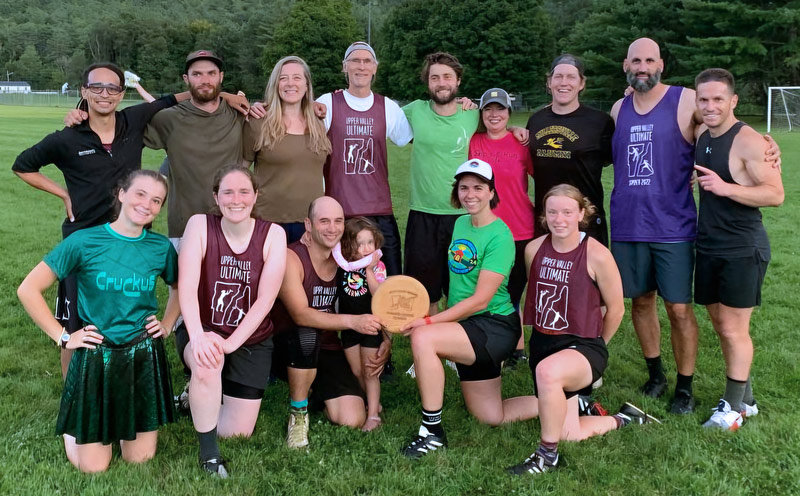
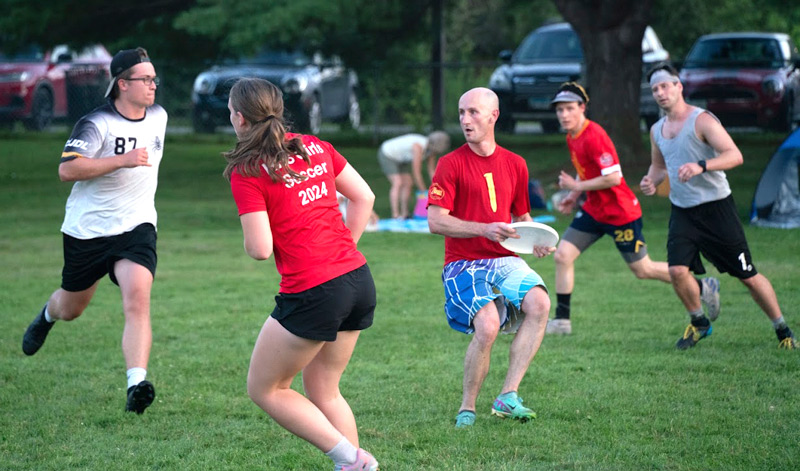
2024 League Team photo. Becca Bates (back row, sixth from left) grew up in Lebanon and found the league about 20 years ago when she was looking for a way to make new friends.

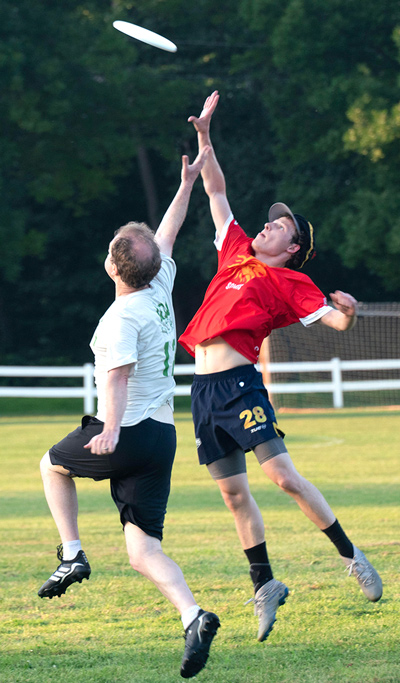
Many people reach a point in their lives when it becomes difficult to meet new people. Thankfully, Upper Valley Ultimate has been remedying this problem for decades by providing a third space to play Ultimate Frisbee. To clarify, “…in social theory, a ‘third space’ refers to a place, separate from home (first space) and work (second space), where people gather to socialize, relax, and build community. It’s a neutral ground for informal interactions, fostering a sense of belonging and connection.” (AI search summary) At Sachem Field in West Lebanon, over thirty people meet at 6pm on a Monday to throw the disc in a friendly pick-up game.

Becca Bates, a current Enfield resident who grew up in Lebanon, first found the group around two decades ago. She was looking for a place to meet friends and saw an ad in the paper for a co-ed Ultimate Frisbee league. When she asked if she could play, the group said yes, but she wasn’t sure if she was “in” until all of the players went to the Salt Hill Pub after the game. After ordering a Pabst Blue Ribbon in front of one of the regular players, she knew she was when someone said, “You’re a frisbee person if you’re ordering a PBR.”

It’s important to note – preferring specific adult beverages has never been necessary in attending the Upper Valley Ultimate group, as the group is welcoming to all. Attendees range from 16 years old to those in their 70s, though most are more centered around the middle of that age range. Though there are several residents from Lebanon and the surrounding Upper Valley area, some players drive over an hour to play, such as some from St. Johnsbury. Part of the reason for this is simple. Although other areas in the region have pickup games, this is one of the most well-attended groups, so there are always enough people to play.

Over the years, Bates has seen the group transform with a few different organizers, and even ran it herself for a few years. After COVID, she stopped running it, and now it is a committee-run group. A group of four sets up communication through emails and a Discord server, coordinating all sorts of logistics.

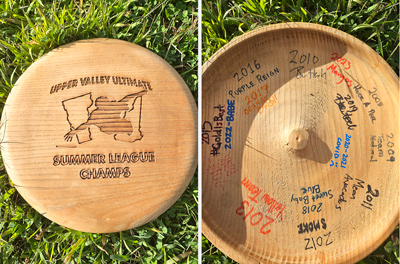
Beyond pick-up games, the Upper Valley Ultimate group hosts an additional league night during the summer. Teams are internally constructed within the group with co-ed teams of equal gender-mixing. One of the coordinators’ hardest jobs is making sure teams are balanced effectively for fair play. The latest summer league that just finished had four teams. Team names are typically constructed based on a theme, and this year’s was medieval professions: the Bladesmiths, the Shepherds, the Town Criers, and the Jesters.

Finals trophy - top and underside - the years reveal how far back the summer league goes.

Finals trophy – top and underside – the years reveal how far back the summer league goes.

Despite the league being a bit more involved, all games exude a casual hangout feel. Two Lebanon residents, Jeffy Wang and Lily Frappier, are two new attendees standing on the sidelines for the first time. When asked if they’ve ever played Ultimate Frisbee before, Frappier says she “played a little in high school” and Wang says, “I’ve thrown a disc before. Does that count?” Their lack of experience doesn’t seem to intimidate them either, as they each eagerly wait for their turn to play.

They both found out about the group from Adam Jones, an engineer and current Lebanon resident here on work rotation. Originally from London, England, he played Ultimate Frisbee regularly there, and he was shocked he could keep it up in Lebanon, NH. He found out about it from the Upper Valley Ultimate Facebook page and said it helped him meet other people in the area when he moved here this May.

Upper Valley Ultimate attendees stress that the group is for everyone, and a unique aspect of the sport that furthers this outlook is “the spirit of the game,” something that has, over time, been written directly into the rulebook. The gist is that players are encouraged to respect each other on the field, and games have no referees. Instead, when a foul is called, both players talk out the call and have to agree on its legitimacy, making it completely self-regulated. The rule furthers the inclusivity and community aspect of the sport.

In the last four years, the group found another way to be more inclusive by creating and running a separate women and nonbinary players’ night. The intention was for it to be a space for new players that was less intimidating. Originally, the group held practices and drills to increase the skills of these players, but this made it difficult for those who couldn’t make it every week. Eventually, coordinators shifted it to a separate pick-up night.

Though Sachem Field is perfect during the summer, fall makes the area less viable due to several school teams needing it for games. This is when the Upper Valley Ultimate group moves down to one night a week. Though still able to utilize the field for a time in the fall, when the weather turns, they meet inside and whittle down their games to a four-on-four player structure.

One of the greatest challenges the group has is spreading the word about the group. Though there are several returning members, a great deal of the members are transient, including students and medical residents at Dartmouth Hitchcock. Flyers have been utilized in the past, but most come to know about the group through the over 400-follower Upper Valley Ultimate Facebook page. The group is always looking for more players. Those interested can simply show up to a pickup game held on Monday or Wednesday at Sachem Field or reach out to the Facebook group for more information.

If you’re someone who’s looking for a way to be outside more frequently and meet new people, the Upper Valley Ultimate group is here for you. Whether you’re athletically inclined or not, the group stresses they’ve always been more about community-building than anything else. Though many argue about the vanishing “third space,” when you look around Sachem Field, you’ll find Upper Valley Ultimate is keeping it alive as those from all walks of life gather to play a friendly, casual game together.

Share:
Reading time: 5 min
All, Goodness InDeed

Music for Everyone: The Kilton Public Library & Upper Valley Music Center Collaboration

by Bill Cooper No Comments

Free concerts at the library? Hearing live music may not be what you first expect while checking out the latest Stephen King or fantasy romance tale, but the Kilton Public Library and the Upper Valley Music Center (UVMC) are working together to bring music education and appreciation to the Lebanon area with varied events for all ages every month.

The two entities started working together around COVID when the library was interested in hosting daytime summer concerts outside at their facility, and the UVMC was happy to oblige. Erin Smith, the education director at UVMC and one of the main people responsible for the work involved in this partnership, expressed that one of the greatest aspects of the collaboration is “making music education accessible to the whole community.” She expressed that having free programs in the library, where free programming for the community is the norm, has become a great way to do that.

After these initial concerts with the Kilton Public Library, both organizations were able to work toward making music appreciation and education more accessible. Because of patron interest, the UVMC received a grant to increase the types of programming they were able to provide. After the library and the UVMC conducted surveys, they were able to provide more participatory events with this funding. Whether they bring down guest program leaders such as the Burlington Taiko Group or utilize the various talented educators at their facility, the UVMC strives to provide the community with the music education they’re looking for. Though some events are still held outside, a good deal of them now occur in the community room inside the library.

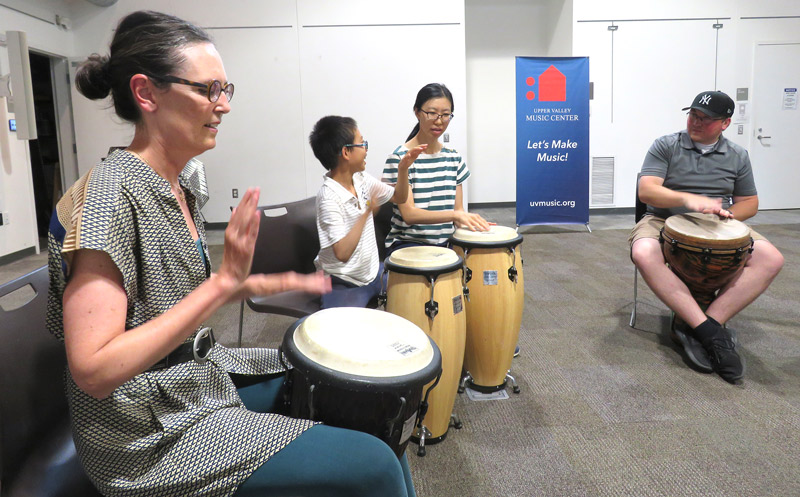
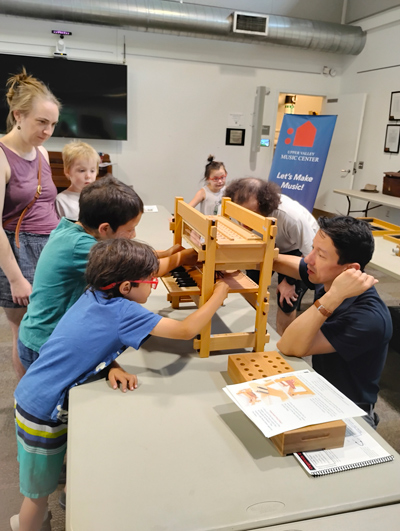
One successful recent participatory event was a drum circle headed by percussion instructor Christian Terry. The first event took place in July, and Terry had ten people, spanning from ages 4 to those in their 70s, each with varied musical ability. Terry explained that one of his favorite things about this specific outreach event is that anyone can do it, even if they don’t have a strong music background. After holding another larger drum circle in August with mostly different attendees, he expressed that another exciting aspect is that every drum circle is different. Everyone “shar[es] in this moment that will never happen again,” which makes the experience only more powerful.

Draa Hobbs, a jazz guitar instructor at UVMC, also had a lot to say about unique music moments. In addition to being scheduled to play an upcoming concert with John Stowell this September, he expressed how under-represented jazz is in the surrounding community, partially due to it being an improvised art form. To help remedy this, he held a well-attended workshop at the library a little while ago, where he taught guitarists how to improvise. He expressed how one of the hardest aspects in running a workshop like this is to make sure everyone learns something from the instruction, especially when there is such a wide range of skill levels. Despite the challenges, Hobbs believes the outreach is worth it because “it’s crucial to keep putting…a great music [genre] in front of an audience,” as well as “continue to interest younger people in a very interesting art form.”

Even when events seem more passive, like a concert, the music educators at the UVMC still impart music history and appreciation to the Lebanon community. Take Faith Goodness, a flutist who led a recent concert on August 18th. Goodness expressed how, in her latest concert at the Kilton Public Library, she focused on more “modern playing” techniques in classical music, from “flutter-tonguing,” along with “multiphonics,” “overtones,” and even singing while she plays flute. Throughout, Goodness took time in between pieces to cue listeners into what they were about to hear, as well as talk about the history of each piece that she was playing. Selecting works from the Baroque period to the modern era, she worked to encapsulate an entire primer of flute classical music history.

It’s not just educators who perform. In the past, a group of students from the UVMC came to the library to perform music set to picture books. These experiences illustrate some of the values incorporated by major programs at the UVMC, including Music Together and the Suzuki method, which encourage the strengthening of musical bonds between parents and children and within their larger surrounding communities. Benjamin Van Vliet, the UVMC’s Executive Director, expressed that one of his favorite aspects of the events was that the Kilton Library keeps the community room doors open, and it’s “so fun to see people wander into these experiences. Sometimes, it’s a little kid dragging their parent along, but sometimes, it’s an adult just going for a book that gets sidetracked and curious.”

In outreach like this, sometimes the impact can be greater than ever imagined. Erin Smith shared one incredible example, where the UVMC worked with the Kilton Public Library to put on a couple of jam sessions where musicians with any instrument or ability level were invited to participate in playing New England fiddle tunes. The attending group enjoyed the accessibility and welcoming nature of these events so much that they continue to run similar events, even though the UVMC is no longer involved in hosting them.

Whether you want to learn more about different genres, participate in music events regardless of your skill level, or simply hear great music, the Kilton Public Library and Upper Valley Music Center have their Lebanon residents covered as they continue to make music more accessible to everyone.

Share:
Reading time: 4 min
All, Cover Story

Sunshine Brings Out Lebanon’s Skate Park Community

June 27, 2025 by Richard Ford Burley No Comments
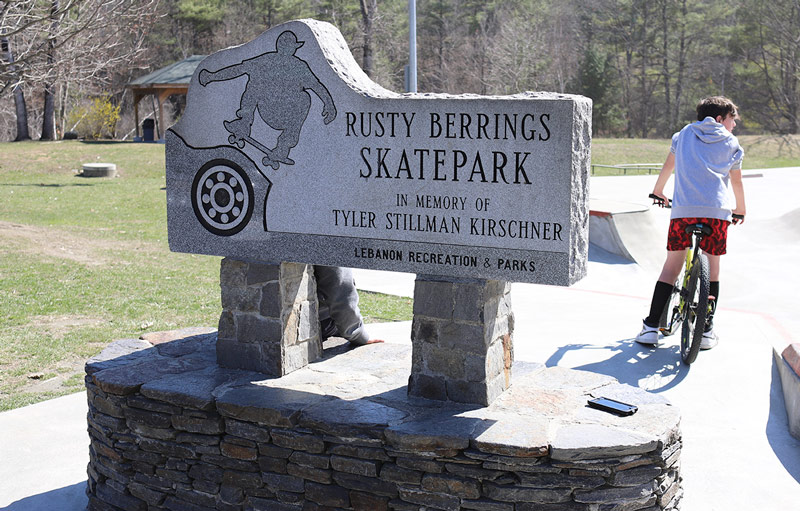
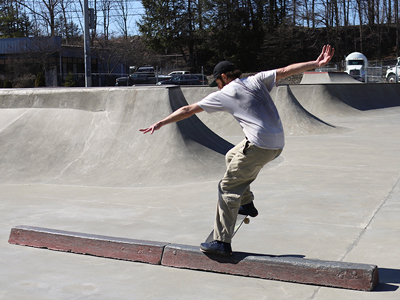
A teenager named Gray enjoys the Rusty Berrings Skate Park on a sunny April day in West Lebanon.

Spring may have gotten off to a dry and dusty start, but the April sunshine was perfect weather for fans of the Rusty Berrings Skate Park at West Lebanon’s Riverside Community Park. As the sun chases away the last of the chill, adults, teens, young children, and families make use of what’s become a regional hub for a supportive and generous culture.

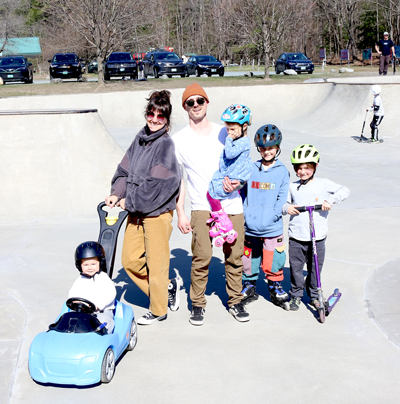
“We’ve been here four times this week,” says Cassandra Rossing, corralling four kids, all wearing helmets and ready for action. “It’s a really great community.” Her husband Michael agrees and adds, “It’s one of the nicest free public parks I’ve ever been to.”

The Rossing family

The Rossing family

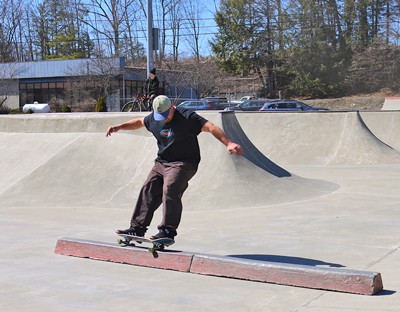
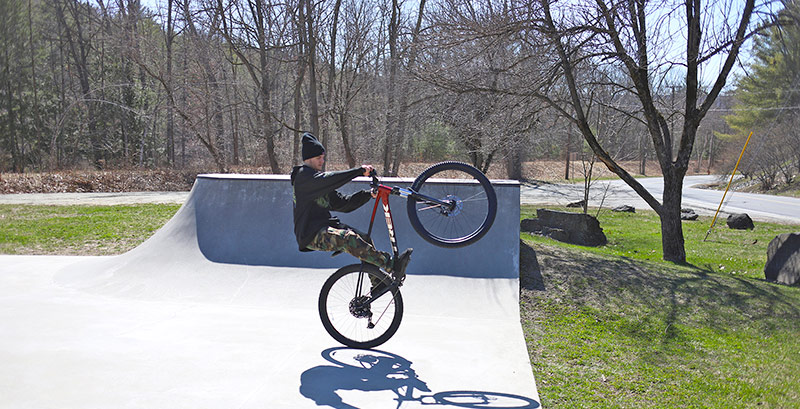
The concrete ramps and steel rails host an eclectic crew: adults Marcus and Brian practice their 50-50 grinds and frontside noseslides while a beanied teen named Gray works on ollieing onto a ledge. When asked about photos, Marcus laughs: “so long as you don’t mind them all being of me falling.” Another teen, Jacob, offers to demonstrate wheelies, then crosses the length of the park on his bike – using only the rear wheel. Smaller children do laps on scooters while their adults sit at picnic tables.

“It’s a great culture,” says Jess Morin, alternately watching the kids play and arbitrating disputes about exactly whose scooter belongs to whom. She’s brought her family up from Cornish for the afternoon to use the park. Last year, her daughter, then brand new to skateboarding, was frustrated and getting ready to leave when a group of anonymous teens showed up. One in particular offered some free lessons: “She actually strapped her up in her own brand new equipment,” Morin says, “and she taught her for like 45 minutes.” She didn’t get the good Samaritan’s name, but it really shaped her perceptions of the park and the kind of people that use it. “It was a real ‘restore my faith in humanity’ moment.”

Brian practicing his “50-50 grind”

Brian practicing his “50-50 grind”

It’s a story that gets to the heart of the culture of the park, which itself wouldn’t exist without the generosity of the community – especially that of the Kirschner family, who, in memory of their son Tyler, raised much of the funding to make the park into what it is today. In fact, the park’s name, “Rusty Berrings”, was – in the fashion of skateboarding greats Birdman, Ragdoll, and Wee Man – Tyler Kirschner’s skateboarding nickname. When it came time to upgrade and revitalize the park from the old wooden ramps into something new, the family acted as the skate park’s “angels,” according to Paul Coats, director of Recreation, Arts, and Parks for the City of Lebanon.

That culture of generosity also extends to our relationship with our neighboring communities. “It’s a regional park,” says Coats. “People from neighboring towns are coming to Lebanon to skate – and that’s the way it should be. Just as much as people in Lebanon are going to other towns to do other things. There’s not really a beach in Lebanon at [Mascoma] Lake, so people are typically going to Enfield to do that, or they’re getting in the Connecticut River via Hanover or Hartford’s waterfront. They’re going to other communities for the dog parks because Lebanon doesn’t have that. So it’s good to see a regional approach to a lot of the recreation that happens – and we get the skate park.”

It isn’t just Lebanon’s neighbors coming to use the park. For anything close to the same experience, skaters have to travel as far afield as Burlington, Manchester, and Nashua, which probably explains why it’s the city’s most used “non-programmed” park. “We put a lot of kids in Civic Park and Eldridge Park,” Coats says, “because we have sports being played there. Colburn Park is mostly a pass-through park…but Riverside Park, as far as people seeking recreation, that’s where they’re going.”

Marcus practicing his “frontslide noseslide”

Marcus practicing his “frontslide noseslide”

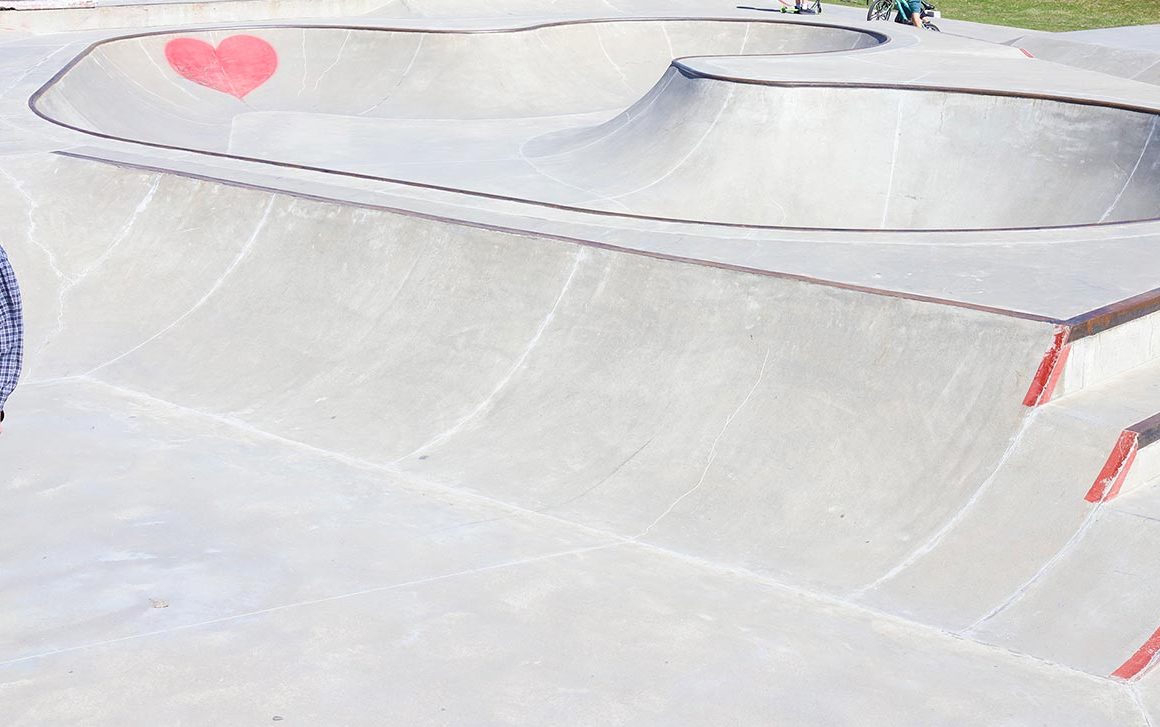
As the sun goes down the park lights up, its hours extended by the relatively recent addition of lighting to help out in the shoulder seasons. Despite all the people still using it, Rusty Berrings Skate Park isn’t even “finished” – if a living park can ever be considered really done. The most recent addition was some beginner areas, but there are plans for more expansions. Ideally, they’d like to pave the floor of the pavilion (“We’re not trying to make the pavilion skatable,” Coats says, laughing, “but they will skate in there.”) and there are plans for the addition of another “bowl” as well, not to mention the planned extension of the Mascoma River Greenway to connect the park with the Powerhouse Mall, Miracle Mile and parts beyond.

Watching everyone from kids to adults use it together, it’s clear that Rusty Berrings Skate Park is a place for all – from first-timers to four-day-a-week families, more seasoned skaters to those new to the sport. It’s more than just a community resource –  it’s a home for a culture, one with generosity and support at its heart.

Any kind souls wishing to donate toward additions to the park can contact the nonprofit Friends of Lebanon Recreation, Arts, and Parks (FoLRAP): friendsoflebrec.org.

Teenager Jacob Hoisington demonstrating a wheelie

Teenager Jacob Hoisington demonstrating a wheelie

Share:
Reading time: 4 min
Page 3 of 25« First...«2345»1020...Last »

Our Latest Issue

The Lebanon Times is delivered to every mailing address in Lebanon.

  • Subscribe at an out of town address!
  • Pick up a copy!

© 2024 copyright Greater Good Media. All rights reserved.