Taking a risk and having the courage to share a talent in front of others is one valuable decision that 11-year-old Carter Moote made when she decided to start singing the responsorial psalms at Sacred Heart Church during Sunday services. Carter, a Lebanon resident and Lebanon Middle School student, took the leap when Sacred Heart’s music director, Alice Maleski, asked her if she’d be willing to sing for the congregation.
“I’d never been presented with an opportunity to share one of my talents,” Carter says. “I don’t really understand why I said ‘yes,’ I just said it. I just felt like I was meant to do it.” This leap of faith became a way for Carter to share her faith and love for her church community, and it’s helped grow her confidence over the past two years.
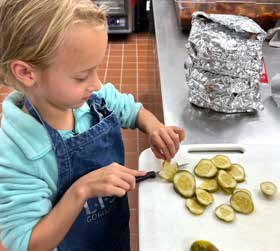
In her spare time, Carter Moote loves to bake!
“When I’m up on the altar [singing], it makes me feel like I’m close to God and it feels important that I get to be up there using my gift to praise God,” Carter explains. This role within the church is typically reserved for adults, and Carter is one of the first children that her mother, Courtney Baker, can remember singing psalms since she herself started attending services as a child growing up in Lebanon.
“It makes me really proud that she has chosen to use her voice and her singing gifts to celebrate her faith in this way,” says Baker. “I’m taken aback by her poise. She’s constantly surprising me with what she’s able to do.”
In the Catholic tradition, psalms, from the Book of Psalms in the Old Testament, each carry a specific meaning within their verses, and “you’re not just singing a psalm, you’re praising the Creator,” Carter explains. In worship, psalms serve as prayers that reflect a wide array of human circumstance and emotion.
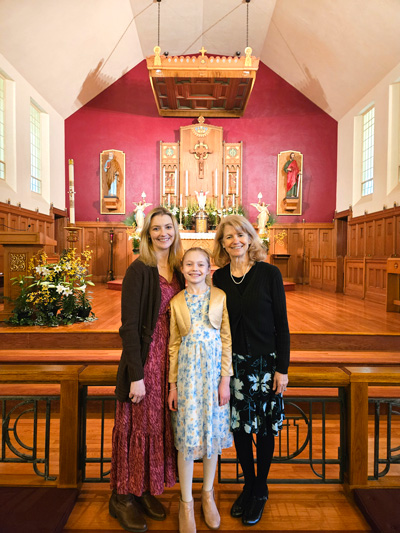
Courtney Baker, Carter Moote, and Deborah Carney (Courtney’s mom and Carter’s grandmother) on Easter Sunday at Sacred Heart Church.
Since Carter has started singing at Sacred Heart Church, she’s been inspired to share her vocal talents elsewhere, as well. Carter was nominated by her music teacher at Lebanon Middle School to participate in a musical performance in Providence, Rhode Island, which was held in January by the American Choral Directors Association (ACDA). “I don’t think that would have happened had it not started with the church,” Baker says. “I think it’s really built her confidence in regard to singing and every other aspect [of her life].”
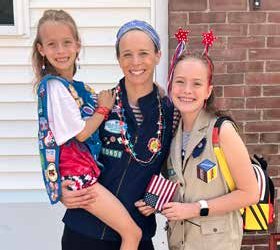
Outside of the church, Carter also exercises her voice in her school chorus and at the Upper Valley Music Center as part of their “Singing for the Stage” program, and this summer, Carter plans to join the Musical Theatre Lab at Northern Stage. She’s also a member of the local Girl Scout troop, and in her spare time, she enjoys playing sports and baking with her grandmother, Deborah Carney.
For Carter, singing for the Sacred Heart Church community has been an opportunity to share her faith and offer her gift of song in worship. “It makes me feel special in a way…It’s not just like normal singing,” she says. “I’m doing it for an important cause.”
Nestled at the southern end of the Route 12A commercial corridor – past the Best Buy, Walmart, and Applebees, and tucked behind the Home Depot parking lot – comes something of a surprise, if you haven’t been. The destination in question is the Fore-U Golf Center: an all-ages “oasis” that boasts a double-decker driving range, mini-golf course, batting cages, and ice cream – a local business shaped by economics, family ties, and an impressive level of community engagement.
Owned and run by sisters Meredith and Jennifer Johnson, the story of Fore-U began in the 1970s, when their father, Peter, partnered with a local farmer and landowner named Paul Korpela to develop the 12A corridor. The first business to result from their handshake deal was Johnson’s Home Center, which opened in 1972, and was located on the current site of the recently-opened Jersey Mike’s Subs. The partnership would eventually bring a laundry list of businesses to the area: Wendy’s, Walmart, Price Chopper, Home Depot, Golf & Ski Warehouse, BJ’s, and Staples – and, of course, the Fore-U Golf Center.
The mini-golf course
The business has changed over the years, starting as a simple driving range in the ’80s and growing into the well-rounded family fun center of today. In 1988-89, its modest center of operations shifted from a garden shed to the snowboard corner of the Golf & Ski Warehouse. In 1996, they added mini-golf and a short-lived Par 3 course – though the mini-golf course has relocated since then. Meredith and Jennifer had worked there since they were fifteen, but by 1998, Meredith had just gotten out of college, Jennifer was getting out of teaching, and it seemed like a good time to sign on to be owners of the family business. Their first official act? Expanding into ice cream sales with the opening of the aptly-named Ice Cream Fore-U. Later, in the mid-2000s, the Home Depot moved in, and the mini-golf course shifted to where it is today, a pocket of green between the double-decker driving range and the Connecticut River.
But the business was shaped by more than simple economics. “Our parents took up the game of golf in 1980, and our grandfather as well,” Meredith says, “and they just fell in love with the sport.” That love was clearly passed on to the next generation: not only do the sisters now own Fore-U, but their brother Mark is also a golf professional, the COO and general manager of a golf development down in North Carolina. “Family is a huge priority for us,” Meredith says, “and that’s an environment we try to foster here.” It’s a priority that’s clear in everything from the free mini-golf admission for children three and under, to the playground setup next to the ice cream shop, to the simple number of parents and children in evidence at the driving range.
Bringing newcomers – children and adults alike – into the world of golf is the job of Peter Harris, Fore-U’s director of golf. A PGA teaching professional and longtime friend of the Johnson sisters, Peter is “one of the most enthusiastic people you’ll ever meet. He loves the game and loves to share his knowledge,” says Jennifer. He runs clinics for beginners and juniors, offers private and group lessons, and even works with First Tee, a national youth development program that uses golf instruction to build important life skills, “like honesty, sportsmanship, respect, and integrity,” Peter says. He describes his teaching as “a way to connect people outside, as well as introduce them to the game of golf.”
Thea Olsen enjoying some Fore-U ice cream
All three of them are connected to and invested in the community, says Meredith. “Peter lived in Hanover in high school, we grew up in Lebanon, I went to Dartmouth and coached for Lebanon, Jenn taught in Lebanon…we’re all pretty invested.” And that investment shows. The company donates to (and sometimes acts as a stop for) Project Graduation, a substance-free way for high school graduates to celebrate. Last year on the Lebanon Public Libraries website you could find a link to their “Summer Reading Program,” where if you read ten books, (adults, too!), you could get a free coupon for an ice cream, courtesy of Fore-U – and they’re running that program again this year. And if you have a good enough swing at the driving range, you might just hit (and set off) a Hollywood-style “velociraptor” hanging out downrange – a result of a partnership with the Hartford Area Career and Technology Center.
The connection with people is the most important part, says Meredith. “We have a lot of people that come to the ice cream stand that we talk to on a weekly basis, and they share their lives, their ups and downs…I think we’re a really positive place for people to connect.”
“I’ve been here twelve or thirteen years,” adds Peter, “and you get to see them evolve into golfers – young adults, older adults, families – it’s just the connection of people that we’ll see, either people who are here for the first time, or regulars. It’s a welcoming environment, a family environment, and a little oasis.”
And if that oasis comes with over fifty flavors of ice cream, thirty of soft serve, eight flavors of Italian ice, and several non-dairy ice creams as well? “We’re lucky,” says Meredith, “we’re giving them a product that makes 99% of people smile.”
You can find maple syrup in every city, town, and rest stop in New England, and in every grocery store and gift shop from Connecticut to Maine. Whether you buy it in the familiar, screw-capped, gray plastic jugs or in fancy glass bottles shaped like little leaves, maple syrup carries with it a long tradition of community, family, and hard work. Nowhere is that more true than in Lebanon, where some of the oldest families in town are not only continuing the long legacy of maple sugaring, but carrying it forward into a more efficient – and more sustainable – future.
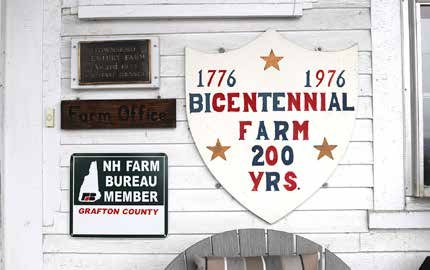
Perched on the top of Storrs Hill sits a white farmhouse, decorated with signs reading “century farm” and “bicentennial farm” on the side. It was built in 1784 by Nathaniel Storrs, one of the first settlers to come to the area. The land had come into his brother’s possession in 1763, just two years after Governor Benning Wentworth signed the charter that brought Lebanon into existence. In February of 1769, “Grandfather Nathaniel” (as his descendant Heidi Townsend Bundy calls him) bought the plot from his brother Cornelius, and two years later he moved his whole family up from Mansfield, Connecticut. The log cabin they first lived in no longer survives, but the farm, which has gone by several names over the years, including Storrs-Townsend and the current Tomapo (an abbreviation of Townsend Maple Orchard) is still in the family – and still producing maple syrup.
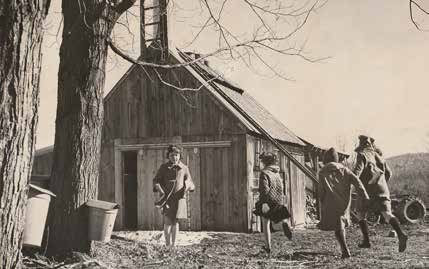
Tomapo Farm, January 2024.Storrs-Townsend (Tomapo) Farm sugar house 1965.
“We believe that they were probably sugaring shortly after Grandfather Nathaniel settled here,” Heidi says, sitting at the kitchen table in the old farmhouse. Nathaniel was her fifth-great-grandfather. “We only have records back to 1824,” she but “of all the things on the farm, that’s the one thing that we can track having been here. I have diaries from Grandfather Abel from the late 1800s. I have diaries from my grandfather, Harry [Storrs Townsend], from the late 1950s…we’ve got a lot of paperwork that makes us believe that sugaring was here early on.” Sarah Murchie, Heidi’s daughter, sits across the table with her own toddler daughter sitting in her lap: “It’s been the one constant,” she adds.
The earliest history of maple syrup itself isn’t perfectly clear, but one thing that everyone can agree on is that it’s always been plenty of work. Indigenous oral histories from across the northeast tell of the origins of sugaring – clearly an indigenous practice long before the arrival of settlers – with several suggesting that syrup itself once flowed directly from the trees until greater powers intervened, diluting it into sap to prevent humanity from becoming too lazy. When the sap comes out of the trees, its sugar content is very low, usually one to two percent by weight. Finished syrup is around sixty-six percent, and the art and science of sugaring is in how you get from one to the other.
Once upon a time, the secret to maple syrup production was simple: more bodies. “When my father was young,” Heidi says, “there would be an announcement at the [high] school in the afternoon, that the Townsends needed help…and the boys would hike up over the hill and spend the afternoon gathering sap.” Today, the sap is collected using vacuum pumps and plastic lines that crisscross the hillsides and collect in great tanks, but back then, the height of technology was metal buckets and rubber boots. “They still stop at the market and identify themselves as one of those kids that gathered sap, [saying] ‘we had so much fun’…I was around when there were buckets, and I don’t remember it being fun,” Heidi laughs, reminiscing. “They were happy. I always had sap in my boots; my mittens were always wet.” The industry has modernized since, not least because students who will work for a dollar an hour (plus a little ‘sugar on snow’ at the end of the day) are understandably harder to come by than they used to be.
“We have come into the 21st century,” Heidi says. “Back ten plus years ago…we added a vacuum system to our mix…so for quite a while we had a vacuum system on the one side of the road, about a thousand taps, and then we had five hundred on the other side that were all gravity fed to a tank” (they’ve since expanded to over 2,000 taps). But that division still meant extra manual labor, and so they tried an experiment with something called a “sap ladder”. “You bring all of your tap lines into a main line that’s headed downhill, and then there’s a vacuum system that has you spread that volume out into small lines so it will climb up into another line that goes downhill,” Heidi explains, describing the way the sap can travel up a line sixteen feet into the air to safely cross a road frequented by farm trucks and utility vehicles. “And then this past year, we added reverse osmosis to the mix.”
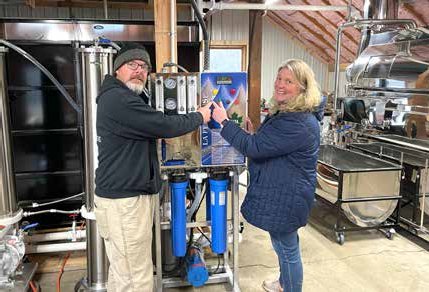
Eric Cole and his wife, Susan Cole, pressing the start button on the RO machine for the first time.
Reverse osmosis – or RO – is a technology that might be more familiar as a water filtration system: using high pressure and a semi-permeable membrane, water is divided into pure drinking water on the one side and a leftover liquid called concentrate on the other. Its use in sugaring just flips around which side is considered valuable. In a drinking water system, it’s the pure water that’s the goal, but in sugaring, it’s the concentrate. “So what it does is, it separates. Seventy-five percent of the water is pulled out of the sap before you even put it in the evaporator,” Heidi says. “I end up with hundreds of gallons of pure water in a tank that I use for cleaning, and then I have the rest of the sap that’s left, which has been condensed from two percent sugar to eight percent.” That means less time and energy spent boiling the sap down into syrup. “Last season, I spent ten 12-14 hour days in the sugar house [boiling sap], and I had help,” she adds. “This last season, 2023, we had the reverse osmosis set up, and I ended up doing 6-8 hour days, at most.” These moves toward labor-saving modernization aren’t limited to Tomapo Farm, either.
Not a mile away as the crow flies is another farm that’s also been around since almost the first days of Lebanon. Standing in his garage-turned-sugar house, Eric Cole explains that Elm Tree Farm has been in his family for eight generations. “We do business here as Ascutney View Farm, which is off of Poverty Lane…our kids will be the ninth generation.” But while sugaring is something the family has done for as long as anyone can remember, this particular venture is something new for Eric, who doesn’t look old enough to be on his third career. “I went to school for forestry, got my forestry license…was in the logging industry for a few years.” After hurting his back, he spent seventeen or eighteen years selling logging equipment: “skidders and feller-bunchers…everything that you need to cut down a tree in the forest and process it and get it to the mill.” And then, a year ago last November, “I decided to…I say ‘retire’ from my second career,” he says, looking at the setup in the repurposed three-car garage. “And now I’m on career number three.”
The garage doesn’t look like the old traditional sugar house that’s just next door, where Eric grew up sugaring with his brother, father, and grandfather, nor does it look like the modernization of a legacy sugar house like they have at Tomapo. In fact, from the outside, the only clue that it isn’t for cars is the way three large blue sugar lines run up to (and through) the exterior wall. But one look inside tells another story: two raised, black, 3,000 gallon tanks take up a quarter of the interior space. Another half is taken up by an enormous stainless steel machine. “So that’s a three-and-a-half by fourteen CDL evaporator,” Eric says. “It’s oil-fired. Help is fairly limited today – for a lot of people – and so my goal was to be able to do as much of this myself as I possibly could.”
He isn’t overstating things: every part of his sugaring operation can be run from right where he’s standing. The sugar bush, a 20-acre patch with about 2,200 taps so far, is about three quarters of a mile up the hill. “I have a twenty foot conex box, a shipping container, out in the woods with a 2,200 gallon tank inside of it, and a vacuum releaser. So the vacuum goes out to the releaser, from that releaser I’ve got main lines that go all through the woods, which brings the sap down to the storage container…and then I have a pump that’s run off a generator out there, and it pumps the sap back to here.” From his phone, he can tell in real time the temperature and vacuum pressure of any given segment of line, and how full the sugar bush storage tank is. It’s a far cry from buckets and boots. “I don’t touch anything through the whole process. It just comes out of the trees, through here, through here, to the barrel,” he says, pointing. “It’s very efficient for me, as one person. I can do pretty much everything myself.”
Next to the internal storage tanks is an RO setup not unlike the one at Tomapo, but unlike the eight percent sugar concentrate that Heidi runs through her setup, Eric runs his up to twenty, using his two tanks and multiple passes to achieve that level of concentration. The difference is in how long the sap spends being heated in the different evaporators.
The color and flavor of maple syrup come from something called the Maillard reaction. It’s a reaction between amino acids and certain sugars that happens when they’re exposed to heat – think a nicely seared steak or a lightly-browned campfire marshmallow. That browning is what gives maple syrup its flavor, and it’s a function of the type of sugars in the sap and the length of time it spends being heated. Depending on the evaporator, the concentrate might be too sweet, in which case it wouldn’t be able to spend enough time exposed to the heat to develop all the color and flavors that maple syrup is famous for. Heidi recalls an early boil after taking hers to twelve percent: “I tasted that syrup, and I thought… this doesn’t have the kind of flavor I want.” Meanwhile at Elm Tree Farm, Eric says his “rig boils so smoothly at twenty percent that that’s what I shoot for.”
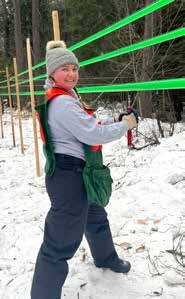
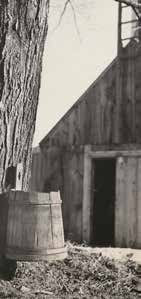
Clara Cole helping install tap lines at Ascutney View Farm for another sugaring season.Wooden sugaring bucket Storrs-Townsend Farm sugar house, 1965Heidi Townsend Bundy holding the same sugaring bucket in 2024
Reducing the number of hands needed isn’t the only upside of modernizing the sugaring process: a more efficient setup also means a significant reduction in greenhouse gas emissions. At Tomapo, Heidi says they used to get six gallons of sap for every third of a cord of wood. Thanks to improvements that include the new RO setup, they now get thirty-six gallons for the same amount of wood, an over 80% reduction in emissions. Meanwhile, running twenty percent concentrate, Eric’s boiling runs are far shorter than they would otherwise be. “Last year my longest boil was two, two-and-a-half hours. I can make about forty gallons of syrup an hour,” and less time boiling means fewer emissions.
But for all the ways that sugaring has changed, some things are still the same. When asked “why sugaring?” Eric says it’s a mix of nostalgia and the need for a challenge. “I have a lot of memories of my father and my grandfather here in the sugar house… [and] I’m just kind of drawn to the woods.” Heidi’s father, Bruce Townsend, still comes down to the sugar house once a season, too. “He tastes the syrup, tells me it ‘tastes pretty good,’ and then as he leaves…he’ll turn around and look at me and say, ‘well, you look like you know what you’re doing.’” She laughs and says, “But that’s Dad…It’s a fun activity, it really is. I mean it’s a lot of work, but it’s fun, especially when you can do it with family.” With a little luck, and a little help from new technologies, they’ll be able to do it for generations to come.
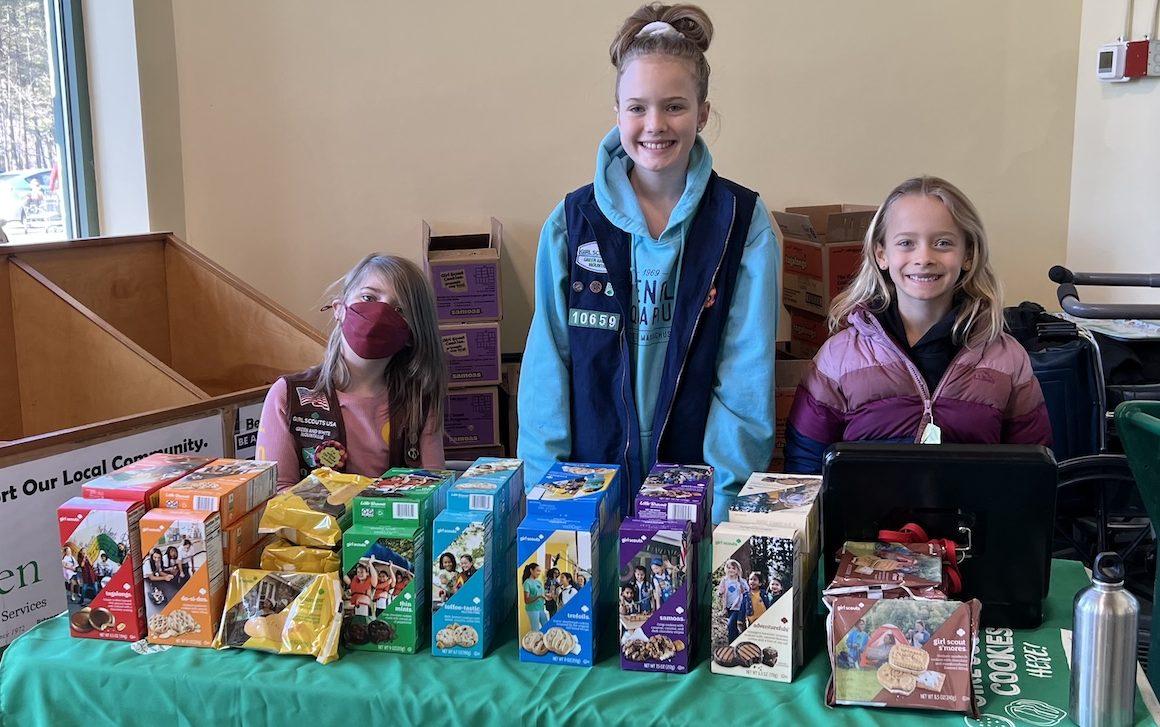
Once a year, Girl Scouts from across the country unite to fulfill a shared tradition and mission – in the well-known form of selling cookies. Whether you’ve sold Girl Scout cookies at some point in your life or eagerly await stocking up your pantry with these nostalgic treats, there’s something to look forward to for everyone when Girl Scout Cookie season rolls around. For the local Girl Scouts in and around Lebanon, there’s a lot of preparation that leads up to this beloved – and busy – time of year. Lebanon local Erin Buck is a troop leader to 18 Girl Scouts in the Upper Valley, including her two daughters, Acadia and Azalea Buck. This year, they have some big goals for cookie season. Acadia, 14, plans to sell at least 1,000 boxes of cookies, while Azalea, 8, has made a goal to sell 2,024 boxes between January up until March.
Selling cookies is more than just a fundraiser or an activity to pass the time; for Girl Scouts, it’s an opportunity to learn and realize their ability to succeed when they put their minds to something.
“I like doing cookie booths because I get a chance to manage the money or do credit-card transactions,” Acadia says. “And, I like eating cookies.”
Certain incentives also help motivate Girl Scouts to reach their cookie-selling goals. This year, if a Girl Scout sells 1,000 boxes of cookies, she gets a pair of custom Converse sneakers, and another pair will be given to a child in need. If she sells 2,024 boxes, she wins a two-week day or resident camp program or an iPad, and if she sells 5,000, she wins a travel trip.
At age 10, Acadia was the top cookie seller of the Girl Scouts of the Green and White Mountains and was awarded a trip to Athens , Greece. Unfortunately, the trip was canceled due to the pandemic.
But, it’s not just the incentives that inspire Girl Scouts to sell cookies, Acadia and Azalea both report. “The most important thing about the shoes [prize] is that you also give a kid [in need] shoes,” Azalea says.
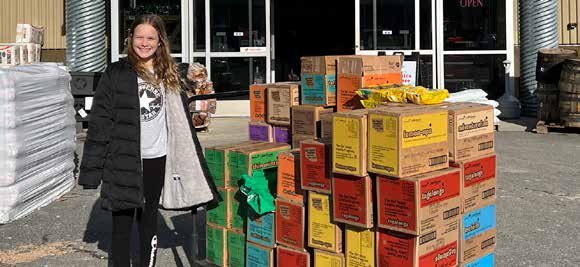
Acadia working toward her 1000 boxes of cookies sold at Tractor Supply.
“The Girl Scout Cookie program is the world’s largest girl-led entrepreneurial program,” says Carrie Loszewski, VP of engagement for Girl Scouts of the Green and White Mountains. “[It teaches] five incredibly valuable lessons in life skills: decision-making, goal-setting, financial literacy, business ethics, and people skills.”
Girl Scouts learn about and practice these skills throughout the year leading up pivotal moments like Cookie Season where they get to witness the culmination of their efforts in action. Along with these five important skills, Girl Scouts also focus on the importance of building and belonging to a community throughout the year.
Buck became a Girl Scout troop leader shortly after Acadia became a Girl Scout when she was in kindergarten. Since then, their troop has grown and had many memorable experiences together.
Acadia’s troop is a multi-level troop (Girl Scouts of all different grade-levels and ages) that caters to each girl’s interests and needs. “My role is to support all of those kids and create a bigger sisterhood than just ourselves,” Buck says. “I’m blessed that I get to do this with both of my children at the same time, and be able to offer a second family for a lot of children in our community.”
Buck also supports her daughters as a “Cookie Mom”. Cookie moms are a crucial part of their daughters’ experiences as they help with delivering cookies and restocking inventory, and they travel all across the Upper Valley to do so. “That’s what we do as Cookie Moms; we help [our Girl Scouts] get there,” Buck says. “I think one word to describe Cookie Moms is ‘organized’,” Buck says. “I put a lot of energy into understanding what both of my kiddos goals are for the season ahead…it means being realistic about our goal-setting and managing expectations.” There are various steps throughout the season that start with initial ordering, which involves asking local businesses and community members to support their local Girl Scouts. This encourages Girl Scouts to get to know members of their community and create new relationships, while also teaching business and entrepreneurial skills. Next steps include booth sales at local businesses, like Joann Fabrics or the Lebanon Coop.
Acadia and Azalea’s troop meets every Monday. Weekly troop meetings begin with a snack, followed by reciting the Pledge of Allegiance and the Girl Scout Promise and Law. The rest of the meeting might consist of crafts or an activity that explores the traits involved in earning a particular badge.
During cookie season last year, Girl Scouts in Buck’s troop created their own version of The Day the Crayons Quit – an imaginative picture book written by Drew Daywalt about the interpersonal conflicts between different colors in a box of crayons.
The Girl Scout version of the story followed a similar plot, but instead of crayons, each of the girls were assigned different Girl Scout cookies – both current and discontinued varieties. By looking at life through the perspective of each cookie type, they created dialogue between each of their characters. The re-imagined story, “The Day the Cookies Snapped”, was a way for the Girl Scouts in Buck’s troop to use their imagination to find a creative solution to a make-believe problem, and to familiarize themselves with all the different types of Girl Scout cookies. The Girl Scouts program is built around trust and nurturing relationships through unique shared experiences. Through activities, badge opportunities, and community service, Girl Scouts have a chance to work together as a team and express themselves creatively, while also offering their unique talents to help solve problems.
“Encouraging girls to explore, reach for their dreams, and thrive in our complicated world while being their authentic selves is core to the mission of Girl Scouts,” Loszewski says.
“While many Girl Scouts earn these prestigious honors, earning badges and participating in our activities fulfills our mission to make the world a better place,” she adds. “You see it when a young girl comes out of her shell to speak up for herself, when a child conquers her fear and reaches the top of our climbing wall or jumps into the water at summer camp, or simply makes a new friend.”
Azalea preparing food for community members at the LISTEN Center Dinner
Girl Scouts interact with their local communities in a number of ways. Some of Acadia’s favorite ways to give back to her community as a Girl Scout are by volunteering to help serve dinners at the LISTEN Center, helping out at local humane societies, and participating in local food drives. “I get to help my community and learn business skills,” she says. “I also feel like a leader in my community.”
Through the Girl Scout program, girls complete a variety of tasks that challenge them to employ their knowledge and skills to earn badges. Each badge represents a different trait or skill earned when a Girl Scout completes a particular project among a variety of categories.
“Since 1912, girls have learned to turn their passions into action through Girl Scouting. Whether they’re using science, technology, engineering, and math (STEM) skills to solve problems; starting their own nonprofits; finding more ways to protect the environment; or discovering the power of spreading kindness, all their actions add up to a better world,” Loszewski says.
Earning badges in areas like these encourages Girl Scouts to not only better themselves, but also make a difference to others around them by giving back to their community.
“Girl Scouts of all ages take action in their communities,” Loszewski adds. “The pinnacle of the Girl Scout Experience is the Gold Award, which Girl Scouts in grades 9-12 may earn. This past membership year, 18 Girl Scouts in our council achieved this remarkable honor. They took on issues like fighting the negative impact of fast fashion, helping grieving children, helping children deal with stress and anxiety, honoring veterans, encouraging reading, feeding the hungry, and more.”
Younger Girl Scouts – like Azalea – also give back to their communities and learn leadership skills by earning awards and badges for their grade levels.
Azalea, Erin, and Acadia at the Memorial Day Parade in Lebanon.
“We try to plan a variety of activities so it hits every kid’s interest,” Buck says. Everyone is able to share their interests and can expect their ideas to be heard. The older girls of the group including Acadia will help the younger troops like Azalea, voice their opinions. Older kids give ideas that will benefit the wants and needs of the younger girls and they have a strong connection with them.
“Often, our youngest look up to our biggest,” Buck says. “Emotionally, [the older girls] are very important, they help stabilize the younger side of the group. They find a lot of comfort in each other and that’s an integral part of what we do.”
“Really, it’s just about how much fun we get to have with the Girls and we get to go on fun trips,” Azalea says. “And it’s amazing that we get to help the community and other people.”
Fun trips that align with learning goals – like visits to a trampoline park or amusement park, camping adventures, and even international travels – are some of the experiences that Girl Scouts look forward to as they advance through the program and celebrate their accomplishments. An annual boat race is one of Azalea’s favorite Girl Scout memories, where her troop works together to craft boats out of cardboard and duct tape and race them across the pool at Six Flags.
The quality time that the Girl Scouts get to spend with each other allows for relationships to develop and flourish within the troop. For Azalea, it’s this quality time and friendships that she loves most about being a Girl Scout. “I love spending time with everyone and I know I’m with safe people,” she says.
“When other parts of life aren’t going well, Girl Scouts is a big outlet,” Buck adds. “It’s a different group of people that you can be yourself with.”
The Lebanon Outing Club at Storrs Hill celebrated its 100th season in 2023. To commemorate the event, a centennial celebration weekend was organized, featuring good food, guest speakers, and of course, skiing.
Over the course of its history, The Lebanon Outing Club (LOC) has provided a local hub for winter activities at Storrs Hill, with opportunities for skiers, snowboarders, and competitive training such as alpine ski racing and ski jumping. Other special community events, like the “full moon fiesta” and family fun nights, provide an opportunity for local families to gather and celebrate the joy of the winter season in Lebanon.
The Lebanon Outing Club was originally founded as a student club at Lebanon High School in 1923 by Erling Heistad, a Mechanical Arts teacher, Winter Sports and Track coach. Heistad’s goal was to make a ski jump within walking distance for every child in Lebanon. Since then, LOC has more than accomplished that goal, having taken countless measures over the years to improve skiing opportunities for Lebanon and the Upper Valley.
In 1925, the Club installed its first ski jump at Storrs Hill and nicknamed it the “Scrape”, because ski jumpers would often scrape their bellies when they landed. The first alpine ski trail at Storrs Hill was installed in 1931; a second ski jump and lighting for night skiing were added in 1939. Various other improvements and additions were made over the years – including new ski jumps, expanded slopes, and a second lodge – and by 1973, LOC embarked on a modernization project led by Storrs Hill Ski School founder and developer of Snow Crest ski area (later known as Whaleback), Ernest Dion. LOC reorganized and officially became a 501(c)(3) nonprofit organization in 1986, and the Club assumed responsibility for ski area operations from the City of Lebanon.
More recently, Storrs Hill and the Lebanon Outing Club have continued to improve their operations and provide joy to many skiers and residents of the Upper Valley. The Olympic torch made an appearance at Storrs Hill in 2002, where it passed through the “ring of fire” off of the 35-foot ski jump. Many Olympians have skied at Storrs Hill at some point, like ski jumper Nick Alexander (Lebanon native) and alpine skier Mikaela Shiffrin. LOC also continues to improve its slopes and jumps over time: recently, the Club purchased a winch cat groomer to improve the slopes and installed stainless steel tracks on the ski jumps. In 2016, they refurbished the ski lifts, and in 2020, replaced the lift’s platter poles. The Club has also improved its lighting with LED lights provided by the City of Lebanon.
In January, LOC received a grant from the Killington World Cup Foundation (KWCF), which has allowed them to make lift improvements after recent weather events and electrical shortages. “The damage caused by the weather caused a lot of headaches and hardships,” says Lebanon Outing Club president Cory Grant. “A lot of thanks goes to that organization (KWCF) for helping us out with that grant.”
During the pandemic, the Lebanon Outing Club – like many other local organizations – had to navigate the changing times, adjusting to abide by new community guidelines while continuing to provide a place to ski for Upper Valley residents. To do so, the Club expanded its lodge, adding an outdoor canopy to ensure that enough people could fit in the lodge while also keeping that infamous 6-foot distance from each other.
Today, the Lebanon Outing Club and Storrs Hill continue in their dedication to providing the community with a great place to ski and celebrate winter. Multiple local high schools use Storrs Hill to practice and race, and LOC provides lessons for all ages and experiences, from first-time skiers to competitive racers. Storrs Hill also hosts U12 and U14 ski races, and Ski Jumping Junior National Qualifier competitions also happen on the hill.
Some short-term future plans for continued improvements include adding a tubing and sledding area to Storrs Hill. Another goal is to introduce a freestyle team – a place where skiers and snowboarders can safely practice freestyle skiing and snowboarding, says Cory Grant. To accomplish these goals and other future plans, more committees and volunteer work are essential. The Lebanon Outing Club is a nonprofit organization, and many of the things that they offer the community can only be accomplished through the help of generous donors and volunteers. As the Club continues to grow, Grant says that committees and volunteers will become more and more important. “Come learn more about what we’re doing,” Grant says. “Help us build a greater future for the Upper Valley.”
Those of us who have ever played sports in high school remember our favorite coaches fondly. At the time they may have seemed too tough, too regimented, or too discipline-oriented, but after some time, we realized the lessons that they taught us were important in negotiating the real world in which we later found ourselves. Those lessons of teamwork, giving it your all, carrying through till the finish, and practice till you get it right are not just applicable to sports, but to almost every aspect of life.
For the players on the Lebanon High School (LHS) Boys Hockey Team, they now have a new coach from whom they’ll learn both the intricacies of the sport and the life lessons of participating on a team. Last year, Dean Cashman assumed the role of head coach of the Raiders hockey team. Now in his first season as Lebanon’s coach, Cashman is far from a newbie to the sport, and coaching.
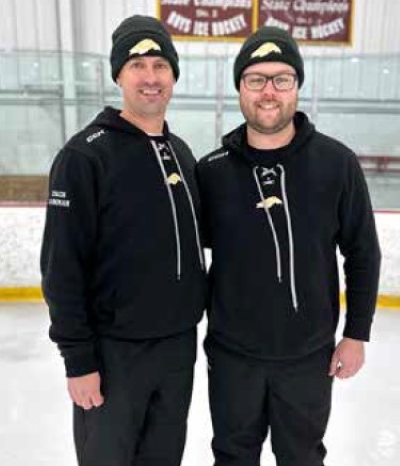
Coach Dean Cashman (left) with assistant coach Ben Peters.
“I played for Dick Dodds at Hanover High, graduating in 1996,” says Coach Cashman. “When I returned home from college, Scott Peters was looking for a youth hockey assistant and Dick Dodds offered up my name. Scott and I have been friends ever since, and I helped him for four years before I eventually ended up assisting Dick (Dodds) for 10 years at Hanover. Last year, I transitioned back to youth as I thought it would be my last chance to coach my boy. I coached the U14 Storm team.”
A big change in the program at LHS was adding Mascoma Valley Regional High School to their co-op arrangement which resulted in a move up to a higher division in high school hockey in New Hampshire, which peaked Cashman’s interest in taking on the coaching vacancy. “With the new co-op alignment of Lebanon-Mascoma-Stevens (high schools) and the bump up to Division 2, there was a clean slate and opportunity to build a new beginning for the Raiders,” says Cashman. In addition, “Five of the kids I coached at the U14 Storm (team) are a part of the team now. Knowing how much they all love the game motivated me to get involved.”
Familiarity with those involved in the current LHS team extends beyond the players themselves. “Scott Peters’ son, Ben, who I coached for four years, is my assistant now,” says Cashman. Support from parents, and the community in general, is critical for the success of any high school sports team and their coaching staff. Dean Cashman says his Lebanon team is reaping the rewards of that community support.
“A group of proud alumni and parents created a Boosters program to support the boys’ and girls’ teams,” Cashman says. “(Held recently) was the first Winter Classic at Campion rink. The girls played at 10am and the boys at 1:30pm. In between games there was a public skate for families with current Raiders players. All day long the lobby was filled with raffles, concessions, and a side room with little kids coloring and playing. Both (Lebanon) teams won their games but seeing the hundreds of people roll into Campion throughout the day was the biggest win.”
Cashman says one initiative in particular is creating much goodwill, and bolstering his confidence for the future of the Lebanon program. “Credit to Nenia Ballard for implementing a ‘Kid Captain’ at each home game. Before the game, a local kid gets a gift bag with a t-shirt, puck, and certificate to memorialize the day. They also come down to the locker room with me and take a picture with our Captain, Jack Clary, or some other players they might have a tie to,” Cashman says. “When I get these pictures post-game, it’s a reassurance that we are building a program the community can be excited about.”
At any level, when a new coach comes onboard, they put their own mark on the program by detailing their priorities. Dean Cashman was no different, upon becoming head coach of the Lebanon Raiders. “(We’ve) made a concerted effort in letting the players know from day one that accountability was going to be demanded from the players. The players are all showing up every day, working hard and getting better. They are excited to come to the rink,” Cashman says, adding that he’s always open to a dialog with his players.
“The players know that they can approach me at any time. Coach Peters and I consistently meet with individual players. We discuss school and their other life interests. Whatever they want to discuss. It doesn’t have to be hockey.”
Eventually, it’s the players’ reaction to their coaching staff that helps determine the success of any program. Jack Clary, the Raiders’ team captain, affirms the positive reaction of the players towards Lebanon’s new coaching staff.
“Coach Dean has been met with lots of enthusiasm and has brought so much to the program,” says Clary. “He and I came into this year preaching the importance of discipline and camaraderie, and it has paid immediate dividends. Everyone shows up each day ready to work, and I know we will continue to improve as the season progresses.”
This year, Whaleback Mountain is celebrating 10 years as a non-profit organization. Over the past decade, Whaleback Mountain has continued to provide the Upper Valley with an affordable and accessible winter sports experience for all members of the community.
While many ski resorts have become overcrowded and expensive, Whaleback has remained dedicated to sustaining the soul of snow sports. The mountain offers opportunities for all age groups and all backgrounds to not only develop and hone skills but also to instill a lifetime appreciation for winter sports surrounded by members of our community who share the same passion.
After School Program (Feb 2023).
Throughout the winter season, Whaleback offers a variety of opportunities for the community to get involved. Upper Valley elementary and middle school students can participate in an after-school program that is tailored to their experience level. Currently, over 600 students from the Upper Valley participate in the program with participation rates continuing to grow. On Thursday nights, adults can join a ski race league, competing for weekly prizes. In addition, the mountain just recently launched a new uphill program for racers or casual groups to skin up the mountain and then ski down.
Whaleback has also expanded its experiences beyond the snowy season. During the summer, the mountain offers a summer camp for kids ages 5-12. “We saw an opportunity to step in and provide an affordable summer daycare option for our community,” said Whaleback’s executive director, Jonathan Hunt. “We are excited to see this program grow and get more kids outside!”
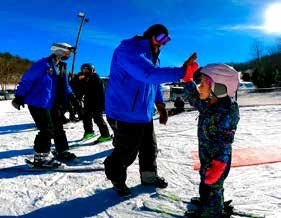
Young Skier in Beluga Explorers (Feb 2022).
Camp counselors and staff guide the kids through daily summer camp adventures such as nature walks, beach volleyball, arts and crafts, and more. Here, kids can escape into nature on the very same slopes that they navigated in the snow just a few months earlier.
During the fall, Whaleback hosts a “Flannel Fest”, which consists of live music, delicious food and drinks, and a silent auction in support of the Upper Valley Snowsports Foundation at Whaleback Mountain.
Thanks to the generosity of local donors and several philanthropic organizations, Whaleback offers scholarships for both the summer children’s camp and winter ski lessons. To date, Whaleback has awarded nearly 100 percent of requests from children and families seeking financial aid, regardless of their ability to pay.
Whether you are learning how to ski, racing down the slopes under the lights, or throwing on a flannel, Whaleback not only offers an escape into nature but also a place grounded in community. Nurturing a sense of connection and belonging has become increasingly important in our society as technology advances and we face a faster-paced life. Whaleback is the ultimate breath of fresh air. It is more than just a mountain –it is a positive force that brings people together to connect on a deeper level through unique experiences.
The past 10 years at Whaleback Mountain would not have been possible without the continuous support of the community. This support is a key component to the sustainability of the mountain and its mission. “On behalf of the Board of Directors and the staff at Whaleback Mountain thank you, we are so excited about the future and it doesn’t happen without our community,” Hunt said.
Learn more, join the Whaleback family, and sign up for our weekly email newsletter, Tales From the Whale, at www.whaleback.com.
The childcare shortage in the Upper Valley has become an increasingly pressing and widely felt issue over the past several years, affecting not just families with children, but whole communities. In Lebanon, the Early Learning Center of the Upper Valley Project (ELCUV) – a 22-milliondollar childcare facility projected to be in business by 2027 – aims to help address this issue.
A pre-Covid Vital Communities study estimated that there was a shortage of around 2,000 childcare openings in the Upper Valley. Now, with staffing shortages and childcare facility closures increasing, this number presumably continues to rise, putting more and more Upper Valley families in a tough spot.
Certain economic and equity problems within the community are a direct result of the lack of quality childcare in the area, says City Manager Shaun Mulholland, who is leading the team for this project.
“We have a lot of highly qualified people who cannot return to work because they don’t have adequate childcare, or they can’t find child care, or they can’t afford childcare,” he says. “This is a critical need in the Upper Valley – it directly impacts the workforce.”
“That’s one issue,” Mulholland continues. “There’s also an equity issue here. Not always, but more often than not, it’s women who are left unable to return to the workplace… while their peers are advancing in their careers and the ability to gain funds for retirement in the future, that woman is falling behind, and that is incredibly unfair.”
The Early Learning Center – which will be located on City-owned land at the new Airport Tech Park on Airpark Road – is a collaboration between the City of Lebanon and the Boys & Girls Club of Central New Hampshire, who will run the facility and provide on-site training for Upper Valley childcare professionals.
“It’s a good partnership – public, private/non-profit – to try to address this problem,” says Mulholland.
The facility is predicted to meet about 10% of the childcare needs in the Upper Valley, by providing care for 140 children ages 0-5 and 60 school-age children through an after-school program, with 51% of spots dedicated to families with low-to-moderate income (at or below an annual income of $73,000 for a family of four). Financial aid packages will also be available.
The center will serve families throughout the Upper Valley region, and conveniently located near route 12A, it will be a useful resource for employees who work in and around West Lebanon.
Funding for the project will consist of grants, state tax credits, and fundraising. Proposals have already been submitted for a congressionally directed spending grant and a community development block grant. The project team will work with corporate partners and set fundraising goals to meet the rest of the projected budget.
While the primary goal of the project is to address the local childcare shortage, it will also embrace the early childhood education model, which is becoming increasingly popular in the U.S., and has already gained traction in the Upper Valley.
“It’s no longer ‘childcare’ (that’s what it’s commonly referred to as); it’s actually early childhood education,” Mulholland explains. “Because we’re teaching kids at young ages, we’re starting to educate them… that’s what we’re focusing on here to allow these students when they do get to grade school that they will have some of the skills that are necessary to help them accelerate through that and allow them to be more productive and effective in the world that we live in.”
“The world is really changing,” Mulholland adds. “When my kids went to daycare, it was daycare – it wasn’t to educate students, it wasn’t to help them socialize… now there are formal programs and curriculums [for early childhood education].”
With this in mind, the project will take advantage of the natural landscape around the building site, including conservation land that will be easily accessible to the ELCUV and the public. Plans for a public park and nature-based learning will be incorporated into the design for the facility.
“There’s a lot of opportunity here… to help our kids get ahead,” Mulholland says.
As an Enfield native, Nicole Ford Burley has a special connection to the Upper Valley and its history. With a background in medieval art history and research administration, Nicole is well-positioned to serve as the Lebanon city historian, chair of the City’s Heritage Commission, and curator for the Lebanon Historical Society. Nicole’s volunteer and professional roles converged recently to inform the writing of her first book, Images of America: Lebanon (Arcadia Publishing, 2023), now available online through the Lebanon Historical Society website, at the Lebanon libraries, and at local bookstores.
William Bliss (1815–1853; standing at left) moved to Lebanon at the age of 7 and enrolled at West Point at 14. He was chief of staff to Maj. Gen. Zachary Taylor (seated) and became Taylor’s private secretary after the general became president of the United States in 1849. William Bliss was a talented linguist able to read 13 languages, and he taught mathematics at West Point. He fought in the Mexican-American War and participated in the forced displacement of the Cherokee people. Bliss died of yellow fever at the age of 37, and the US Army named the El Paso military post Fort Bliss in his honor.
Surrounded by iconic cultural and academic institutions such as Dartmouth College, the Enfield Shaker Museum, the Cornish Colony, and St. Gaudens National Historic Park, Lebanon’s history and relevance in the Upper Valley might be easy to overlook. However, Lebanon’s location along the Mascoma River was significant for the Western Abenaki Indians, who lived close to the land for farming, fishing, and traveling the land and waterways in all seasons. The arrival of European settlers eventually served to position Lebanon and West Lebanon as centers for agriculture, commerce, and industry. This pattern continues today with Lebanon steadily earning livability, recreation, and business-friendly accolades since 2008 when Forbes magazine ranked the City as the #1 least vulnerable town in America, and Bizjournals named Lebanon a Top ‘Dreamtown’.
Writing a book about Lebanon’s history wasn’t exactly on Nicole’s agenda when she and her family returned to Lebanon after a decade of living and working in the Boston area. Getting involved in the Lebanon community was a priority for Nicole, and the book opportunity naturally arose in alignment with her appointment as the City Historian. With a young child, the time commitment required over the year of writing the book was a challenge, but not the biggest one.
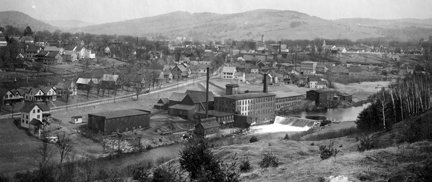
The Mascoma Mill, shown here in the foreground, was first constructed as a flannel mill in 1882 and was expanded as the American Woolen Mill in 1899. The mill’s location near Scytheville preserved it from destruction during the 1887 fire that consumed Lebanon’s other major mills. This photograph was taken from the side of Storrs Hill around 1915 and shows the mill alongthe Mascoma River, with Mechanic Street running beside it and leading into the central Lebanon village in the distance. The towers of the town hall and the First Congregational Church are visible in the background at right, as is the smokestack of the Lebanon Woolen Mill (between the towers). The railroad runs just behind the houses lining Mechanic Street at left.
“The hardest part of writing the book was paring down which images to include,” says Nicole. “Nearly all the images came from the Historical Society’s vast collection.”
Working within strict guidelines set by the publisher, it was a little tricky to pull the correct images to tell Lebanon’s story spanning more than 10,000 years. “I really wanted a narrative shape to the book,” she adds. “Picking the right images to tell that story was challenging. There were many images I wanted to include, but they didn’t fit into the final structure of the book.”
In researching images housed in other collections, Nicole was surprised by the quality of the available images and the generosity and enthusiasm of the organizations she contacted. “I worked with the Vermont Historical Society and they provided a wonderful portrait of Ammi Burnham Young.” Young was a Lebanon-born architect who designed the First Congregational Church in Lebanon and went on to design custom houses and courthouses around the country, as well as many Dartmouth buildings and the Second Vermont State House. Nicole continues, “I received a fantastic image of Phineas Gage from Dominic Hall, the curator at the Warren Anatomical Museum at Harvard.” Gage is still considered a medical marvel for having an iron rod driven through his skull and surviving for many years.
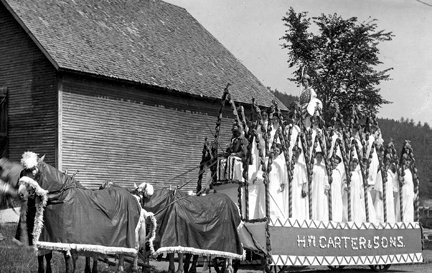
Members of the United Garment Workers of America labor union are shown here posing with their Labor Day parade float on North Park Street around 1905. Many of the union members were employees of the H.W. Carter & Sons factory on Bank Street, including Mary Josephine Stas (third from left), Eliza Copp (fifth from left), and Daisy Dowse (seated immediately to the left of the “U.G.W. of A. Local 90” sign).
The time period covered in the book was Nicole’s decision. “It was really important for me to capture Lebanon’s history even before the Western Abenaki people settled here. I leaned on images of the natural features of Lebanon, as well as maps, for that component.”
The book’s timeline begins around 11,000 BC when the first humans came to the area. “Images of Lebanon’s pre-history are more like place settings, and they build a foundation for 10,000 years of history.” For the first Abenaki settlement, Nicole obtained an impressive image from the Archives de la Ville de Montréal of an early Abenaki couple. There are a total of 204 different photographs in the book, each with a well-researched caption contributing to Lebanon’s story. “I am at the point now where I can look at the book from an evaluation perspective. I’m quite happy with how it turned out, but it could have been twice as long. I could easily do another book with an entirely different set of topics.”
Forty families from single-family homes and apartment buildings were displaced by the 1887 fire. Many of their hastily evacuated possessions, loaded into wagons and sleighs, found safety in Colburn Park alongside the contents of the liveries, gristmills, machine shops, grocers, cobbler shops, and photography studios destroyed by the disaster. Remarkably, no lives were lost in the fire.
Writing the book deepened Nicole’s understanding of Lebanon’s history. “It required me to think about all the different facets of Lebanon’s history, and in particular the architectural and building history, and it also reinforced my understanding of how neighborhood-focused Lebanon has historically been. I also had to expand my thinking about the City’s recreation and athletic history.” Historically, like many Upper Valley towns, Lebanon was made up of village centers (Lebanon and West Lebanon) and surrounding regions like Hardy Hill and Poverty Lane. “An entire history could be done about each neighborhood,” says Nicole.
It was important to make sure West Lebanon was well represented, according to Nicole. “It’s natural to focus on Colburn Park and the center of the city. In the Mascoma and the Mills chapter, I included references to the Connecticut River, and I tried to include as many of the geographic areas as possible. West Lebanon could still have its own book!”
On April 30, 1886, the Atlantic attempted to cross the bridge at Chandler’s Mill (near Riverside Drive). However, the bridge was designed for older, lighter trains, and the 60-ton locomotive caused the bridge to buckle. The engine crossed before the bridge failed, but three freight cars were caught in the collapse. There were no serious injuries, and, remarkably, the wreck was cleared and a temporary bridge was installed by the following evening.
In her day job, Nicole manages research grants as the senior manager of research administration for the Institute of Human Development and Social Change at New York University. She has also worked with biomedical engineers and in cancer research, and is currently focused on education and working with students in inner-city schools. “One of the most exciting projects we’re working on is supporting a version of Sesame Street in Arabic,” says Nicole.
Writing the book fit well with Nicole’s professional training. “I knew I wanted to do it right away, but it was incredibly ambitious. I discussed the idea with the Historical Society because the majority of the photos were coming from our collection. The group felt that we had such a great collection, so why not share it.”
Nicole credits her predecessors at the Historical Society with setting up and maintaining strong organizational systems for the papers and artifacts in the society’s collection. “Previous curators and custodians have done a great job,” says Nicole. “Robert Leavitt (a previous long-time City Historian) was before my time being involved in Lebanon’s history, but he wrote extensive reports on houses and scribbled notes on tiny slips of paper to remind himself to come back and expand on different aspects.” Nicole first came across Robert Leavitt as a college student. “The most inspirational thing about him was that his commitment to Lebanon’s history was transcendent. You can’t touch anything in Lebanon’s history without encountering him. I try to have that same level of commitment.”
One of Nicole’s primary interests is the history of individual buildings. “I love looking at the photos of buildings throughout different eras – when a building was built, how it has changed. The most common request we get is from people who have just purchased a house and want to know more about it.” Nicole and her Historical Society colleagues look through the Society’s document collections and deeds, researching previous owners and other information related to the house to share.
Community support for the book has been gratifying following a successful launch party in September. “I’ve been blown away by how many people have expressed interest and enthusiasm for the book. We sold 115 copies at the launch and the Historical Society inventory was completely sold out.” The publisher takes care of supplying the major vendors and author appearances at local bookstores.
Nicole hopes the book will have a positive impact. “My major hope is that people will develop a better understanding about Lebanon’s history. I wanted it to be readable for people with as many interests and perspectives as possible.”
Nicole Ford BurleyImages of America: Lebanon
For more information or to get involved in volunteering with the Lebanon Historical Society, contact Nicole Ford Burley nicole.ford.burley@gmail.com.
By the time the ink had dried on the 501(c)3 paperwork declaring “Lebanon in Service to Each Neighbor (LISTEN)” an official nonprofit in 1973, the start-up activist collaborative had already racked up some significant accomplishments.
In the early 1970s, the conversation around town might have sounded familiar to modern ears: it centered on the shortage of quality, affordable housing for the people who lived and worked in the city. The city’s residents were in favor of the idea of public housing, but then – as now – the question had been about exactly where to put it. In late 1971, the City Council had rezoned South Main Street in West Lebanon to rule out anything other than single-family homes. But by the end of the following year, not only had a tight-knit band of parents and activists helped to overturn that decision – leading to the Lebanon Housing Authority’s construction of Romano Circle –they had also started a food co-op, a community garden, and a thrift store, and had begun to focus their efforts on a proposal for expanded tenants’ rights. Fifty years later, LISTEN Community Services is still working hard every day to serve those in need, in Lebanon and beyond.
LISTEN’s founder, Marcia Boutincurrent executive director, Rob Roy McGregorcomms coordinator, Roscoe Putnam
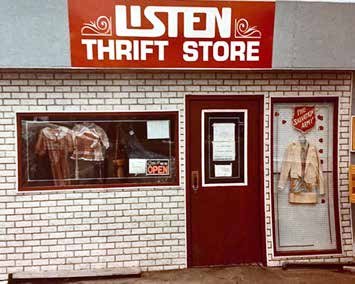
It would be impossible to explain the early days of LISTEN without mentioning Marcia Boutin – its founder, first chairperson, and (as everyone will tell you) the driving force behind its early achievements. By all reports, Boutin was an activist in every sense of the word. In 1972, she showed up to City Council meetings to complain that the City’s “substandard housing board” rarely, if ever, met, and that there were dozens of “wrecks” it should be addressing – complaining that she had personally been working on three of them, but that it was a losing battle without City help. The fact that she had been doing so while both founding a community garden on Heater Road and opening a thrift store in the side of former Olympian Ernie Dion’s ski shop on Hanover Street only serves as further testament to her commitment to the cause.
Early Listen thrift store, circa 1980s
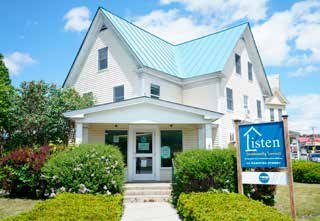
According to Roscoe Putnam, LISTEN’s Communications Coordinator, the thrift shop began as a way to fund the organization’s community aid efforts. “[Marcia] went to the community and said, you know, you donate [the clothes], we’ll put them all on hangers. We’ll sell them for fifty cents and we’ll give the money away to anybody who needs heat or food or whatever else.” By 1973, the shop had moved to 92 Hanover Street, the site of the drive-through for the present-day Jiffy Mart and Dunkin’ Donuts. But even that home proved too small for the quickly-growing organization, and in 1976 they purchased 60 Hanover Street, at the time known as “Scotty’s Boarding House,” and made it LISTEN’s central office. “We had a thrift store downstairs, a food pantry in the back, and [offices upstairs].”
Over the years the thrifting operation expanded further. They opened a second location in White River Junction in 1980 and expanded into Canaan in 1985. In 2013, LISTEN opened their River Point Plaza in White River Junction – renamed the Bourne Center in 2016 after former executive director Merilynn Bourne –which houses not only a thrift store and a used furniture store but also the kitchen and dining hall for their Community Dinners program. In 2018, they purchased the old Bridgman’s furniture showroom on the Miracle Mile and moved their Lebanon thrift store to where it is today. While the stores aren’t solely to fund the other work the charity does – they don’t sell everything they take in, offering vouchers for clothes, shoes, kitchenware, linens, and even furniture to those in need –according to the organization’s 2023 Annual Impact Report, last year the stores generated 22% of LISTEN’s roughly $1.5 million operating budget.
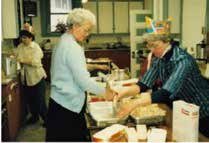
That budget goes towards fulfilling LISTEN’s core mission, “to provide services and support to meet the critical needs of Upper Valley individuals and families,” and few needs are as critical as food. The community garden, first planted in June 1972, was meant as a part of the “Food Co-op” LISTEN had started in March of the same year. The Co-op was intended as a way to shrink families’ grocery bills and provided roughly 75 families a week with nonperishables, bread, and around 25 varieties of fresh vegetables from the garden. There was even a canning operation, both to provide preserved vegetables for the winter and to teach families how to preserve produce for themselves. The Co-op also worked with local businesses like Cabot Creamery to provide access to cheese and milk at wholesale prices, a model that persists to this day, with McNamara Dairy providing milk to the Food Pantry at a deep discount. The community garden and Co-op programs eventually evolved into the modern-day Food Pantry, which had over 11,000 visits last year. Also, in 1986, LISTEN took on the responsibility for the “Soups On” program, which was a weekly free dinner program run through local churches. It was quickly renamed to the Community Dinners program, and in 1994 it found a more permanent home in Canaan. Today, the dinners are served Monday to Friday from 4:30 to 5:30 at the Bourne Center in White River Junction, last year serving almost 33,000 meals.
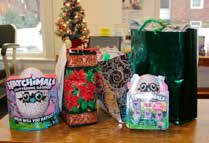
LISTEN Holiday Baskets LISTEN Community Dinner at Sacred Heart Church c 1987
LISTEN also serves the community in other important ways. In 1982, when the Winter Home Emergency Network (WHEN) dissolved, LISTEN took on the home heating assistance program itself. In 1998 it became their Heating Helpers program when it became internally funded. In 2002, the organization began its Housing Helpers program, providing one-time grants and legal assistance to help community members stay in their homes when they are at risk of losing them. Last year alone, those programs helped over 1500 people stay warm and prevented over 350 evictions.
Although they have stepped back from aid specifically for children and teens in recent years – in 2020, they transferred ownership of the Junction Youth Center in White River Junction to Second Growth, an organization more tailored to youth aid and outreach – LISTEN still does a great deal to support children in the area, running an annual Holiday Basket program and giving out scholarships for students to attend summer camps when they otherwise might not be able to. The Holiday Baskets program began in 1980, and today provides groceries and winter clothing for under-18s and seniors, and the Summer Camp Scholarship program began in 1990 and last year made it possible for 186 students to attend summer camps.
The Holiday Baskets and Summer Camp Scholarship programs were also two things Roscoe Putnam mentioned when asked about the benefits of being an independent charity rather than a government agency. “It may be hard for the government to see the need for summer camp scholarships and holiday baskets. Why do you need a holiday basket?” It could be hard, he argued, to sell the need
for summer camps to a government-run program that’s beholden to voting taxpayers, but “[it’s] an opportunity for kids to have some good memories of summer, not [just] sitting at home, sitting on the steps, bouncing a ball.”
The wide diversity of programs offered by LISTEN is at the core of the way the organization operates today, and that flexibility is important for LISTEN’s future, as well. In March, Rob Roy McGregor was appointed as the new executive director of the nonprofit, after almost twenty years as President and CEO of the Southern District YMCA in Exeter, New Hampshire. When asked about the future of LISTEN, he said he sees it as “a social enterprise, where you have a core part of your organization that generates revenue to support other elements of your organization that can’t support itself.” He said it was important for the charity to continue “to be able to generate the revenue through our thrift stores and [to] be able to use that as a revenue driver” to fund their fuel assistance and food insecurity work. He also wants it to be a “community driver for sustainability and environmental impact,” describing a kind of virtuous cycle, diverting clothing and goods from landfill and into reuse, all the while using the proceeds to help those in need.
McGregor seems to feel as though, at LISTEN, he’s standing on the shoulders of giants. He refers to himself and others privileged enough to do the work as “stewards,” of “fifty years of history.” “That’s all we can do, is to try to build on the pillars of what each of us has done.” As a final thought before rushing off to another meeting, he added a final, pragmatic thought about the future: “I’d love to see us out of the food industry and food insecurity business because that doesn’t exist in this world [anymore]. I don’t see that happening. And I’d love to see us out of the housing insecurity world because that doesn’t make sense, but I don’t think that will happen [either]. Until then, we just have to keep moving forward.” With fifty years under its belt, LISTEN has proven that it can do just that.
Shelf stable food and personal care items can be dropped off at LISTEN’s main office at 60 Hanover Street from 10 am-4 pm, Monday-Friday, and monetary donations can be made by going to listencs.org/make-a-donation-now.