


The Nexus Festival: “Our Olympics”
When Joe Clifford became the executive director of the Lebanon Opera House in 2017, one of the first things on his mind was the 100th anniversary season. Since then, there have been some ups and downs for the live entertainment industry, but the Nexus Festival – the Opera House’s response to the challenges of the pandemic – highlights not only the executive director’s vision, but also the hard work of everyone at the nonprofit, plus the incredible engagement of the whole community in supporting, preserving, and celebrating an important center for culture and the performing arts in the Upper Valley.
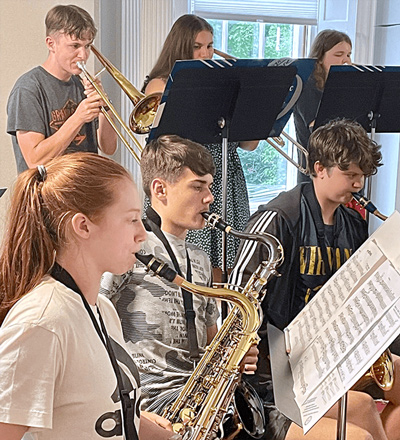
High school students from the Upper Valley Music Center
kick off Day Two of the Nexus Festival in 2024. (Photo from lebanonoperahouse.org)
The Nexus Festival was born out of the pandemic. Everything shut down in March of 2020: from office work to restaurants, meetings to movies, everything that could do so “went remote.” Needless to say, this posed a problem for a community organization whose focal point is a live, in-person entertainment venue. “By six months in,” Clifford says, “we were getting pretty squirrelly.” But at the same time, it was also becoming fairly clear that the safest place a person could be was outdoors. “At that time, people were doing drive-in movies, outdoor concerts – any workaround not to be in a contained space.” That was when he and the Opera House’s technical director, Joel Giguere, started to formulate a plan.
“We hit upon the idea of doing our festival in downtown Lebanon,” Clifford says. On the one hand, it would allow them to continue with their mission, “by doing events, bringing people together.” But it would also serve as a thank you to a community that helped them to survive. “Even though we weren’t doing programming, they were there to support us during that closure.” The Lebanon Opera House is a nonprofit, and, as Clifford told the Valley News back in 2021, half of their revenue stream at the time came from donations, with the other half coming from events: “To have one half of your revenue stream completely shut down is terrifying.”
It took a year of planning, organization, and elbow grease to see the plan turn into reality. The first Nexus Festival ran for three days: Friday to Sunday, August 13-15, 2021. As with this year’s event, they had three stages: the main stage in the parking lot behind City Hall, the bandshell in Colburn Park, and a “busker stage” directly on the Mall. Featured acts included Bitter Pill, a NH “rhythm and bluegrass” group, Mystic Bowie’s Talking Dreads, who reimagine the hits of the Talking Heads as reggae anthems, and Red Baraat, a NYC-based funk, punk, and hip-hop band with a Punjabi bhangra flair. The festival has only grown since.
This year’s Nexus, the Opera House’s fourth, was bigger and better than ever. Friday evening’s acts may have been moved indoors thanks to Tropical Storm Debby, but they didn’t suffer for the venue change. Jax Hollow kicked things into gear with her signature riff-driven blues rock and an energy that was more than enough to overcome the soggy start to the weekend. Next, the Clements Brothers kept the crowd enthralled (and dry) in the Opera House’s lobby with a gentle combination of guitar, upright bass and harmonies, until grammy-nominated singer-songwriter, Joan Osborne, took to the main stage, playing new singles and old stalwarts alike.
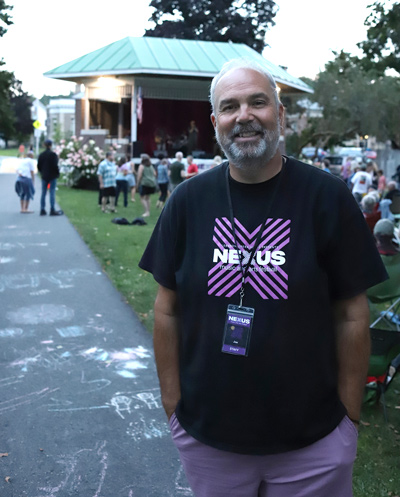
Lebanon Opera House Executive Director Joe Clifford
stands in front of the Colburn Park bandshell Sunday night.
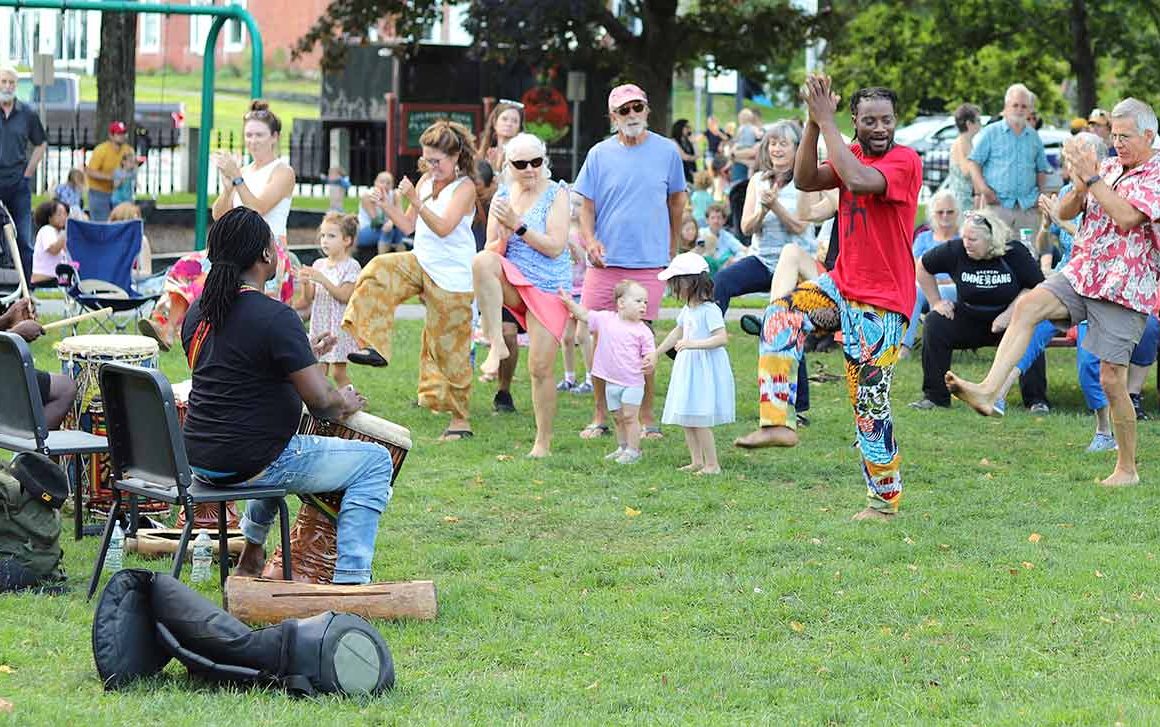
The sun came out Saturday and shone on a full day of eclectic acts, both local and wide-ranging. Notable acts included a dance workshop in Colborne Park led by West African music and dance ensemble Jeh Kulu; Los-Angeles-based folk punk singer, songwriter, and guitarist Sunny War; and a boisterous set by self-described “foot stomping freak folk” collective Bella’s Bartok that had crowds dancing in front of the mainstage well into the night.
Sunday saw yet another day of acts, with an afternoon of jazz and soul by performers like Nation Beat and Soul Porpoise giving way to the mainstage finale: The Full Cleveland. Described as “Vermont’s premier Yacht Rock band,” they played hits by the likes of Steely Dan, Hall & Oates, and Toto to much fanfare. According to Clifford, “the closing band on Sunday has always been a cover band. The first year was a tribute to Van Morrison, the next year it was tribute to the 80s, and then last year was tribute to Prince.” The Full Cleveland did not disappoint.
All in all, this year’s festival had over twenty acts split between the three stages, drew thousands of attendees, and – thanks to the generosity of the festival’s many sponsors – it cost the music-and dance-loving public absolutely nothing. This year, the Opera House’s costs hit “about $60,000” for the festival, Clifford says, between paying artists and extra staff onboarded specially for the event. That also doesn’t include the “army of volunteers”: 20-30 people working 3-hour shifts, doing everything from crowd control, to handing out information, to physically guiding attendees between the stages.
That estimate also doesn’t include the seven months of work that lead up to the event. “Probably in January” is Clifford’s answer to when the planning starts, but he immediately backtracks, explaining that in a way, he’s always thinking about it. The decision to try to get Sunny War, for instance, began when he saw her perform in Nashville back in September of 2023. But “after the holidays,” he says, “that’s when I’ll start putting out offers, and the tech team will start thinking about changes and tweaks to the setup.” He starts recruiting volunteers in March.
But even though it’s an incredible amount of work, and also (as he gently puts it) “a break-even event,” Clifford sees it as something more. “It’s a point of entry,” he says. “The evolution would be, you come to the free festival, and then this fall, come across the street. Go buy a ticket at the box office, go to the show, you know?” If the announced lineup is anything to go by, Nexus attendees will have more than enough reasons to come back.
In fact, looking at the fall schedule, the weekend’s festivities were only the opening act for an exciting season to come. The reason? This October marks the 100th anniversary of the Lebanon Opera House’s construction, and Joe Clifford has been making plans. When he joined the team in 2017, fresh on the heels of a 17-year stint at the Hop, he had already decided that the Opera House’s 100th anniversary season would be a blockbuster one. The response was, as Clifford describes it, a slightly quizzical “okay, but that’s not until 2024?” But there was a lot that needed to happen first. Building the kind of momentum that would be needed would take, in his words, “a seven-year runway.”
It hasn’t always been easy for the performing arts in Lebanon. Back in 1924, when the 100-year-countdown started with the construction of a new Town Hall, it wasn’t unusual for civic buildings to come with a public performance space inside. But, according to city historian Nicole Ford Burley, “it quickly became clear that live theater was out and movies were in.” For decades to come, the Opera House would serve as Lebanon’s local cinema, until that venture closed in 1969. After that, an attempt was made to bring live performances back – an attempt that was stymied by a temporary blacklisting by Equity (the Actors’ Equity Association) because of the state of the green room and other preparation spaces. In 1975, after a renovation, the Lebanon Opera House reopened to great fanfare, with a pre-Broadway production of Moss Hart’s “Light Up the Sky.” “It was a big deal” at the time, notes Ford Burley. Since then, the venue has played host to increasingly notable acts. Among others, pianist George Winston graced the stage in 1996, Marc Cohn performed in 2010, Buddy Guy shredded his way through town in 2012, and Chris Isaak crooned for a full house in 2016.
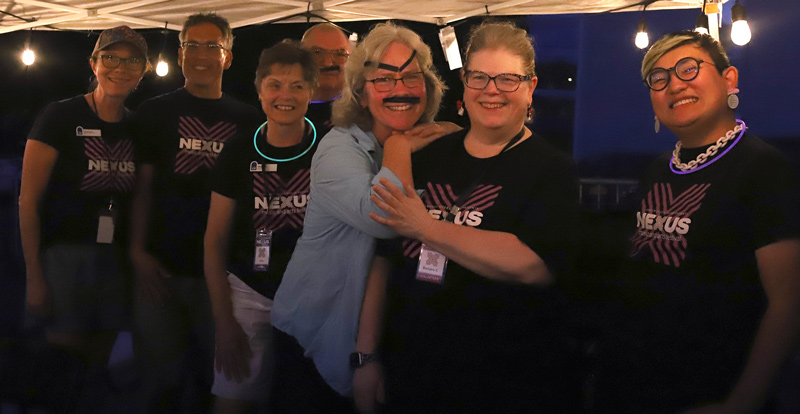
Opera House staff, board members, and volunteers pose under a tent Saturday night. L-R: Kristen Coats, Paul
Coats, Chris Morin, Bob Winters, Patrice O’Brien, Barbara Sterling, and Lucas Mendelsohn.
But Joe Clifford is more ambitious. Under his leadership, the Lebanon Opera House has undergone a major renovation, including a new lobby and concessions, a complete makeover of the performance hall, and improvements to the sound systems and the lighting, all funded by a community-driven capital campaign. “We bought a piano, we built up our donor base, and the staff. To get us ready…It’s like a marathon, right? It’s our Olympics.” And if that’s the case, then it’s clear that the Opera House doesn’t intend to sit out any of the events.
At the time of writing, announced acts for the fall season include the multiple Grammy Award-winning blues-rock band Blues Traveler; singer-songwriter and sometime lead singer of the Canadian indie-rock group The New Pornographers, Neko Case; an evening with Pulitzer-Prize-winning NPR host Ira Glass; hot off his Netflix special “Sweet & Juicy,” comedian Sheng Wang; the incredible participatory musical experience Choir!Choir!Choir! with “An Epic Queen Singalong”; and for the ballet fans, the World Ballet Company will be performing Swan Lake – and that only takes us to the end of November. Clifford gives assurances that there’s more excitement yet to be announced.
“In some ways, it’s a look back on the last 100 years,” Clifford says of the upcoming season, “But also, maybe more importantly, what’s coming forward. It’s [about] the future of the arts in this community. The future of live arts in general.” With Clifford at the helm, a capable team by his side, and a whole community at his back, it’s hard to think that the future will be anything but bright.


Leave a Comment