Home
Our team
Content
    Cover Story
    All Articles
    Animals Rule!
    Around Town
    Cityscapes
    Community Impact
    Elder Profile
    For The Love Of It
    Good For You
    Goodness InDeed
    Green Page
    History
    Local Sports
    Meet your Neighbor
    Miscellaneous
    Spotlight on our Sponsors
    The Arts
    Your Green Spaces
Advertise
Archives
Donate
Contact


The Lebanon Times - Good people, good places and good things happening
  • Home
  • Our team
  • Content
    • Cover Story
    • All Articles
    • Animals Rule!
    • Around Town
    • Cityscapes
    • Community Impact
    • Elder Profile
    • For The Love Of It
    • Good For You
    • Goodness InDeed
    • Green Page
    • History
    • Local Sports
    • Meet your Neighbor
    • Miscellaneous
    • Spotlight on our Sponsors
    • The Arts
    • Your Green Spaces
  • Advertise
  • Archives
  • Donate
  • Contact
All, Cover Story

Did Someone Say “Free Skiing”?

March 5, 2025 by Frank Orlowski No Comments

If you’re a skier, you are well aware of the hit your wallet takes on a weekend ski adventure. Lift tickets for you and a partner, maybe a child or two, add in hot chocolate, a burger and chili, maybe an adult beverage mid day…the costs add up quickly and substantially. That is, of course, unless you are skiing or snowboarding at Lebanon’s own Storrs Hill this winter season.

Thanks to a generous gift from the philanthropic Jack and Dorothy Byrne Foundation, visitors to the Lebanon ski area paid nothing for their lift tickets during the ’24/’25 season. That’s correct; skiers and snowboarders experienced free tickets at the venerable hill in the heart of town. So did area winter enthusiasts take advantage of that economical opportunity?

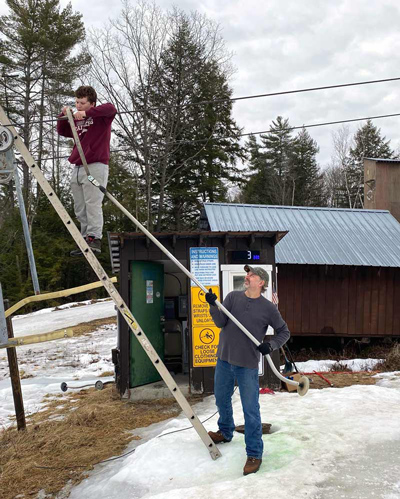
Volunteers help keep Storrs Hill ship shape all season long.

Volunteers help keep Storrs Hill ship shape all season long.

“[On] opening weekend, we saw over 600 skiers from Friday through Sunday,” says Cory Grant, president of the Lebanon Outing Club (LOC), which operates Storrs Hill. That number sounds impressive, especially so when Grant adds, “In the past, we would be lucky to see maybe 15 skiers on a Friday, 40 on a Saturday and Sunday.”

Not surprisingly, the free skiing offer brought many new skiers to Storrs Hill, opening their eyes to this community treasure. “Some locals didn’t know we existed until [now],” says Cory Grant.

Storrs Hill has a long history with Upper Valley skiers. A ski jump was first built on the hill in the 1920s (Storrs Hill originated as a ski jump area), and in the early ’30s, the first alpine trail was developed on the hill. A rope tow was added for skiers in the mid ’30s, which makes Storrs Hill one of the oldest continually operating, lift-served ski areas nationally. Over the years, improvements such as snow making and the POMA lift were added to the ski and ski jump operation.

The history of Storrs Hill cannot be told without mentioning the name of one of the world’s greatest alpine skiers. World Cup and Olympic champion Mikaela Shiffrin spent some of her early years skiing at Storrs Hill, before moving on to Burke Academy and the U.S. Ski Team. In the early 2000s, Shiffrin could often be found practicing for hours on the Storrs Hill ski slope. Another prominent local athlete, Lebanon’s Nick Alexander, learned the art of ski jumping at Storrs Hill as a child, and went on to be a long time member of the U.S. Ski Jumping Team, appearing in two Olympics.

Photos from LOC Facebook page

Photos from LOC Facebook page

The history of Storrs Hill is closely tied to the Lebanon Outing Club. For decades, volunteers from the LOC have operated and maintained the ski area. “The Lebanon Outing Club is a non-profit organization outside of the City of Lebanon, that has to fund the Storrs Hill Ski Area in order for it to be operable,” says Cory Grant. Though one source of funding does come from the City of Lebanon, the LOC must continually seek funds from other sources, such as the Byrne Foundation, to keep operating the ski area each year. Grant says the LOC volunteers spend considerable time writing grants and fundraising for hill operations. Prior to this season, lift tickets and season pass sales also helped run Storrs Hill, though the LOC always kept those prices low to allow as many as possible to use the slope.

“We are still seeking more donations to help with operations; we have to look for business support and community support to keep the ski area functioning,” says Cory Grant, adding, “We have had some unforeseen activities that have cost us a lot this season with snowmaking, and grooming equipment.”

The charitable gift to offer free skiing this winter is not the first time the Byrne Foundation has assisted Storrs Hill. In recent years, the Byrne Foundation provided grants to repair and upgrade equipment and mechanical operations at Storrs Hill.

Snowmaking at Storrs Hill ski area, overlooking downtown Lebanon.Snowmaking is one of the many jobs

Snowmaking at Storrs Hill ski area, overlooking downtown Lebanon. Snowmaking is one of the many jobs

With such a dramatic increase in the number of skiers at Storrs Hill this season, it seems natural that more LOC volunteers would be needed to assist in operations. Cory Grant confirms that, saying, “Volunteers are roughly one per top, and one per bottom [on the slope]. Now we are looking to have at least four so we can do shifts and have a couple of people to help at bottom with [those with novice] abilities.”

So with the increased number of patrons, does the LOC welcome more volunteers? “Yes, we are looking for as many volunteers as possible,” Grant says.

Having a local, community ski area, especially one that offers its slopes at no charge, is a rarity. To make that possible, the community must depend on the generosity and goodwill of others. With a little help from volunteers and donors and grateful patrons, Storrs Hill will remain a hidden gem in Lebanon for years to come.

For other winter activities to explore in Lebanon, read “Mastering the Art of ‘Wintering’ in Lebanon” in this issue on page 22-23.

Share:
Reading time: 4 min
All, Cover Story

Striking at Success on the Playfields: Lacrosse Club Propels Local Athletes to High Levels

by Isabella R. Vanasse No Comments
Coach Taylor Miller and Lebanon resident, Caroline Knittle.

In the spring of 2022, the former director of the local girls athletics program, Echo Lacrosse, announced she was moving out of the area. When parent and educator Vicki McCorkle heard this, she immediately stepped up to the plate. She knew she wanted her three young daughters, and the broader Upper Valley community, to continue to benefit from a competitive youth lacrosse program. “I’ll do whatever it takes,” McCorkle had reported to the former director, expressing her intentions to keep the program going.

So after Vicki McCorkle expressed her willingness to lead, the former Echo Lacrosse director “paired [me] up” with another parent and educator, Kim Higgins, she says. Higgins had played Division I college lacrosse at Virginia Tech.

Morgan Fitts and Vera Linter at Echo Lacrosse summer camp in Lebanon.

Morgan Fitts and Vera Linter at Echo Lacrosse summer camp in Lebanon.

Higgins became the new head coach of the Lebanon-based program, while McCorkle became its director of operations. Like McCorkle, Higgins is also a mother of three growing daughters, so they had seen each other on the sidelines from afar prior to their newfound partnership.

McCorkle attests that Higgins has become “a friend I never knew I needed…We both saw the value in this program to the community.” Both have certainly shown unflagging commitment to Echo Lacrosse. Over the years, it has grown from a small exclusive program, serving primarily the Hanover and Norwich communities, to an organization that draws girls and boys from all over the Upper Valley, including seven towns last season, with many players hailing from Lebanon.

The expanded program now offers year-round programming for girls in grades 3-12: from a club team in the spring, camps in the summer, Sunday drill sessions in the fall, and indoor skill development in the winter, to keep development of technical skills sharp. Boys in grades 3-12 now too benefit from a high level of competition and offerings three seasons a year, including camps, fall Sunday drills, and competitive spring club teams, with all play rooted in New Hampshire.

In the winter, girls’ programs practice indoors at the CCBA (Carter Community Building Association), a nonprofit recreation and fitness organization in downtown Lebanon. Why continue with lacrosse in the winter if girls are already committed to their ice hockey or basketball teams? To Nordic or Alpine skiing organizations? Higgins paints the landscape: The sport of lacrosse is growing in regions of the country, and world, with prolonged outdoor play. “It’s an incredibly technical sport in terms of hand-eye coordination,” she says. “If you’re able to play lacrosse year long, you have a technical advantage.”

In the warmer months, athletes practice on the CCBA-owned fields behind the brick and mortar facility. CCBA “has become a pivot point for us,” explains Higgins. “It’s centrally located, so people can see what lacrosse looks like out here on the fields…there’s still a lot of people who don’t know what lacrosse is…and the staff have become a great partner supporting us any way they can.”

Team cheer at the end of practice.

Team cheer at the end of practice.

But Echo Lacrosse is more than a recreation outlet for Lebanon youth and their neighboring p eers. The organization’s directors have aimed to develop an extraordinarily high level of competitive play that stays as local as possible – a gem of an offering these days.

Competing on a club team for young athletes of the Upper Valley typically requires families to commute to Manchester or Boston, just for practices. Club team travel for away-games stretches to the far reaches of the Northeast: for lacrosse, the hotbed communities are Maryland, Philadelphia, and Long Island. Game and tournament travel to these locations, or Florida or Texas, typically occurs eight to a dozen times annually.

That’s why Higgins and McCorkle set as a top intention for their program to provide local lacrosse players with a high level of competitive play and multi-season skill development within their own broader Upper Valley community.

Enter Echo Lacrosse’s spring club program: Echo’s primary season of operating center-stage. The eight boys’ and girls’ Echo Lacrosse teams compete against other New Hampshire club teams through the New Hampshire Youth Lacrosse Association (NHYLA). Echo hosts its home games at the Kimball Union Academy (KUA), also a fairly central location for its Lebanon High School, middle school, and elementary athletes.

“It’s been a labor of love,” recounts McCorkle. Beyond serving their daughters, McCorkle and Higgins have been able to help Upper Valley families stay in Lebanon and Meriden for a high-level of competitive play during the travel club season, and in keeping their hands on the stick in the off-season.

Juggling eight spring teams and year-round programming, Higgins and McCorkle are far from a two-woman show. Many layers of collaborative and selfless contribution have watered and fed Echo’s profuse and quality expansion. Higgins and McCorkle are quick to spread the credit around the table: Higgins opens by noting, “We inherited a very nice program.” What’s more, Echo receives a steady amount of support from a vast and impressive array of coaches, guest speakers, and supporting organizations, such as Lebanon’s CCBA and Empower Lacrosse.

Yes, Echo Lacrosse skillfully “leverages” the incredible array of coaching and educational resources within the Upper Valley community. But much more than this, Higgins continues, “in this community, there’s a lot of willingness: [people routinely ask] ‘how can we help?’”

For instance, Echo has benefited from a cast of coaches that includes former and current Division I players – from Dartmouth College and elsewhere – former high school players, and expert teachers: Taylor Miller, for one, a current medical student at the Geisel School of Medicine and graduate of West Point. She played goalie on the military university’s Division I lacrosse team and now presently coaches goalies for Echo Lacrosse.

The diversity of contribution has also come from local sports psychologists, who talk to the players about balance and emotional well-being, and coaches who are trained or experienced educators – who know the ”science of learning.” Higgins clarifies, “educators know that learning a technical skill like lacrosse is not a linear path. There are plateaus, there are dips when new skills are acquired.” Even more than this, the Echo Lacrosse directors work to educate their experienced lacrosse coaching staff with teaching principles, and their experienced educator coaching staff with the principles of the game. “We have a good balance [of type of coaching expertise] on most of our teams,” Higgins describes.

Support has also come from the distinct complementary organization, Empower Lacrosse, which exists exclusively to offer financial support to Upper Valley players, and their families. Proof of income is not even required. According to Higgins and McCorkle, the Upper Valley Lacrosse community really wants everyone to be able to play lacrosse.

Empower Lacrosse is not the only player committed to keeping the sport financially accessible. Echo itself recently paired up with CCBA to offer a gear swap to make “this expensive sport accessible to everyone.” Higgins continues to marvel at the behind-the-scenes collaboration: the dynamic with CCBA and Kimball Union has always been one of mission-oriented problem-solving, she reports. “The conversation with them will start with the query, ‘we’re thinking about …a gear swap (for instance); there’s a need…’ So we sat down and had a problem-solving meeting.” The response is always unequivocally, “‘sure, let’s think about this.’”
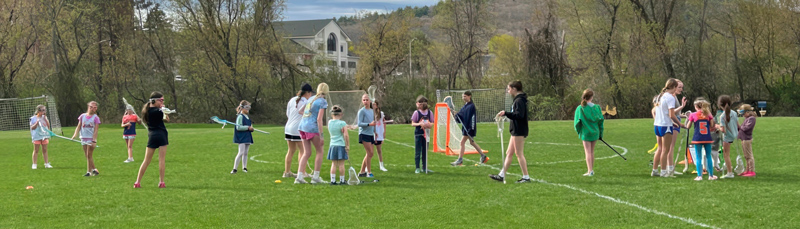
Echo Lacrosse practicing on playing fi elds at the CCBA in Lebanon.

Echo Lacrosse practicing on playing fi elds at the CCBA in Lebanon.

Another noteworthy contribution from the leadership at CCBA has been to support Echo’s three weeks of half-day summer camps by partnering to provide wraparound childcare.

For their own part, Higgins and McCorkle strive to collaborate beyond Echo’s domains as well. When winter snow flurries begin to fly, Higgins and McCorkle reach out to query how to best support the high school lacrosse teams during Echo’s off-season development program. Higgins recounts, each year at this time, “[We] contact the high school coaches to ask, ‘How can we support you? Is there any [specific skill] you need us to work on [with] your players? How can we help your players get ready?’” What other types of support do your players need?

This cycling back to reflecting on how to best support the personal development of young athletes weaves throughout this interview for the Lebanon Times. McCorkle opened our evening’s conversation at CCBA musing, “We talk about this a lot. How to help each child develop not just as an athlete, but a person and a friend.” Higgins concurred: “We focus a lot on the intangibles…We encourage whatever [activities] a child is interested in…We also talk about how to hold each other and ourselves to high standards, standards of excellence…in a non-confrontational way.”

The focus and commitment of Echo’s second phase, with McCorkle and Higgins at the helm, has paid off: in their community-wide relationships, their friendship and professional collaboration with one another, their impact upon countless Lebanon youth, in the saving of innumerable Lebanon families from extensive driving beyond state limits; and not least of all, with the successes of their own daughters on the lacrosse field.

Lena Braga and Maddy Pearce at Echo summer camp in 2024.

Echo Lacrosse practicing on playing fi elds at the CCBA in Lebanon.

Higgins’ eldest, Sadie, is beginning her first year playing lacrosse for the Naval Academy. Her middle, Maggie, is a junior lacrosse player at Holderness Academy. The youngest daughters of both directors, Campbell and Clare, play on the eighth grade teams and help with the younger Echo Lacrosse groups.

McCorkle’s middle daughter, Allie, is a current player at the University of Colorado, another hotbed lacrosse region of the country. McCorkle’s eldest daughter, Maddie, just completed her tenure as a standout on the starting roster for Duke University, her father’s alma mater. She’s now working toward a master’s degree at the University of Virginia, studying public policy, with an interest in sports leadership. Maddie looks at sports philosophy underpinnings: how to help all players, not just the standouts, to feel belonging?

Both McCorkle and Higgins, as current and former educators, both know the importance of respectful and positive interactions. At the Ray School in Hanover, where McCorkle is a speech language pathologist, the philosophy of respectful interactions predominates their educators’ perspectives: at the Ray School as at Echo, “How can everybody feel seen? Everybody [needs to] get a greeting …Every single person should get a touch point, (for example) ‘I’m so glad you’re here,’ explains McCorkle. “People need to feel seen and valued for more than being …the best [at a sport].”

The focus on steady service, focused contribution, and the whole child’s well-being seems to be bearing fruit for many.

When Higgins observed the girls arriving at the first session of the winter program, returning to Echo Lacrosse and CCBA after a month away, she heard exclamations of greetings between not just teammates, but friends. “We’re building something special.” McCorkle nods in agreement: “you get a sense we’re their people. We are their community.”

“It’s about so much more than lacrosse,” McCorkle summarizes. “It’s about community and learning about yourself, as a person and a teammate.”

During all seasons of the calendar, from the neighborhood gym and fields of CCBA, young Lebanon athletes are maneuvering, spinning, pivoting, and stretching their lacrosse sticks – and spirits – towards their goals, and their own personal best.

Share:
Reading time: 9 min
All, Around Town

Nature’s Wisdom in Art

by Rose Terami No Comments

We’re excited to share that one of the Lebanon Times’ beloved writers, Cindy Heath, has a fantastic art show on display at the Kilton Library in West Lebanon through March. Cindy is a talented artist and writer who cares deeply about the environment, evident in her work with local gardens and as a member of Sustainable Lebanon, and in her constant advocacy for protecting and respecting the nature around us.

Cindy’s hand-dyed and screen-printed silk panels, representing the colors on the color wheel.

Cindy’s hand-dyed and screen-printed silk panels, representing the colors on the color wheel.

Her quilted art exhibit, titled “Nature’s Wisdom”, features vibrant and evocative depictions of various elements of nature that are important to Cindy, and that she hopes will inspire others who view her artwork to consider their relationship with the natural world.

“I’ve always been an environmentalist and drawn to nature themes,” she says, explaining that this exhibit is “intended to represent the fact that we can learn so much from nature.”

Cindy employs biomimicry (nature inspired designs) to demonstrate this in her quilted artwork. One piece, “A Gift From the Sun”, depicts pieces of a Sun in fiery yellows and oranges and deep, mysterious reds moving across the fabric canvas confined by a quilted frame. “That piece says a lot to me about how everything on Earth and in life starts with the Sun; we need it to live.” Another of Cindy’s favorites, “Night Forest”, shows “dark skies” and a “raspberry-colored moon” above a shadowy forest of trees in grays and blacks.

“Night Forest”

“Night Forest”

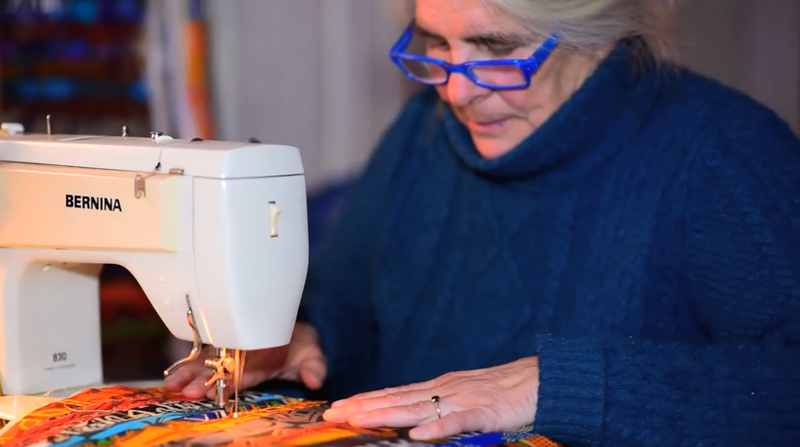
Cindy started making quilts as a child, learning from her mother how to work a sewing machine and sew her own clothes. In the early ’80s, Cindy rediscovered quilting and sewing in a new light through art quilting, a method of merging art with traditional quilting. “Quilters who had been working in textiles making full bed quilts with patterns started to shift to freelance designing quilts and wall hangings,” Cindy says.

Adapting to this new trend, Cindy started taking classes with professional art quilters who taught her different styles and techniques to incorporate into her own work. “I gradually began to learn mixed media and how to dye my own cloth,” she says. “Other pieces contain some of the cloth that I’ve dyed, but there’s also commercial cloth [and] there’s textiles that I get at thrift stores or people give me.”

“Night Forest”

“Night Forest”

Colors have since fascinated Cindy, and she tries to feature every color of the 12-color colorwheel in her art – a theme she’s been working on for a few years. “When I do a series, I try to think about what it might look like in all the different colors of the color wheel and variations of those colors,” she says. Hand-dying her own cloth helps achieve that goal. One part of this exhibit, a series of panels of silk cloth – represent “the sky and air and movement, energy,” she says, using a screenprinting technique to layer different designs onto fabric that she previously dyed. “You’ll see if you look closely…I had several shades of screenprinting, so it went from white, to gray, to black, so that there’s different variations of white in it.”

“Some pieces take a few days once I get the idea,” Cindy says, but a piece as big and intricate as her colored panels takes around a year to complete, needing time to dye her fabrics to just the right shade before adding their finishing touches.

Cindy’s art show will close with a reception on March 20th (fittingly, the spring equinox), from 6-8 pm at the Kilton Library in West Lebanon.

“I hope people take the time to read the descriptions next to some of the pieces about how nature is operating in the world,” she says, “and how nature can help us with our [own] designs and systems.”

Share:
Reading time: 3 min
All, Miscellaneous

Gusanoz Aims for Another Twenty Years

by Richard Ford Burley No Comments
Nick Yager at the counter in Gusanoz Express, next door to the flagship Gusanoz on Lebanon’s “Miracle Mile”. Photos by Richard Ford Burley

When the news dropped at the end of December that two restaurants in the Gusanoz family would be closing their doors, it felt like another sign of the times for an increasingly challenging industry. Costs for restaurants are rising, margins are shrinking, and uncertainty is the economic word of the hour. But for Nick Yager and Maria Limon, co-owners of the restaurant that’s been serving Mexican food to the people of Lebanon for almost twenty years, there might be a better word to focus on: perseverance.

Gusanoz first opened its doors on August 16, 2005, and has been a fixture on Lebanon’s ‘Miracle Mile’ ever since – but it hasn’t been the couple’s only venture. In 2006, they expanded briefly into Woodstock: “that lasted a little over a year,” Nick says. “Which was great in the summertime, but in the fall, everybody would go home and it just wasn’t sustainable.” In 2010, they tried again in Hanover, which worked well until they took on an ice cream business. “[We] found that ice cream was a business that was very foreign to us.” Throughout it all, their flagship location carried the weight well. “We had a good crew here, and we focused on this for the next ten years or so.”

The most recent challenges for the business began in 2021, with the purchase of Mickey’s in Enfield. The previous year, the couple had worked with their son Eddie to open Lalo’s, a taqueria on the Lebanon Mall, and while it wasn’t yet profitable, it wasn’t the strain on the finances that the Enfield location would become: “We were having to put in probably $10,000-$15,000 a month [to support Enfield],” Nick says. “Gusanoz really couldn’t sustain that type of cash flow going out to support that business.”

Talking about exactly how bankruptcy happens, Nick quotes Hemingway: “Two ways: gradually, then suddenly.” A consultant determined that the Enfield location wasn’t financially sustainable. Lalo’s could have survived under Chapter 11, but would have had to make some compromises on ingredients and pricing that were deal breakers for Eddie. But the flagship location? “If we just met our normal budgets, [it] could survive.”

Nick Yager reveals a flavorful batch of slow-cooked birria destined for tacos. Photos by Richard Ford Burley

Nick Yager reveals a flavorful batch of slow-cooked birria destined for tacos. Photos by Richard Ford Burley

“Chapter 11” is the chapter of the US Bankruptcy Code that can help a business make a plan to keep its doors open and its staff employed. In fact, thanks to the restructuring the business is undergoing, Nick was able to offer positions to “anybody that was looking for something” from the closing restaurants, in the end taking in five employees from Enfield and one from Lalo’s.

But this isn’t the first time the restaurant has needed to shift directions to keep moving forward. “The day that they shut down indoor dining in New Hampshire [due to Covid], we had a staff meeting, and we said we’re going to reopen tomorrow and we’re going to focus on ‘to-go’…We shifted gears almost immediately, went out and bought a couple of delivery cars…We hit it hard and we just kept going.” Doing so set the stage for their latest move.

Just next door to the Lebanon location are big signs reading “Gusanoz Express” and “To Go Pick Up Here.” In its previous incarnation, the space had been a podcast studio. Then it was the focus for their Covid-era food prep kitchen and pickup, but the need for that had passed, and they’d been searching for another use for the space that would also be a revenue center. “So in December, we opened up Gusanoz Express,” Nick says. “The intent is to have a quick-serve menu that’s ‘to go’ and delivery, so we make burritos, nachos, tortas, birria tacos, and a couple other things…you can just walk in or you can order off the menu online.” Customers can also order through DoorDash, and they’re working on GrubHub and UberEats as well. “It’s a way to access Dartmouth, a bit easier as far as the population there goes.” The hard part? Getting the word out.

Back when they first opened, Nick says, “there were basically three main TV stations, some cable that everybody watched, and a couple of social media platforms…back then it was easy to place an ad and there would be a response.” He laughs, remembering: “We used to do ads on CNN.” These days, the media landscape is more of a challenge, but they’re seeing some success on the DoorDash front, with “probably $2000-$3000 a week…which is decent volume.” He’s hopeful locals will spread the news through word of mouth.

Another revenue driver on the horizon is Gusanoz-branded sauces and salsas. They put in the work a decade ago to get the needed licenses and developed four hot sauces and a salsa. “We’re certified to sell those anywhere in the country,” Nick says. But, “since we have the license, we can also bottle other things that we can sell out of the restaurant.” Bottles of their red enchilada sauce will be back soon. “It’s super simple: it’s all natural, chili peppers, tomatillos – very simple ingredients, but delicious.” After that, a green enchilada and some salsas, too. “So that’s the goal…I can help cover [Gusanoz Express] and also work on bottling, because the prep kitchen is right back here.”

Throughout the challenges, Nick says there’s been a lot of support from the community. “There’s a lot of positive vibes from people. We get some of it directly from people that know us or see us, and we get a lot of feedback from the staff, from regulars, and other folks too who are coming in because they heard we’re in a situation. And then on social media, you see some positive comments about supporting the Lebanon location, too.” Between that, the restructuring, the new efforts, and a history of elbow grease and, again, perseverance, Nick and Maria are hopeful for the future of Gusanoz: “If the economy holds strong, and if product pricing doesn’t shift for our ingredients, we should be on the path to another twenty years. This is our twentieth year of business and we’d like to do another twenty.”

Share:
Reading time: 5 min

Our Latest Issue

The Lebanon Times is delivered to every mailing address in Lebanon.

  • Subscribe at an out of town address!
  • Pick up a copy!

© 2024 copyright Greater Good Media. All rights reserved.