


Striking at Success on the Playfields: Lacrosse Club Propels Local Athletes to High Levels

In the spring of 2022, the former director of the local girls athletics program, Echo Lacrosse, announced she was moving out of the area. When parent and educator Vicki McCorkle heard this, she immediately stepped up to the plate. She knew she wanted her three young daughters, and the broader Upper Valley community, to continue to benefit from a competitive youth lacrosse program. “I’ll do whatever it takes,” McCorkle had reported to the former director, expressing her intentions to keep the program going.
So after Vicki McCorkle expressed her willingness to lead, the former Echo Lacrosse director “paired [me] up” with another parent and educator, Kim Higgins, she says. Higgins had played Division I college lacrosse at Virginia Tech.

Morgan Fitts and Vera Linter at Echo Lacrosse summer camp in Lebanon.
Higgins became the new head coach of the Lebanon-based program, while McCorkle became its director of operations. Like McCorkle, Higgins is also a mother of three growing daughters, so they had seen each other on the sidelines from afar prior to their newfound partnership.
McCorkle attests that Higgins has become “a friend I never knew I needed…We both saw the value in this program to the community.” Both have certainly shown unflagging commitment to Echo Lacrosse. Over the years, it has grown from a small exclusive program, serving primarily the Hanover and Norwich communities, to an organization that draws girls and boys from all over the Upper Valley, including seven towns last season, with many players hailing from Lebanon.
The expanded program now offers year-round programming for girls in grades 3-12: from a club team in the spring, camps in the summer, Sunday drill sessions in the fall, and indoor skill development in the winter, to keep development of technical skills sharp. Boys in grades 3-12 now too benefit from a high level of competition and offerings three seasons a year, including camps, fall Sunday drills, and competitive spring club teams, with all play rooted in New Hampshire.
In the winter, girls’ programs practice indoors at the CCBA (Carter Community Building Association), a nonprofit recreation and fitness organization in downtown Lebanon. Why continue with lacrosse in the winter if girls are already committed to their ice hockey or basketball teams? To Nordic or Alpine skiing organizations? Higgins paints the landscape: The sport of lacrosse is growing in regions of the country, and world, with prolonged outdoor play. “It’s an incredibly technical sport in terms of hand-eye coordination,” she says. “If you’re able to play lacrosse year long, you have a technical advantage.”
In the warmer months, athletes practice on the CCBA-owned fields behind the brick and mortar facility. CCBA “has become a pivot point for us,” explains Higgins. “It’s centrally located, so people can see what lacrosse looks like out here on the fields…there’s still a lot of people who don’t know what lacrosse is…and the staff have become a great partner supporting us any way they can.”

Team cheer at the end of practice.
But Echo Lacrosse is more than a recreation outlet for Lebanon youth and their neighboring p eers. The organization’s directors have aimed to develop an extraordinarily high level of competitive play that stays as local as possible – a gem of an offering these days.
Competing on a club team for young athletes of the Upper Valley typically requires families to commute to Manchester or Boston, just for practices. Club team travel for away-games stretches to the far reaches of the Northeast: for lacrosse, the hotbed communities are Maryland, Philadelphia, and Long Island. Game and tournament travel to these locations, or Florida or Texas, typically occurs eight to a dozen times annually.
That’s why Higgins and McCorkle set as a top intention for their program to provide local lacrosse players with a high level of competitive play and multi-season skill development within their own broader Upper Valley community.
Enter Echo Lacrosse’s spring club program: Echo’s primary season of operating center-stage. The eight boys’ and girls’ Echo Lacrosse teams compete against other New Hampshire club teams through the New Hampshire Youth Lacrosse Association (NHYLA). Echo hosts its home games at the Kimball Union Academy (KUA), also a fairly central location for its Lebanon High School, middle school, and elementary athletes.
“It’s been a labor of love,” recounts McCorkle. Beyond serving their daughters, McCorkle and Higgins have been able to help Upper Valley families stay in Lebanon and Meriden for a high-level of competitive play during the travel club season, and in keeping their hands on the stick in the off-season.
Juggling eight spring teams and year-round programming, Higgins and McCorkle are far from a two-woman show. Many layers of collaborative and selfless contribution have watered and fed Echo’s profuse and quality expansion. Higgins and McCorkle are quick to spread the credit around the table: Higgins opens by noting, “We inherited a very nice program.” What’s more, Echo receives a steady amount of support from a vast and impressive array of coaches, guest speakers, and supporting organizations, such as Lebanon’s CCBA and Empower Lacrosse.
Yes, Echo Lacrosse skillfully “leverages” the incredible array of coaching and educational resources within the Upper Valley community. But much more than this, Higgins continues, “in this community, there’s a lot of willingness: [people routinely ask] ‘how can we help?’”
For instance, Echo has benefited from a cast of coaches that includes former and current Division I players – from Dartmouth College and elsewhere – former high school players, and expert teachers: Taylor Miller, for one, a current medical student at the Geisel School of Medicine and graduate of West Point. She played goalie on the military university’s Division I lacrosse team and now presently coaches goalies for Echo Lacrosse.
The diversity of contribution has also come from local sports psychologists, who talk to the players about balance and emotional well-being, and coaches who are trained or experienced educators – who know the ”science of learning.” Higgins clarifies, “educators know that learning a technical skill like lacrosse is not a linear path. There are plateaus, there are dips when new skills are acquired.” Even more than this, the Echo Lacrosse directors work to educate their experienced lacrosse coaching staff with teaching principles, and their experienced educator coaching staff with the principles of the game. “We have a good balance [of type of coaching expertise] on most of our teams,” Higgins describes.
Support has also come from the distinct complementary organization, Empower Lacrosse, which exists exclusively to offer financial support to Upper Valley players, and their families. Proof of income is not even required. According to Higgins and McCorkle, the Upper Valley Lacrosse community really wants everyone to be able to play lacrosse.
Empower Lacrosse is not the only player committed to keeping the sport financially accessible. Echo itself recently paired up with CCBA to offer a gear swap to make “this expensive sport accessible to everyone.” Higgins continues to marvel at the behind-the-scenes collaboration: the dynamic with CCBA and Kimball Union has always been one of mission-oriented problem-solving, she reports. “The conversation with them will start with the query, ‘we’re thinking about …a gear swap (for instance); there’s a need…’ So we sat down and had a problem-solving meeting.” The response is always unequivocally, “‘sure, let’s think about this.’”
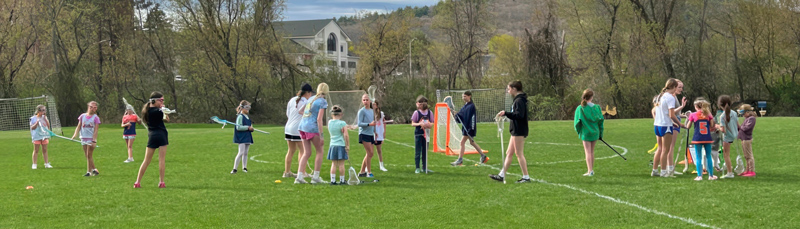
Echo Lacrosse practicing on playing fi elds at the CCBA in Lebanon.
Another noteworthy contribution from the leadership at CCBA has been to support Echo’s three weeks of half-day summer camps by partnering to provide wraparound childcare.
For their own part, Higgins and McCorkle strive to collaborate beyond Echo’s domains as well. When winter snow flurries begin to fly, Higgins and McCorkle reach out to query how to best support the high school lacrosse teams during Echo’s off-season development program. Higgins recounts, each year at this time, “[We] contact the high school coaches to ask, ‘How can we support you? Is there any [specific skill] you need us to work on [with] your players? How can we help your players get ready?’” What other types of support do your players need?
This cycling back to reflecting on how to best support the personal development of young athletes weaves throughout this interview for the Lebanon Times. McCorkle opened our evening’s conversation at CCBA musing, “We talk about this a lot. How to help each child develop not just as an athlete, but a person and a friend.” Higgins concurred: “We focus a lot on the intangibles…We encourage whatever [activities] a child is interested in…We also talk about how to hold each other and ourselves to high standards, standards of excellence…in a non-confrontational way.”
The focus and commitment of Echo’s second phase, with McCorkle and Higgins at the helm, has paid off: in their community-wide relationships, their friendship and professional collaboration with one another, their impact upon countless Lebanon youth, in the saving of innumerable Lebanon families from extensive driving beyond state limits; and not least of all, with the successes of their own daughters on the lacrosse field.

Echo Lacrosse practicing on playing fi elds at the CCBA in Lebanon.
Higgins’ eldest, Sadie, is beginning her first year playing lacrosse for the Naval Academy. Her middle, Maggie, is a junior lacrosse player at Holderness Academy. The youngest daughters of both directors, Campbell and Clare, play on the eighth grade teams and help with the younger Echo Lacrosse groups.
McCorkle’s middle daughter, Allie, is a current player at the University of Colorado, another hotbed lacrosse region of the country. McCorkle’s eldest daughter, Maddie, just completed her tenure as a standout on the starting roster for Duke University, her father’s alma mater. She’s now working toward a master’s degree at the University of Virginia, studying public policy, with an interest in sports leadership. Maddie looks at sports philosophy underpinnings: how to help all players, not just the standouts, to feel belonging?
Both McCorkle and Higgins, as current and former educators, both know the importance of respectful and positive interactions. At the Ray School in Hanover, where McCorkle is a speech language pathologist, the philosophy of respectful interactions predominates their educators’ perspectives: at the Ray School as at Echo, “How can everybody feel seen? Everybody [needs to] get a greeting …Every single person should get a touch point, (for example) ‘I’m so glad you’re here,’ explains McCorkle. “People need to feel seen and valued for more than being …the best [at a sport].”
The focus on steady service, focused contribution, and the whole child’s well-being seems to be bearing fruit for many.
When Higgins observed the girls arriving at the first session of the winter program, returning to Echo Lacrosse and CCBA after a month away, she heard exclamations of greetings between not just teammates, but friends. “We’re building something special.” McCorkle nods in agreement: “you get a sense we’re their people. We are their community.”
“It’s about so much more than lacrosse,” McCorkle summarizes. “It’s about community and learning about yourself, as a person and a teammate.”
During all seasons of the calendar, from the neighborhood gym and fields of CCBA, young Lebanon athletes are maneuvering, spinning, pivoting, and stretching their lacrosse sticks – and spirits – towards their goals, and their own personal best.


Leave a Comment